Clear Sky Science · en
Full-cycle prediction of crack healing in self-healing concrete using generalized polynomial chaos expansion
Concrete That Can Fix Its Own Cracks
Bridges, tunnels, and coastal walls are all made from concrete that slowly cracks as it weathers storms, traffic, and saltwater. Those tiny fractures can grow into big problems, letting in water and corrosive chemicals that shorten a structure’s life. This research explores a new kind of "self-healing" concrete that uses living microbes plus advanced mathematics to predict, from start to finish, how completely its cracks will seal themselves over time.
How Living Concrete Repairs Itself
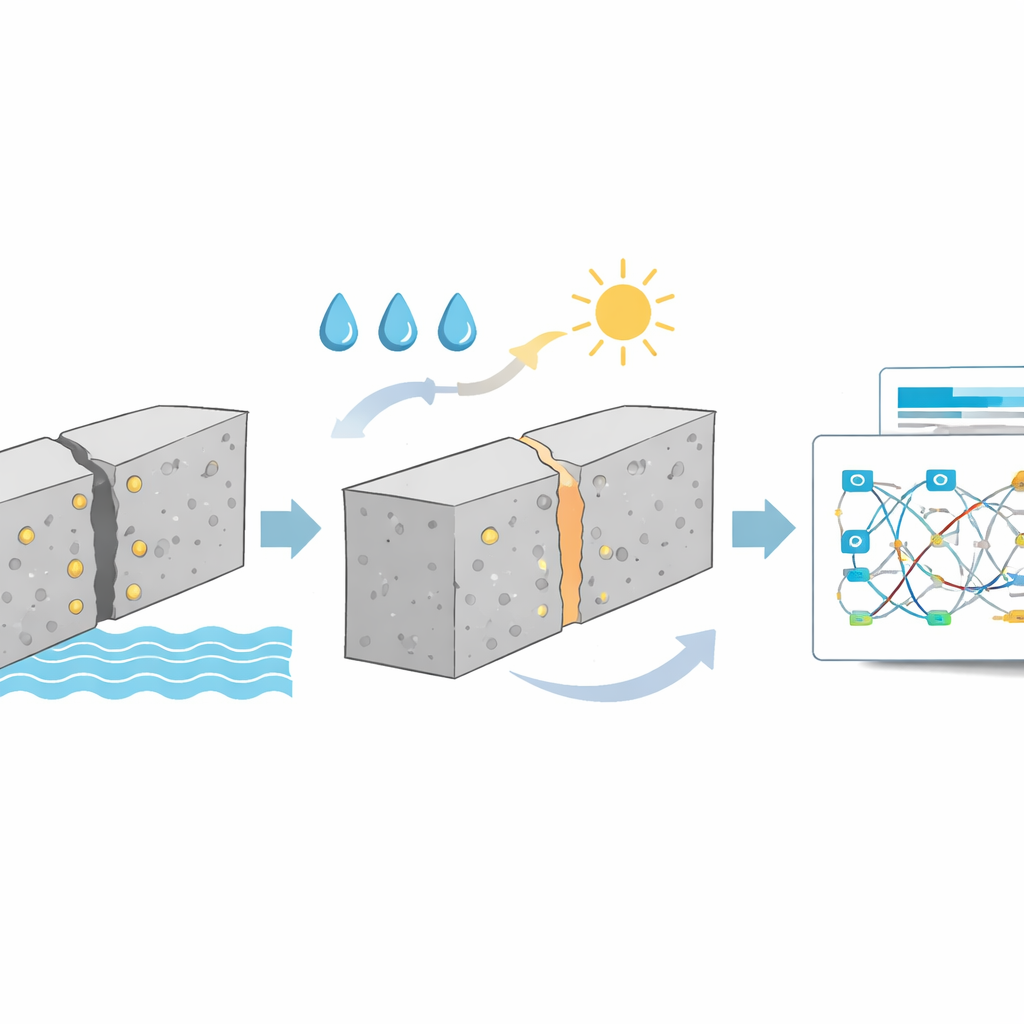
The self-healing concrete studied here is packed with tiny pellets that hold special bacteria and reactive minerals. When a crack opens and seawater seeps in, the pellets break open. The bacteria wake up, use ingredients in their surroundings, and trigger the growth of solid minerals such as calcium carbonate. At the same time, the inorganic additives form layered crystals that help plug and densify the damaged zone. Together, these products gradually fill and bridge the crack, restoring much of the concrete’s strength and blocking the pathways that water and salt would otherwise exploit.
Measuring Healing from the Surface to the Inside
To understand how well this process works, the team did more than simply look at whether a crack appeared closed on the surface. They tracked five different signs of healing in laboratory-made concrete cylinders exposed to repeated wet and dry cycles in artificial seawater. These indicators included how much of the crack surface was visibly sealed, how much water still seeped through, how electrical resistivity changed as the internal paths were rebuilt, how quickly ultrasound waves could cross the crack, and how strongly the material resisted chloride ions that can trigger steel corrosion. By sacrificing some samples and cutting across the cracks, they also directly measured how much of the internal cross-section had actually been refilled by repair products.
From Messy Data to a Predictive Digital Twin
Healing inside a crack is not a simple, steady process. Early on, results vary widely from sample to sample as bacteria wake up, minerals begin to form, and water still flows freely. Later, the system settles down as the crack fills and the repair nearly saturates. To make sense of this time-varying behavior, the researchers built a mathematical "surrogate" model that links the five easy-to-measure indicators to the harder-to-access internal healing depth. Their approach, called polynomial chaos expansion, represents the complex, uncertain process as a weighted combination of smooth curves, each capturing part of the variability seen in the experiments. This allowed them to estimate, for any given specimen and age, how fully the crack cross-section had healed without having to destroy the sample.
Teaching the Model to Learn from Real-World Data
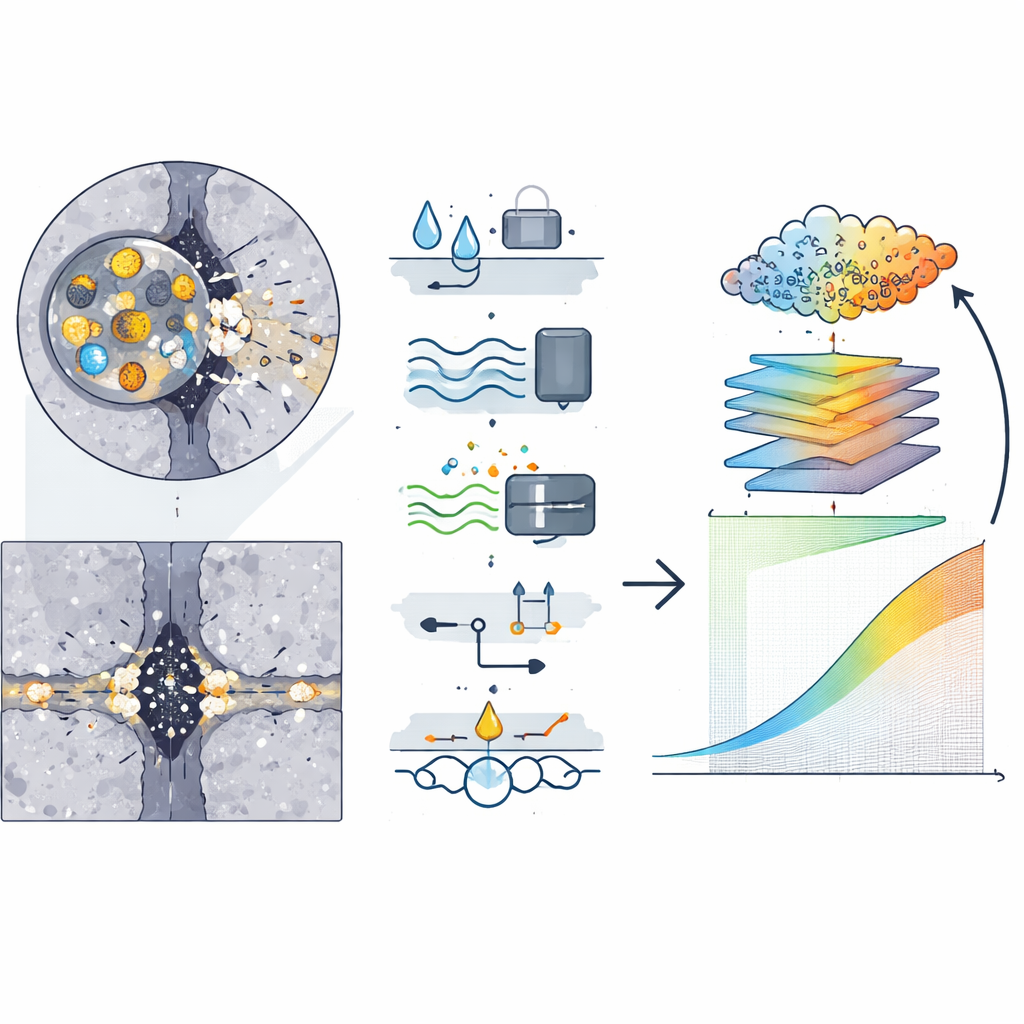
Standard versions of this modeling technique assume that experimental data follow neat, bell-shaped (Gaussian) patterns. The team found that this assumption breaks down when all ages are combined: some indicators become skewed or strongly clustered as healing progresses. To handle these more realistic distributions, they extended the method into a generalized framework. Using a data-driven statistical tool called kernel density estimation, they first identified the actual shapes of the input distributions. They then constructed custom orthogonal polynomials tailored to those shapes, allowing the model to follow the full healing cycle—from the noisy early days to the nearly complete repair stage—without overfitting. Sensitivity analysis based on this framework revealed which measurements matter most: surface closure and water resistance dominate at early ages, while resistance to chloride and internal electrical pathways become key as the crack fills in depth.
Putting the Predictions to the Test
To see if the model could truly generalize, the authors challenged it with new specimens healed for ages it had never seen in training—10, 20, and 30 days—as well as data from a different type of self-healing agent reported in the literature. In each case, the predicted internal healing closely matched the measured values, with typical errors well below one percentage point of cross-sectional repair. The model also captured the overall trend of fast early gains followed by slower, densifying improvements, even though details of the chemistry and microstructure differ between systems.
Why This Matters for Real Structures
For engineers, the main question is not just whether cracks can be patched, but how long a structure can safely serve under real environmental attack. This work provides a practical pathway toward that goal. By combining rich, multi-angle measurements of healing with a flexible, distribution-aware modeling framework, the study delivers a tool that can predict full-depth crack repair across the entire healing cycle. In plain terms, it shows how to turn scattered laboratory data into a reliable "forecast" of how a living concrete will heal itself over time, helping designers choose materials and maintenance strategies that keep critical infrastructure safer for longer.
Citation: Fu, C., Xu, W., Zhan, Q. et al. Full-cycle prediction of crack healing in self-healing concrete using generalized polynomial chaos expansion. Commun Eng 5, 54 (2026). https://doi.org/10.1038/s44172-026-00608-5
Keywords: self-healing concrete, microbial mineralization, crack repair modeling, polynomial chaos expansion, concrete durability