Clear Sky Science · en
A gallium arsenide hybrid-pixel counting detector for 100 keV cryo-electron microscopy
Sharper Views of Life’s Molecules
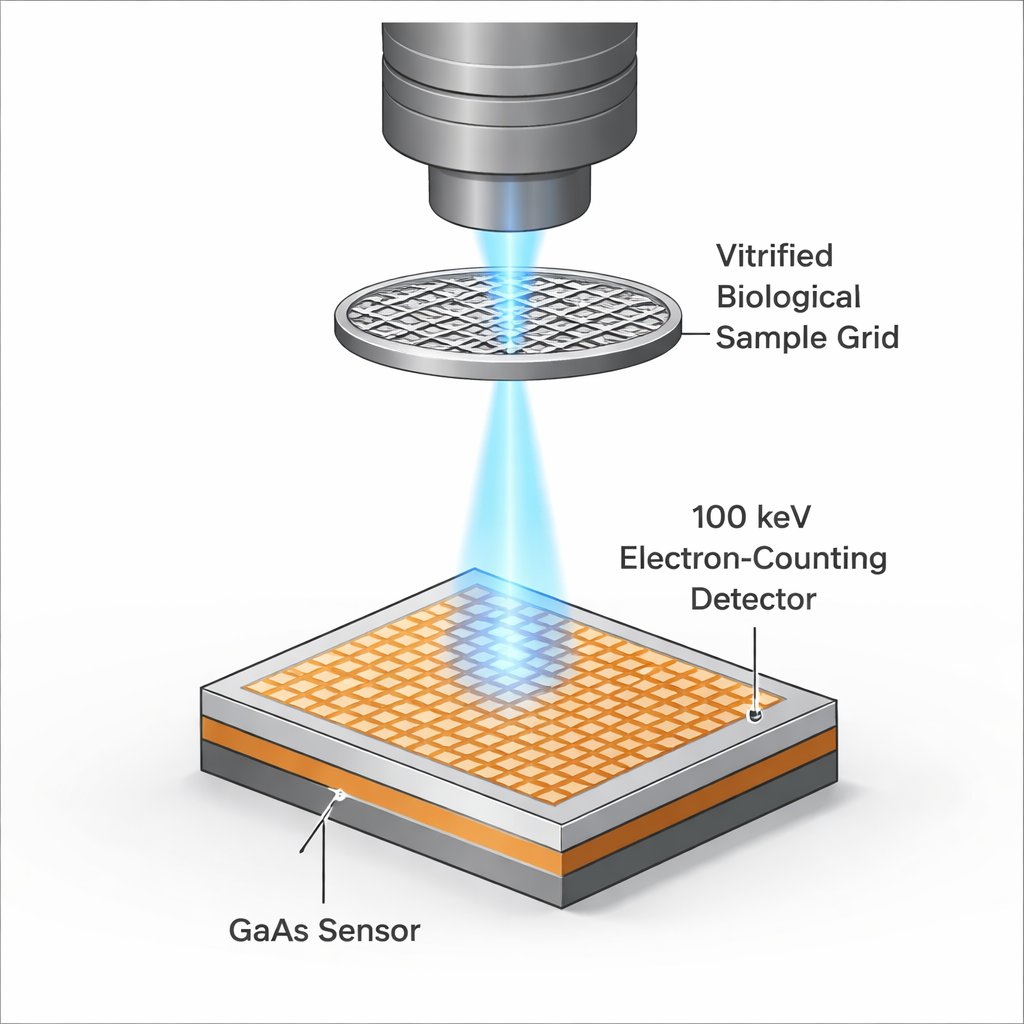
Cryo-electron microscopy (cryo-EM) lets scientists visualize the tiniest structures of life—proteins, viruses, and molecular machines—by freezing them and imaging them with electrons instead of light. This article presents a new kind of camera for such microscopes, designed specifically for a lower, 100,000-volt beam energy. That energy level can reveal more detail per dose of radiation, potentially making high-end structural biology both gentler on samples and more affordable—but only if the detector can keep up. The work described here delivers a detector that does exactly that.
A New Type of Electron Camera
The authors describe a hybrid-pixel electron-counting detector, built around a semiconductor material called gallium arsenide (GaAs). Unlike traditional light-sensing cameras, this device directly counts individual electrons landing on a finely segmented grid of pixels. Each pixel in the prototype is just 36 micrometers across, and more than 1.3 million of them are packed into a seamless rectangle roughly the size of a postage stamp. The detector operates at very high frame rates, capturing up to 7,200 images per second, so that only a few electrons land on each frame. This “electron-starvation” mode allows researchers to reconstruct images from many low-dose snapshots, minimizing damage to delicate frozen samples.
Why Gallium Arsenide Beats Silicon Here
Most existing high-end cryo-EM detectors use silicon-based sensors, which work well at higher beam energies but run into limitations at 100 keV. At this lower energy, electrons wiggle sideways more in thin silicon layers, spreading their signal over too many pixels and blurring fine details. GaAs, being denser and made of heavier atoms, stops 100 keV electrons in a much shorter distance. The team used detailed computer simulations to compare silicon, GaAs, and other detector materials, tracking how electrons deposit energy as they pass through. For GaAs, the sideways spread of electrons matches well with the 36-micrometer pixel size, so each electron’s signal is confined to only a few neighboring pixels. This balance between stopping power and spread is key to preserving sharpness while still collecting enough signal.
Counting Every Electron, Even in Crowds
Because the detector counts individual electron hits, it must perform reliably even when many electrons arrive in quick succession. The authors measured two aspects: the raw number of pixel hits and the number of distinct electron events reconstructed from clusters of neighboring pixels. They developed analytical models to describe how the detector begins to miss or merge events—so-called “coincidence loss”—as the beam gets brighter. Experiments showed that the detector’s response remains acceptably linear up to rates where a typical cryo-EM experiment would operate, with only about 5 percent of events lost at 28 electrons per pixel per second. They also examined how uniformly the pixels respond, finding a fixed, cell-like pattern caused by tiny imperfections in the GaAs crystal. Although this pattern redistributes counts slightly from pixel to pixel, it is extremely stable over many hours, so a simple calibration image can correct it.
Super-Resolution: Seeing Between the Pixels
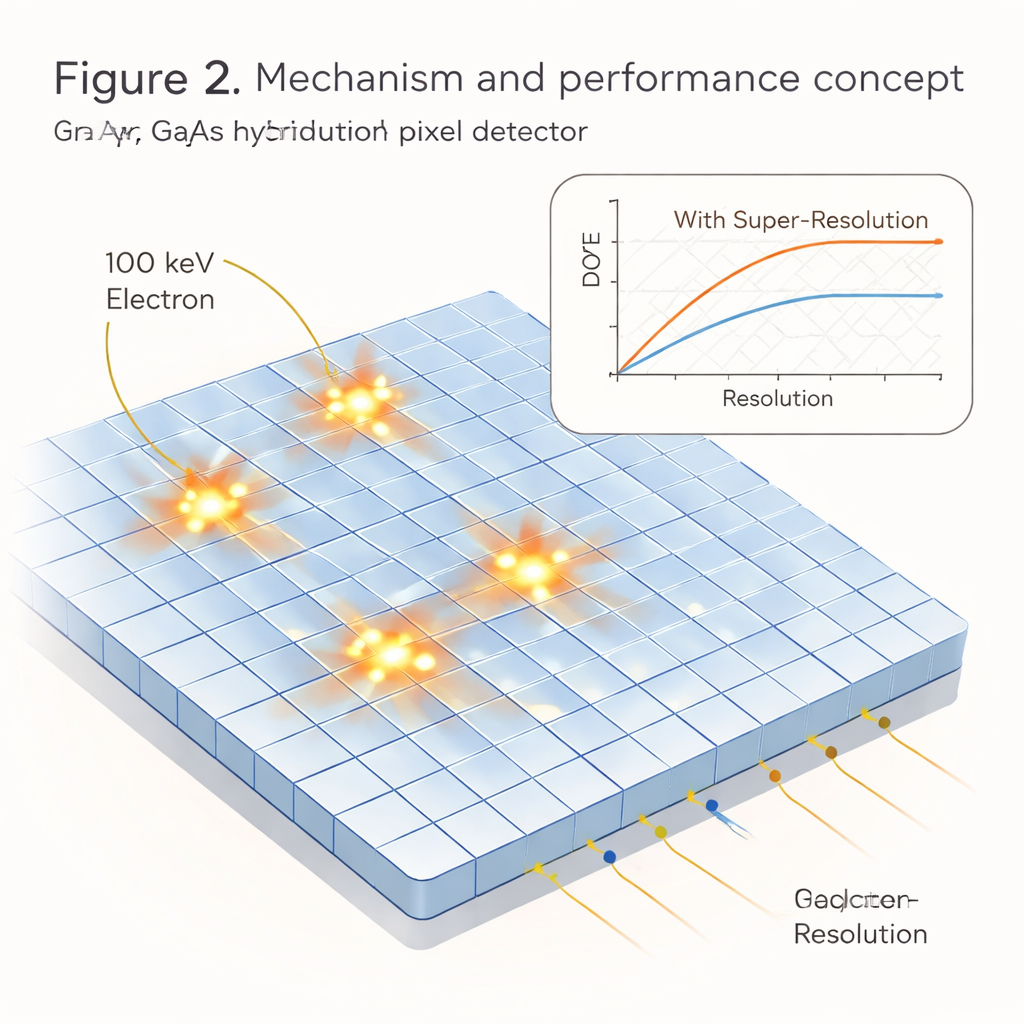
Beyond basic counting, the team applies a “super-resolution” strategy to squeeze extra detail out of the same hardware. Instead of just adding up which pixels fired, they analyze each cluster of lit pixels produced by a single electron and estimate where, within the pixel grid, that electron actually hit. They then place a smooth, bell-shaped marker at that location on a finer virtual grid, effectively doubling the sampling density. Measurements of standard image-quality benchmarks show that this approach significantly boosts both sharpness and detective quantum efficiency—a measure of how well the detector preserves signal relative to noise. At low frequencies, the detector captures about 96 percent of the ideal information content, and at the physical limit set by the original pixel spacing, it still retains more than half. In practical terms, the detector behaves as if it had smaller, 27.5-micrometer pixels and a wider effective field of view, without changing the hardware.
What This Means for Future Microscopes
In plain terms, this new detector is a specialized, high-speed, single-electron camera tuned for microscopes operating at 100 keV. By pairing GaAs sensors with finely engineered electronics and advanced image processing, the authors achieve crisp, low-noise images while keeping the electron dose low—exactly what is needed to reveal fragile biological structures. Their results suggest that 100 keV cryo-EM can be both powerful and cost-effective, provided it is matched with detectors optimized for this energy. As this technology matures and its small geometric quirks are better understood, it could help bring atomic-level imaging of life’s machinery within reach of more laboratories around the world.
Citation: Zambon, P., Montemurro, G.V., Fernandez-Perez, S. et al. A gallium arsenide hybrid-pixel counting detector for 100 keV cryo-electron microscopy. Commun Eng 5, 36 (2026). https://doi.org/10.1038/s44172-026-00607-6
Keywords: cryo-electron microscopy, electron detector, gallium arsenide, super-resolution imaging, structural biology