Clear Sky Science · en
High-resolution, multidimensional solar radiation evaluation for the scientific protection of built heritage sites
Why sunlight matters for ancient stone
Ancient rock‑cut temples and cliff carvings may look timeless, but the same sunlight that lets us see them is slowly tearing them apart. This study shows how light and heat from the sun fall very unevenly across large cliff‑side heritage sites, creating hidden hot spots of mechanical stress inside the stone. By mapping these invisible patterns in high detail, the authors offer a new way to pinpoint which parts of treasured sites are most at risk, so that limited conservation resources can be used where they matter most.
Seeing a cliff as a complex landscape
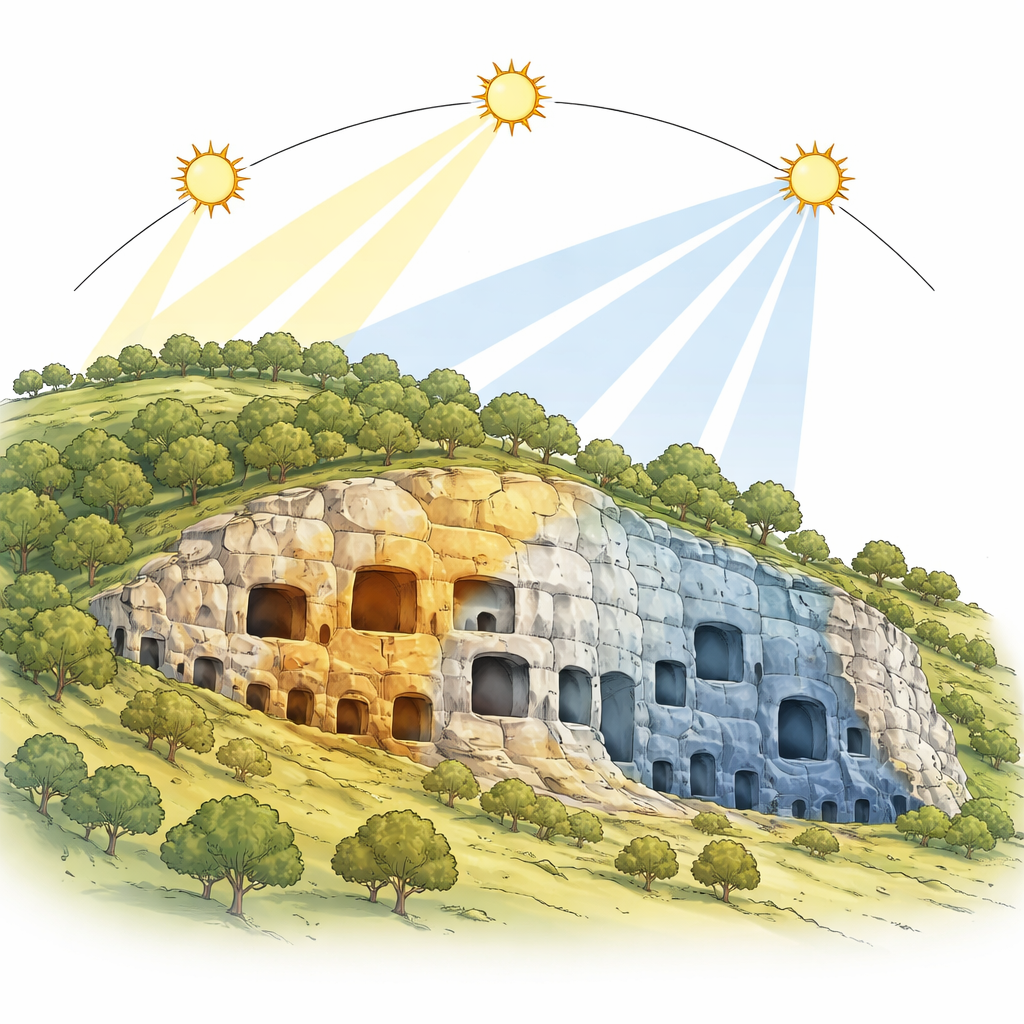
The researchers focus on large grotto temples, where thousands of carvings are cut into steep rock faces. These sites are exposed year‑round to sun, wind and moisture, but their surfaces are anything but flat: there are caves, ledges, pillars, and overhangs, plus nearby hills and trees that cast shifting shadows. Earlier studies either zoomed in on tiny areas in great detail or zoomed out across whole regions with crude geometry. This work combines both views, treating the cliff as a complex 3D landscape and asking how sunlight actually lands on every part of it through the year.
Building a digital twin of light and stone
To do this, the team created a detailed digital twin of the Longmen Grottoes in China. They mounted cameras on drones to capture the whole cliff from many angles, then used computer vision to build a three‑dimensional model down to features only a few centimeters across. Local weather stations recorded sunlight, temperature, humidity and wind hour by hour. A "virtual sky" was then constructed that reproduces the path and strength of both direct sunlight and diffuse skylight at many time scales: yearly totals, monthly averages and even specific hours around solstices and equinoxes. By coupling this sky with the 3D cliff model, they could simulate how mountains, cave geometry and vegetation block or redirect the sun.
Uneven light, shifting seasons
The simulations reveal that direct sunlight is the main driver of variation across the cliff. South‑ and west‑facing sectors receive far more total light than other orientations, but even within a single sector some surfaces soak up several times more energy than nearby shaded recesses. On monthly and hourly scales, the picture becomes even more intricate. In winter, when the sun is lower, certain west‑facing areas receive intense midday exposure, whereas in summer larger zones are bathed in high radiation for longer periods. Trees can sharply reduce light in some sectors, creating cool islands next to bright, hot patches only meters away.
From sunshine to internal stress
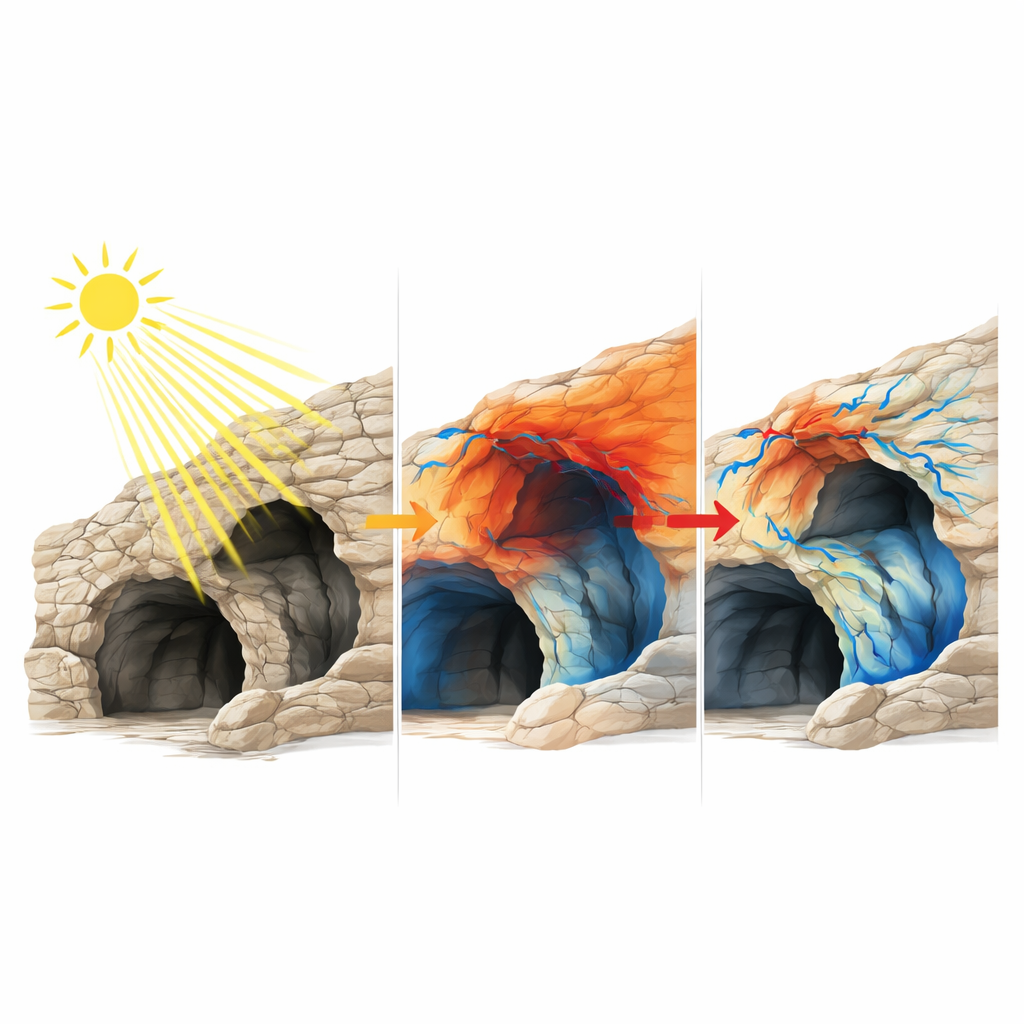
Sunlight does not just warm the stone uniformly—it creates steep temperature gradients between protruding features and shaded cavities. The team translated their high‑resolution radiation maps into estimates of thermal stress inside the rock by combining them with known material properties. They found that edges and outward‑jutting surfaces can experience stresses of 400–500 kilopascals during summer afternoons, while adjacent shaded spots feel only about one‑fifth as much. These strong contrasts can arise over very short distances and within a narrow time window, especially between 1 and 3 p.m. on the brightest days, encouraging tiny cracks to start and grow with each daily heating and cooling cycle.
Guiding smarter protection for fragile treasures
By uniting precise geometry, real weather data and physics‑based models, this framework turns sunlight into a measurable risk factor for stone heritage. Conservators can now see not just which faces of a cliff are sun‑exposed, but exactly which niches, edges and statues face the greatest long‑term thermal stress. That knowledge can guide targeted actions—such as localized shading, selective reinforcement, or improved protective coatings—rather than relying on broad rules of thumb. The same approach could also be extended to city streets and building facades, helping societies manage both cultural treasures and modern structures in a warming, brightening world.
Citation: Ni, P., Zhang, D., Bi, W. et al. High-resolution, multidimensional solar radiation evaluation for the scientific protection of built heritage sites. Commun Eng 5, 55 (2026). https://doi.org/10.1038/s44172-026-00606-7
Keywords: cultural heritage conservation, solar radiation, stone weathering, 3D environmental modeling, thermal stress