Clear Sky Science · en
OpenMetabolics: Estimating energy expenditure using a smartphone worn in a pocket
Why Your Phone Could Be a Health Game-Changer
Staying active is one of the simplest ways to protect your health, yet we still struggle to measure how much movement our bodies truly do each day. Fitness trackers and step counters offer rough guesses, but they often miss short bursts of activity and misjudge effort. This study introduces OpenMetabolics, a new way to use a regular smartphone carried in a pants pocket to estimate how much energy you burn in everyday life, potentially giving anyone with a phone access to lab‑grade activity monitoring.
Turning Pocket Phones into Activity Meters
The core idea behind OpenMetabolics is that your legs do most of the work in common activities like walking, climbing stairs, running, and cycling. When a phone sits in your pocket, its built‑in motion sensors feel every swing of your leg. The researchers built a system that watches this leg motion and uses it to estimate how much energy your muscles are using. Instead of relying on simple step counts or heart rate zones, the system studies the pattern of movement for each step and links it to energy use measured in earlier lab experiments. 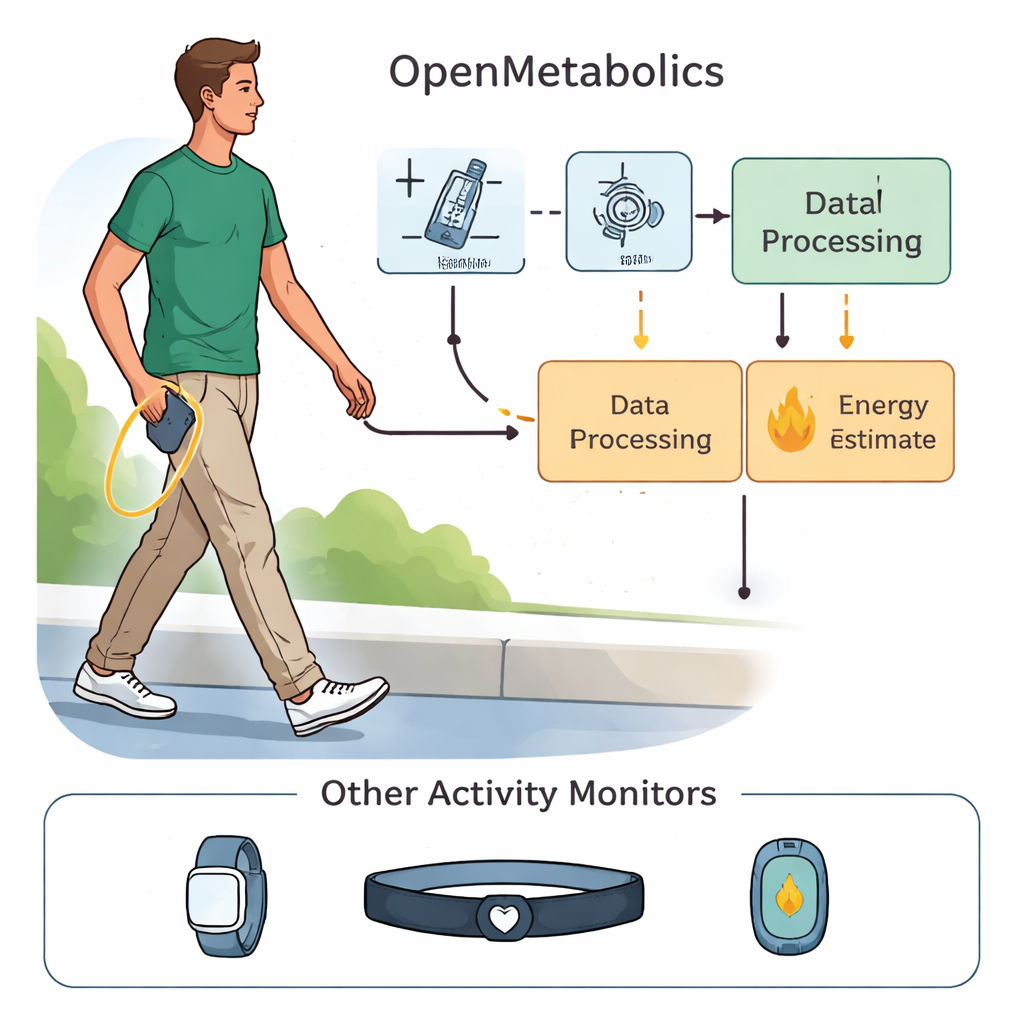
From Raw Motion to Energy Burn
To make this work, the team first had to translate messy real‑world motion into something a computer could learn from. They designed algorithms that align the phone’s position with the thigh, break motion into individual walking or running steps, and reduce each step to a compact description of how the leg moved. They then trained a machine‑learning model—built from many small decision trees—on data from 36 people who performed activities in the lab while their true energy expenditure was measured with specialized breathing equipment. This model learned the relationship between leg motion, body size, and energy use, allowing it to later estimate energy burned for each step outside the lab.
Beating Popular Wearables in Real Streets
Next, the researchers put OpenMetabolics to the test in everyday environments. Volunteers walked, ran, climbed stairs, cycled, and walked up an incline outdoors while wearing a backpack‑style breathing system for ground‑truth measurements, along with common devices: a smartwatch, a heart‑rate monitor, a pedometer, a thigh‑worn motion sensor, and a phone strapped to the thigh. Across these activities, the smartphone‑based OpenMetabolics system made the most accurate energy estimates, with about half the cumulative error of many existing tools. It performed especially well during real‑world walking on sidewalks and stairs, where simple step counters and wrist devices often confuse slow, easy walking with more strenuous climbing or incline walking. 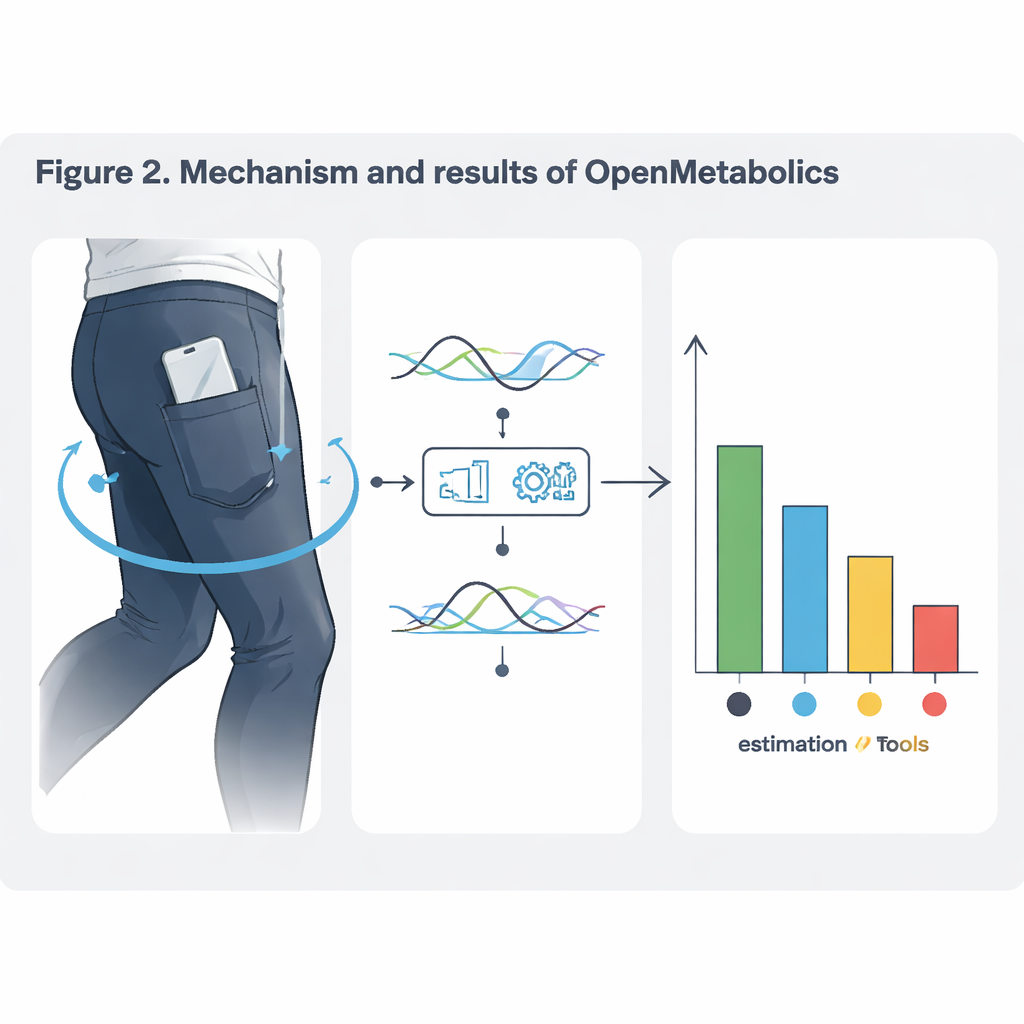
Fixing the Problem of Wobbly Pockets
Of course, people do not normally wear phones strapped to their thighs. In real life, phones move around inside loose pockets, creating “motion noise” that can confuse the sensors. To solve this, the team recorded walking data from people wearing different types of clothing—jeans, sweatpants, regular shorts, and athletic shorts—while carrying one phone in the pocket and another firmly strapped to the thigh. They trained a simple correction model that learns the typical extra motion caused by the phone shifting in the pocket and subtracts it out. This reduced motion errors by more than a quarter and removed most of the bias in energy estimates across clothing types. When the researchers simulated hundreds of combinations of people and clothes, the corrected pocket‑phone data turned out to be just as accurate as data from a firmly strapped phone.
Seeing Daily Life in Fine Detail
Finally, the team ran a week‑long home study in which participants simply carried a study smartphone in their pocket during waking hours. OpenMetabolics produced an energy estimate for nearly every step, revealing rich patterns across days and weeks. It captured how much movement clustered around commuting times, how individual activity levels differed, and how energy use dipped on Sundays compared with weekdays—matching trends seen in larger population studies. Because the entire system is implemented as an app and the data and code are openly shared, it can, in principle, be used with large groups of people in many settings, including communities that lack access to expensive medical devices.
What This Means for Everyday Health
For non‑experts, the takeaway is straightforward: this work shows that an ordinary smartphone in your pocket can closely track how much energy you burn, step by step, rivaling specialized lab equipment and outperforming many popular wearables. By making the methods and software open source, the authors hope researchers, clinicians, and public‑health groups can run large, low‑cost studies that finally clarify how real‑world movement shapes health, disease risk, and treatment success. In the long run, tools like OpenMetabolics could help tailor exercise advice, guide urban design, support weight‑management and rehabilitation programs, and bring high‑quality activity monitoring to people who have never owned a fitness tracker.
Citation: Cho, H., Slade, P. OpenMetabolics: Estimating energy expenditure using a smartphone worn in a pocket. Commun Eng 5, 35 (2026). https://doi.org/10.1038/s44172-026-00604-9
Keywords: physical activity, energy expenditure, smartphone sensing, wearable health, walking patterns