Clear Sky Science · en
Ultra-stable speckle-based optical fiber sensing demonstrated on an uncrewed aerial vehicle platform
Watching Wings While They Fly
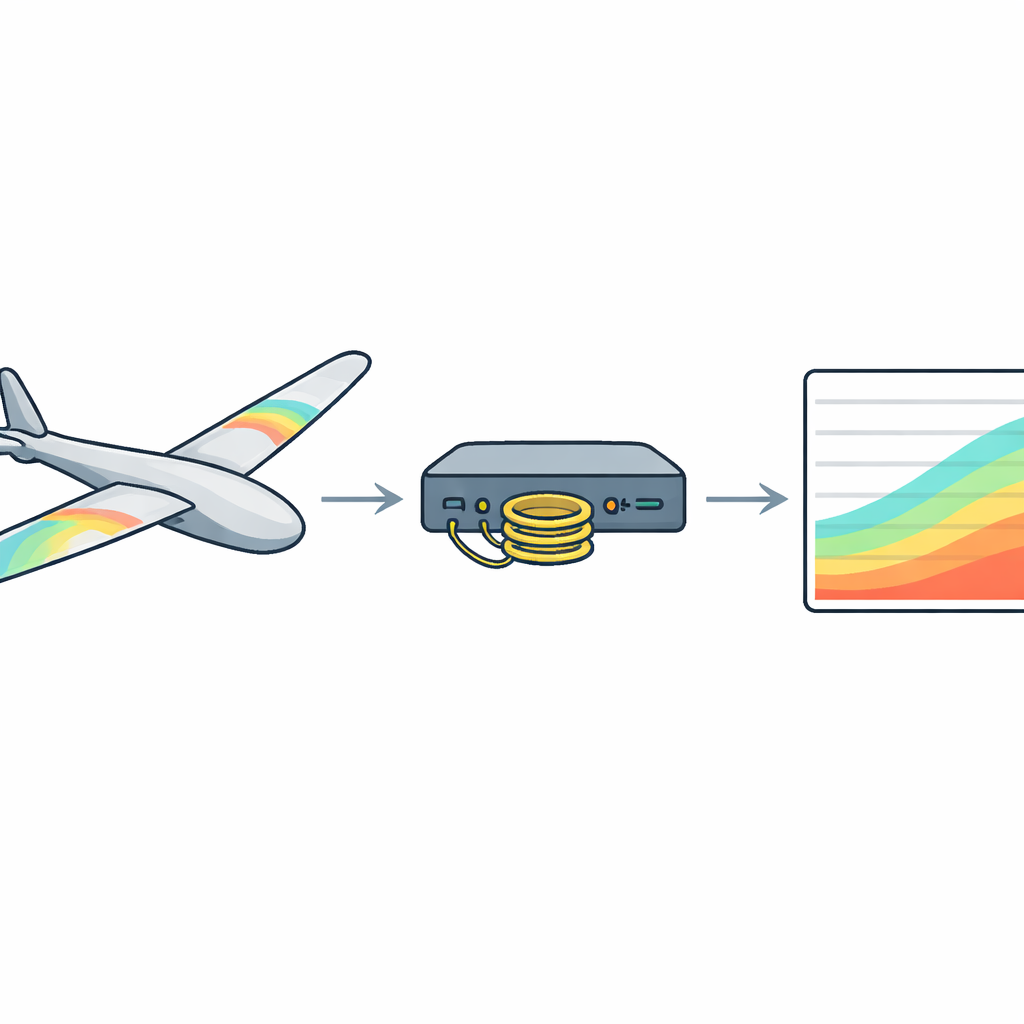
As drones take on jobs from package delivery to search-and-rescue, one nagging question remains: how do we know their wings and bodies are healthy while they are actually in the air? Sending a drone back to the workshop after every mission is slow and costly, yet missing a developing crack or strain hotspot could lead to failure. This study shows how a palm-sized optical device, riding inside a drone, can watch the flexing of its wings in real time with remarkable stability, even while the aircraft vibrates and pulls high G-forces.
Why Tiny Fibers Make Powerful Nerves
Modern aircraft increasingly rely on optical fibers as built-in "nerves" that sense strain and temperature. A key workhorse is the fiber Bragg grating, a microscopic pattern inside a fiber that reflects a narrow band of light whose color shifts as the fiber stretches. Reading that shift, however, usually demands bulky or power-hungry instruments that scan wavelengths or disperse light with lenses and gratings—an awkward fit for small, battery-powered drones. Newer "speckle" approaches promise compact, lens-free readers: the reflected light is scrambled into a grainy pattern whose details reveal the spectrum. The catch has been that these patterns are notoriously unstable, changing with tiny bends, temperature drifts, or vibration, which has limited their use outside the lab.
A New Way to Tame Speckle
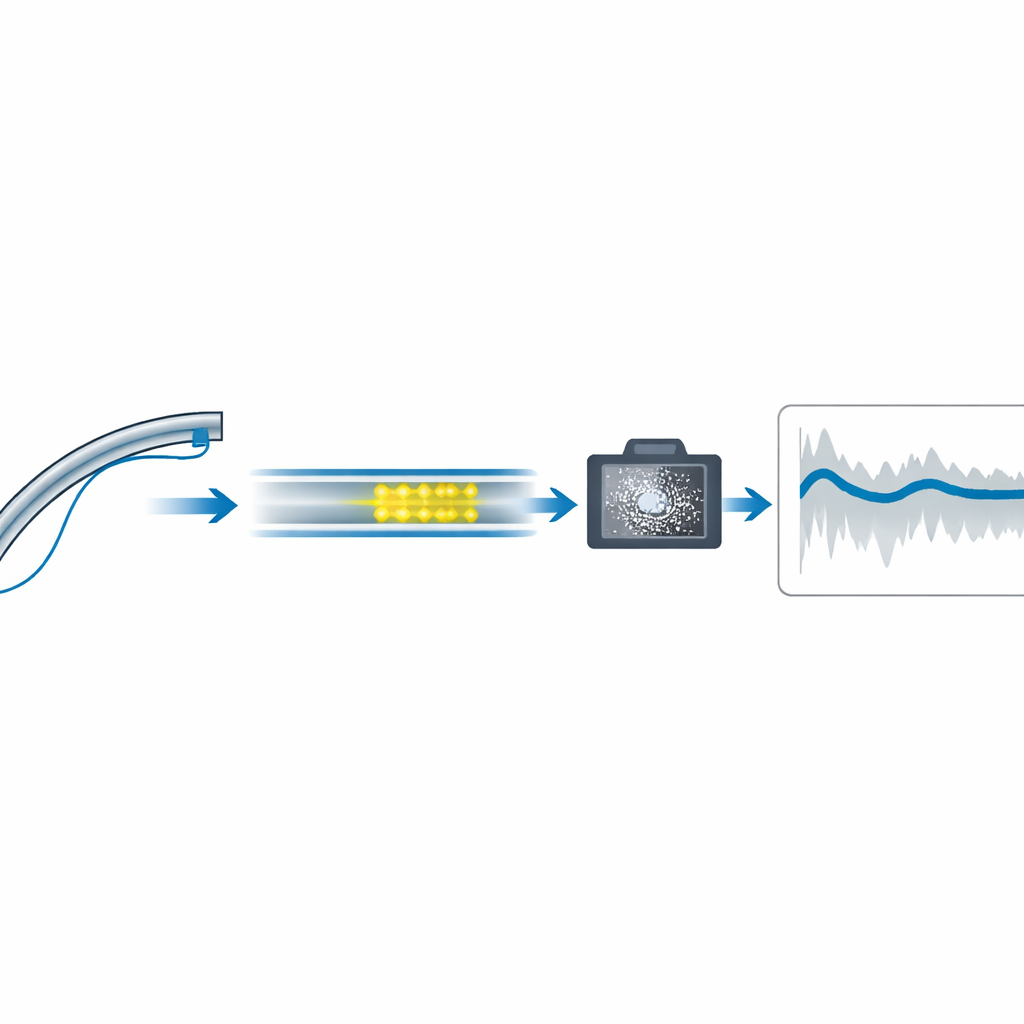
The authors introduce a redesigned speckle-based reader called STASIS (Speckle-based Tracking and Stabilized Interrogation System) that tackles this stability problem head-on. Instead of relying on long, round multimode fibers or loose scattering media that are easy to disturb, they use an ultra-flat, high-aspect-ratio optical fiber containing laser-written scattering centers. This flat geometry confines light tightly and keeps the optical path compact, which reduces how much environmental changes can scramble the pattern. The fiber is fusion-spliced directly to standard fiber and then permanently embedded in a 3D-printed plastic housing along with a tiny camera chip. By eliminating free-space optics and mechanical joints, the entire light path becomes a rigid, monolithic module that is much less sensitive to bending and shock.
Putting the System Through Its Paces
To find out whether this compact module could really stay stable in the real world, the team subjected it to aggressive laboratory tests. They shook the sensing head with sinusoidal vibrations up to ±7 G at frequencies between 5 and 60 Hz while a fiber grating was repeatedly stretched. Two simple math tools were used to track changes in the speckle images: a baseline frame dissimilarity measure that flags any change at all, and a principal component analysis that picks out the main, wavelength-related pattern. Under strong vibration, the raw similarity metric showed that the pattern was being jostled, especially at the highest frequencies, but the key principal component—linked to actual wavelength shift from strain—remained clean and linear. The standard deviation of the recovered strain at rest was about 1.6 microstrain, tiny compared with the hundreds of microstrain the wing experiences in flight.
From Lab Bench to Open Sky
The real test came when the team installed the STASIS unit in the avionics bay of a custom 2‑meter wingspan drone and bonded fiber sensors to the underside of the wings where computer models predicted the highest flexing. During multiple flights, the system streamed speckle images at 10 frames per second while the autopilot recorded acceleration. Across take-off, steady circling, aerobatic maneuvers, and landing, the recovered strain values closely followed the aircraft’s vertical G-forces, ranging from about −100 to 400 microstrain. Importantly, two independent reconstruction methods agreed strongly with each other and remained well behaved despite engine vibration, wind gusts, and temperature swings of roughly 35 °C inside the electronics bay. Any slow thermal drift in the electronics showed up as a predictable, smooth trend that could be removed using a built-in temperature sensor.
What This Means for Everyday Flying Machines
For non-specialists, the central message is that a once-fragile optical trick—reading information from a shimmering speckle pattern—has been engineered into a rugged, compact sensor suitable for real aircraft. By carefully shaping the fiber, locking it into a solid housing, and using straightforward data analysis, the authors show that speckle-based readers can reliably track tiny wing flexes in real time under harsh conditions. This paves the way for drones and other lightweight vehicles to carry their own "sense of touch," spotting structural problems early without heavy or expensive equipment, and ultimately making routine autonomous flights safer and more economical.
Citation: Falak, P., King-Cline, T., Maradi, A. et al. Ultra-stable speckle-based optical fiber sensing demonstrated on an uncrewed aerial vehicle platform. Commun Eng 5, 46 (2026). https://doi.org/10.1038/s44172-026-00603-w
Keywords: drone structural health monitoring, optical fiber sensing, speckle-based spectrometer, fiber Bragg grating, aerospace strain sensing