Clear Sky Science · en
Multi-channel ultrasonic Bessel vortex beams by spatial multiplexing metalens
Sound Spirals You Can Steer
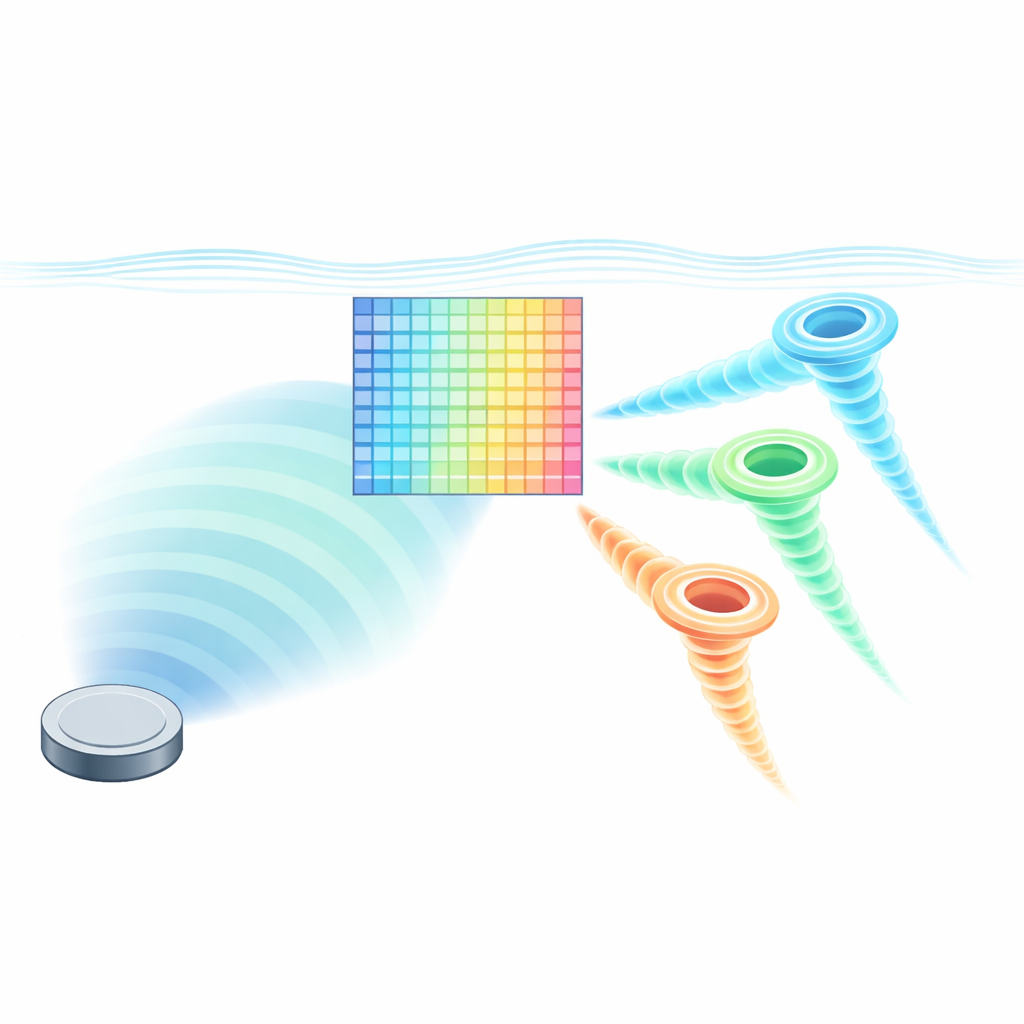
Imagine being able to twist sound into tiny underwater whirlpools and send several of them in different directions at once, all from a single, silent chip. That is what this research achieves: it shows how to sculpt ultrasound into multiple tightly focused "vortex" beams that can be steered independently, opening doors to richer underwater communication and gentle, contact‑free handling of microscopic objects such as cells or particles.
Why Twisted Sound Matters
In water, sound is often the best way to communicate or probe the environment. Beyond simple straight beams, engineers have learned to create sound shaped like a corkscrew, called a vortex. These swirling beams carry a kind of twist that can trap small particles in a dark central spot and make them spin, and different twists can act like distinct channels for sending information. Until now, most devices could make only a single such beam or a fixed pattern, limiting how practical these exotic sound fields could be for real‑world technologies.
One Lens, Many Sound Whirlpools
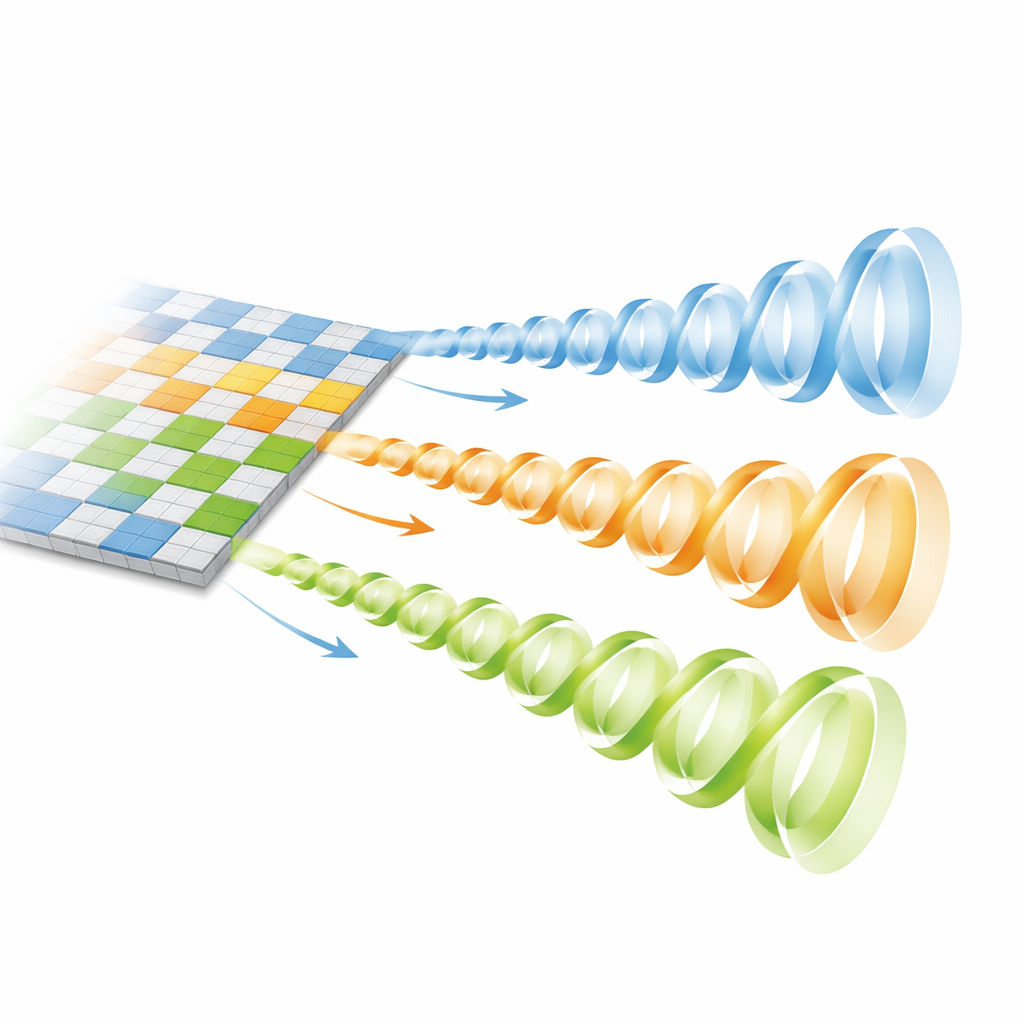
The team designed a special flat lens, or metalens, made of a dense grid of tiny pillars, each about a fifth of a millimeter wide. When ultrasound passes through, the varying heights of these pillars delay the sound by different amounts, reshaping the outgoing wave. Instead of dedicating the whole surface to one pattern, the researchers interleave four patterns across the grid, like a checkerboard where each color belongs to a different channel. A simple incoming plane wave is thus transformed into four separate vortex beams, each tilted in its own direction and each carrying its own twist, all without moving parts or complex electronics.
Keeping Beams Tight and Efficient
Normally, a twisted sound beam spreads out quickly as it travels, wasting energy. To combat this, the authors combine the vortex shape with another type of beam known for staying narrow over long distances, producing what is called a Bessel vortex beam. They fine‑tune the design so that, at a commonly used medical ultrasound frequency of 2 megahertz, the four beams remain focused and well separated in water. Computer simulations and tank experiments using a high‑precision 3D‑printed sample show that the beams emerge at the intended angles with less than one degree of error, and that most of the sound energy is concentrated where it is supposed to be, in the main core of each vortex rather than in unwanted side ripples.
Dialing In Strength and Shape
Because the lens is encoded channel by channel, the designers can change not only the direction of each beam but also how strongly it twists and how intense it is. By assigning higher “twist orders” to selected channels, they produce broader, more diffuse whirlpools, while lower orders stay tighter—useful if you want different particle sizes to be trapped at different spots. They also show a two‑channel version of the lens in which more surface area is devoted to fewer beams. In that case, the sound intensity near the vortex cores increases by almost four times compared with the four‑channel design, trading the number of channels for stronger, cleaner beams.
From Lab Demonstration to Future Tools
Measurements of the sound field confirm that each channel closely matches the ideal vortex shape, with low interference between them. The approach also compares favorably with older methods that simply stack several patterns on top of each other; by splitting the surface into interleaved regions instead, the new lens wastes less energy and better separates the channels. In practical terms, this could mean compact underwater devices that simultaneously send multiple data streams, or acoustic tweezers that sort cells by size or type using different vortices at once. Looking ahead, the same pixel‑by‑pixel scheme could be paired with simple masks or active switches to turn channels on and off without rebuilding the lens, making twisted sound an even more versatile tool for communication, imaging, and microscale manipulation.
Citation: Su, Y., Wang, D., Gu, Z. et al. Multi-channel ultrasonic Bessel vortex beams by spatial multiplexing metalens. Commun Eng 5, 50 (2026). https://doi.org/10.1038/s44172-026-00599-3
Keywords: ultrasonic vortex beams, underwater acoustics, acoustic metalens, spatial multiplexing, acoustic tweezers