Clear Sky Science · en
High-velocity laser Doppler vibrometry measurements on an aluminum nitride bimorph wedge resonator
Why pushing tiny machines to extreme speeds matters
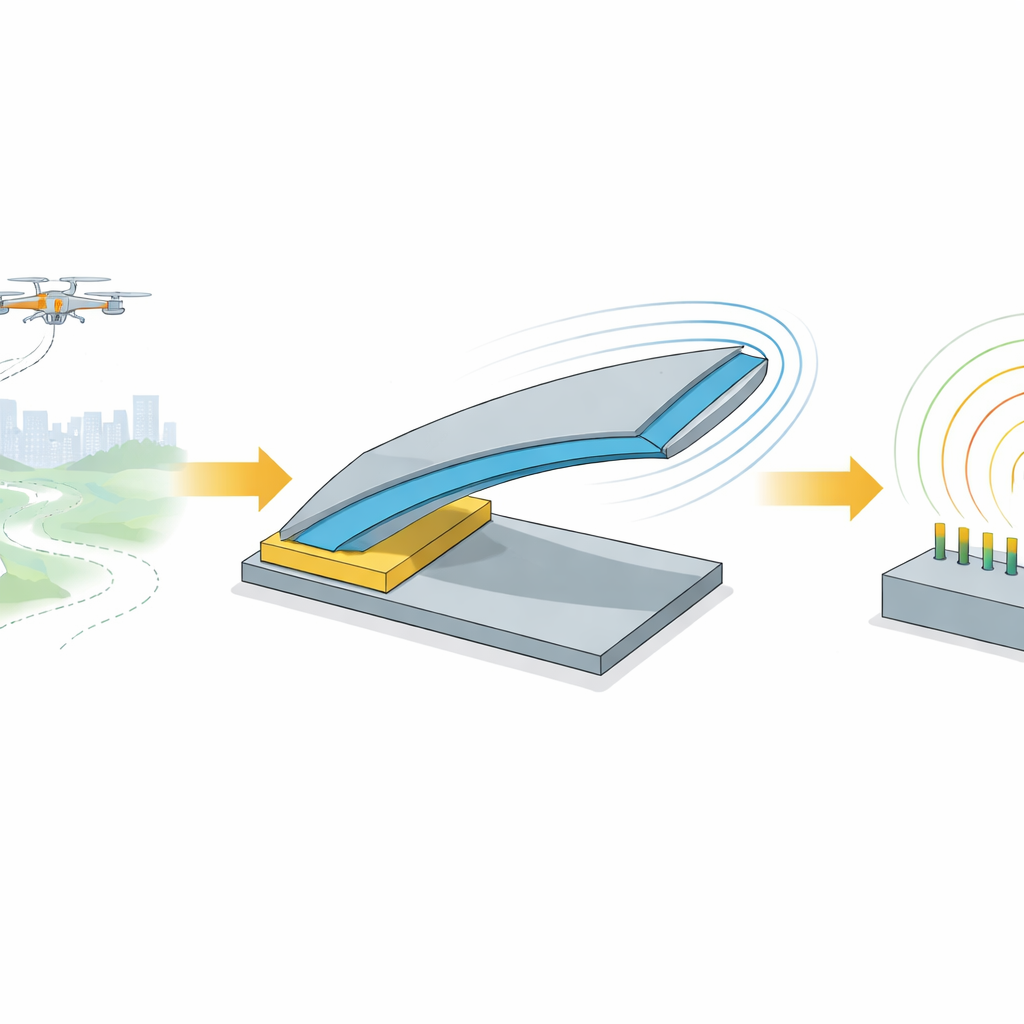
Modern phones, drones, and navigation tools rely on tiny mechanical parts that sense how we move and turn. These microscopic devices, called MEMS sensors, usually operate gently to stay predictable and easy to control. In this work, researchers asked a bold question: what happens if we drive one of these tiny vibrating structures almost as fast as its materials will allow, and can that make future navigation much more precise?
Tiny vibrating beams as motion sensors
Many advanced motion sensors use a vibrating mass to detect rotation. When the mass moves very quickly back and forth, any twist or turn of the device produces a stronger sideways force, making the sensor more sensitive. Today’s commercial sensors keep vibration speeds modest, below about 5 meters per second, to ensure simple, linear behavior. The team behind this study set out to break that barrier, exploring how fast a micro-scale beam could safely vibrate, and what new behaviors would appear when it was driven far beyond the usual comfort zone.
A wedge-shaped beam built for speed
The researchers used a slender, wedge-shaped beam made from aluminum nitride, a material that bends when an electric voltage is applied. The beam is only about one micrometer thick and half a millimeter long, fixed at one end and free at the other like a diving board. Metal layers above and below the active material let the team bend the beam out of the plane of the chip when they apply high-voltage signals. This simple structure, tapered along its length and made entirely of active material, was originally designed for another purpose but turned out to be an excellent test case for reaching extreme tip speeds.
Measuring extreme motion with laser light
To track how fast the tip of the beam moved, the team used laser Doppler vibrometry, a technique that shines a focused laser spot on the vibrating surface and reads its speed from tiny shifts in the reflected light. They mounted the chip inside a small vacuum chamber to reduce air drag and drove the beam with powerful electrical signals that swept across its main resonance near 1.81 megahertz. By carefully shaping these drive signals, they could both protect the device from overheating and reveal how its response changed as they increased the drive from gentle to extreme.
Crossing into a wild nonlinear regime
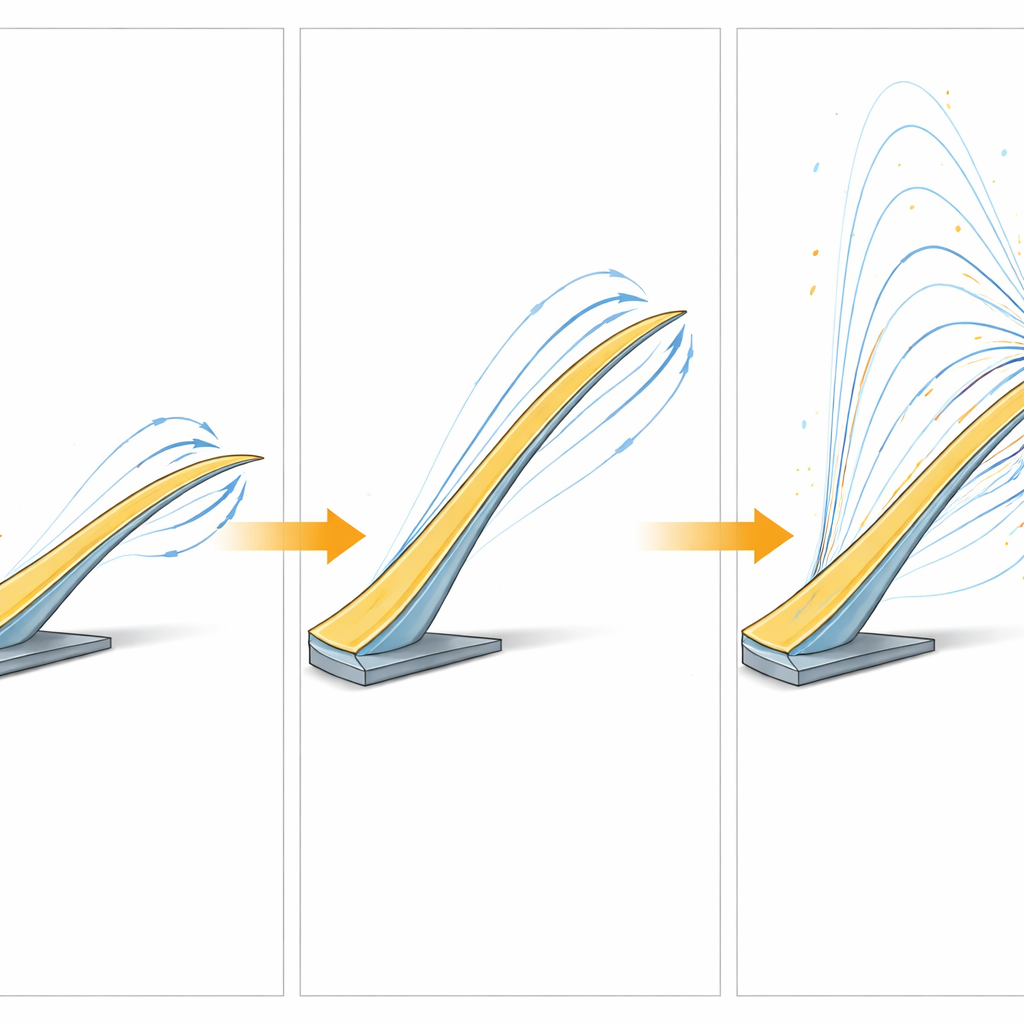
At low drive levels, the beam behaved as engineers usually prefer: its response to changing frequency was smooth and symmetric, and forward and backward sweeps gave the same result. As the team cranked up the voltage, the motion began to warp. The resonance peak bent and broadened, and the response for upward and downward sweeps no longer matched, signaling classic nonlinear behavior. At the highest drive levels in vacuum, the tip speed reached about 50 meters per second—roughly ten times what has been reported for similar devices—while showing sudden jumps in amplitude and loops of hysteresis as the drive strength and frequency were varied. Numerical simulations using a standard nonlinear oscillator model closely matched these patterns, confirming that the underlying physics followed well-understood, though rarely explored, nonlinear rules.
How close to breaking is too close?
Pushing a microscopic beam to such speeds raises obvious questions about failure. The researchers estimated both the electrical field inside the aluminum nitride and the mechanical strain in the bending beam at peak motion. They found that the device was operating at about 90% of its electrical breakdown limit and roughly half of its expected mechanical breaking strain. In other words, the experiment brought the resonator close to both its electrical and mechanical limits without actually destroying it, providing a realistic upper bound on usable speed for this design.
What this means for future navigation devices
By showing that a tiny, chip-scale beam can vibrate at 50 meters per second while remaining controllable, this work demonstrates that MEMS devices do not need to be confined to gentle, linear operation. Instead, designers can consider operating near the edge of material limits to unlock much higher sensitivity for inertial sensors used in demanding settings such as GPS-denied navigation. Although this particular device was not optimized as a final product and still lacks features like built-in sensing along a second direction, it provides a clear proof of concept: carefully managing nonlinear behavior can turn extreme vibration from a problem into a powerful tool for next-generation miniature gyroscopes and accelerometers.
Citation: Liu, Z., Niu, X., Vatankhah, E. et al. High-velocity laser Doppler vibrometry measurements on an aluminum nitride bimorph wedge resonator. Commun Eng 5, 48 (2026). https://doi.org/10.1038/s44172-026-00595-7
Keywords: MEMS resonator, inertial sensor, laser Doppler vibrometry, nonlinear dynamics, aluminum nitride