Clear Sky Science · en
Cyber metasurface system for electromagnetic field closed-loop sensing and manipulation
Smart Walls for Invisible Wireless Control
Imagine if the walls of a room could quietly manage your Wi‑Fi signals—guiding them around obstacles, boosting weak connections, and even sensing where devices are—without plugs, batteries, or visible gadgets. This paper describes a new kind of “cyber‑managed metasurface” that does just that: a thin, tileable panel that both shapes and measures invisible radio waves while powering itself from the very signals it controls.
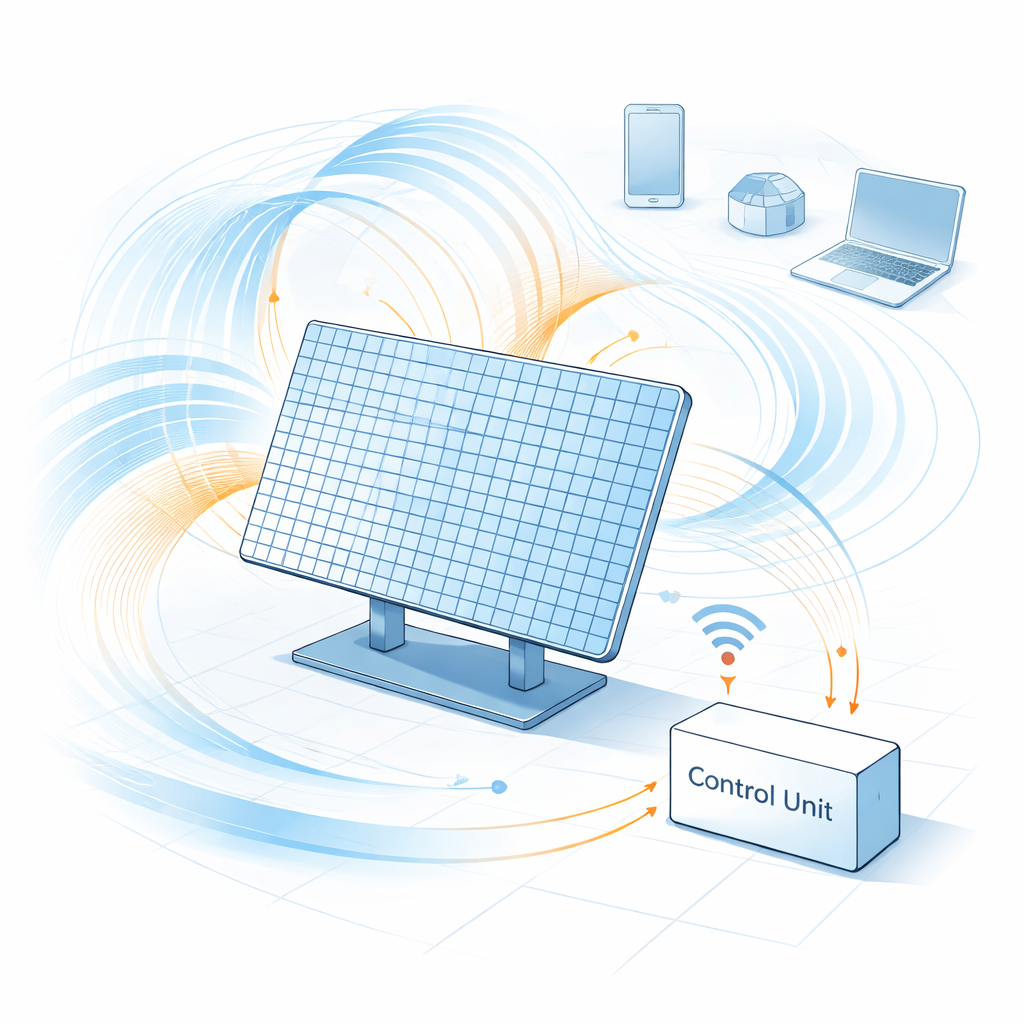
Building Blocks That Act Like Electronic LEGO
The core of this system is a flat panel made of many small square units, each of which can change how it reflects radio waves. You can think of these units as pixels in a controllable mirror for wireless signals. The authors design each small module as a 2 × 2 cluster of units that works like a LEGO block: it contains patterned metal on the front to interact with radio waves and a compact stack of electronics on the back. These layers handle power, local computing, and fine control over how each pixel delays or absorbs an incoming signal. By snapping many of these blocks together, engineers can assemble larger, custom‑shaped panels that fit into real spaces—on walls, ceilings, or objects—while keeping the complexity hidden inside each tile.
Harvesting Power from the Air
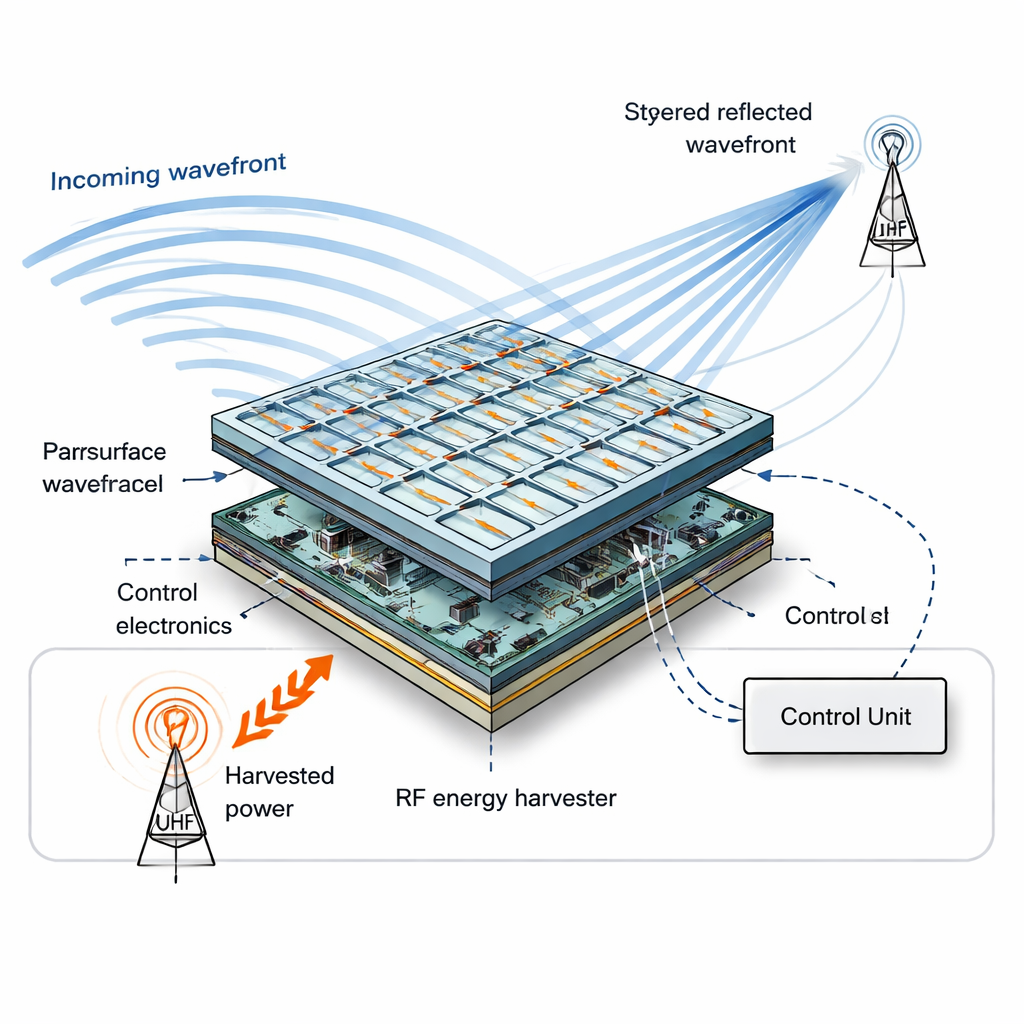
A key challenge for such intelligent surfaces is how to power thousands of tiny elements without running wires or changing batteries. The researchers solve this by letting the surface drink energy from radio waves in the ultra‑high‑frequency band, sent by a central “cyber control unit.” Each tile has a built‑in circuit that converts these waves into direct‑current electricity and stores it in small capacitors. Clever power‑supply management keeps leakage tiny and turns off nonessential loads until enough energy has built up. Multiple tiles are linked by a simple wiring bus that lets them share stored energy like a mesh of parallel batteries. If one tile briefly needs a power surge—for example to perform precise measurements—its neighbors can lend energy, allowing the whole array to act as a cooperative power network.
A Hybrid Nerve System for Control and Coordination
Beyond power, the surface needs a nervous system to coordinate its many tiles. The authors implement a hybrid network that combines wireless and wired connections. Wirelessly, each tile talks to the cyber control unit using the same sort of backscatter signaling found in radio‑frequency identification (RFID) tags: the control unit sends out a strong carrier, and the tile encodes information by slightly changing how it reflects that carrier. At the same time, neighboring tiles are hard‑wired together so they can relay data and share energy even if one wireless link is blocked—for instance, when a panel sits flat against a wall. Each tile has a unique digital ID, and the control unit uses signals from three antennas to estimate where every tile physically sits, so it can later assign the right reflection pattern to the right spot on the surface.
From Sensing the Air to Shaping It
What makes this surface stand out is that it does not just redirect radio waves; it also measures them. Each tile can switch between a “reflection” mode, where it steers signals like a smart mirror, and a “sensing” mode, where its front patches act as tiny antennas that feed on‑board detectors. In sensing mode, the tile measures both the strength and the phase—essentially the timing—of incoming waves along horizontal and vertical directions. By combining these readings from many tiles, the system reconstructs the direction from which a signal arrives and whether it looks like a distant, flat wave or a nearby, curved one. That information is then fed back to update the reflection pattern, creating a closed loop in which the surface constantly adapts its behavior to the current wireless environment.
Sharper Indoor Links and Smarter Future Networks
To show what this enables, the researchers place their panel in a conference room and use it to reflect a 2.4 GHz data stream carrying an image, similar to a Wi‑Fi link. By programming the surface with specific phase patterns, they steer a narrow beam toward a chosen receiver while greatly reducing signal quality in other directions. Measurements of signal‑to‑noise ratio, bit‑error rate, and the final reconstructed images confirm that the metasurface can rescue a weak link at the target angle while leaving off‑target listeners with almost unusable data. In everyday terms, the panel acts like a silent stage‑hand for wireless networks: it senses where the action is, then tilts and shapes invisible beams so that energy and information go where they are needed most. This self‑powered, modular approach pushes metasurfaces closer to becoming practical building materials for future smart buildings, passive Internet‑of‑Things networks, and adaptive communication systems.
Citation: Xuan, X., Wu, B., Chen, Y. et al. Cyber metasurface system for electromagnetic field closed-loop sensing and manipulation. Commun Eng 5, 41 (2026). https://doi.org/10.1038/s44172-026-00593-9
Keywords: metasurface, wireless communication, energy harvesting, beam steering, smart surfaces