Clear Sky Science · en
Harnessing synthetic biology for energy-efficient bioinspired electronics: applications for logarithmic data converters
Why shrinking computers to the scale of cells matters
Modern gadgets—from smart watches to medical implants—are hungry for data and power. Yet nature shows that living cells can sense, compute, and act using a tiny fraction of the energy any microchip needs. This paper explores how to borrow those tricks from biology to build new kinds of ultra‑efficient electronics. The authors design a tiny electronic circuit that converts analog signals into digital ones, guided by principles taken from genetic networks inside cells. Their device can handle signals spanning a huge range of strengths while using less power than many digital watches, making it promising for future wearable and implantable health technologies.
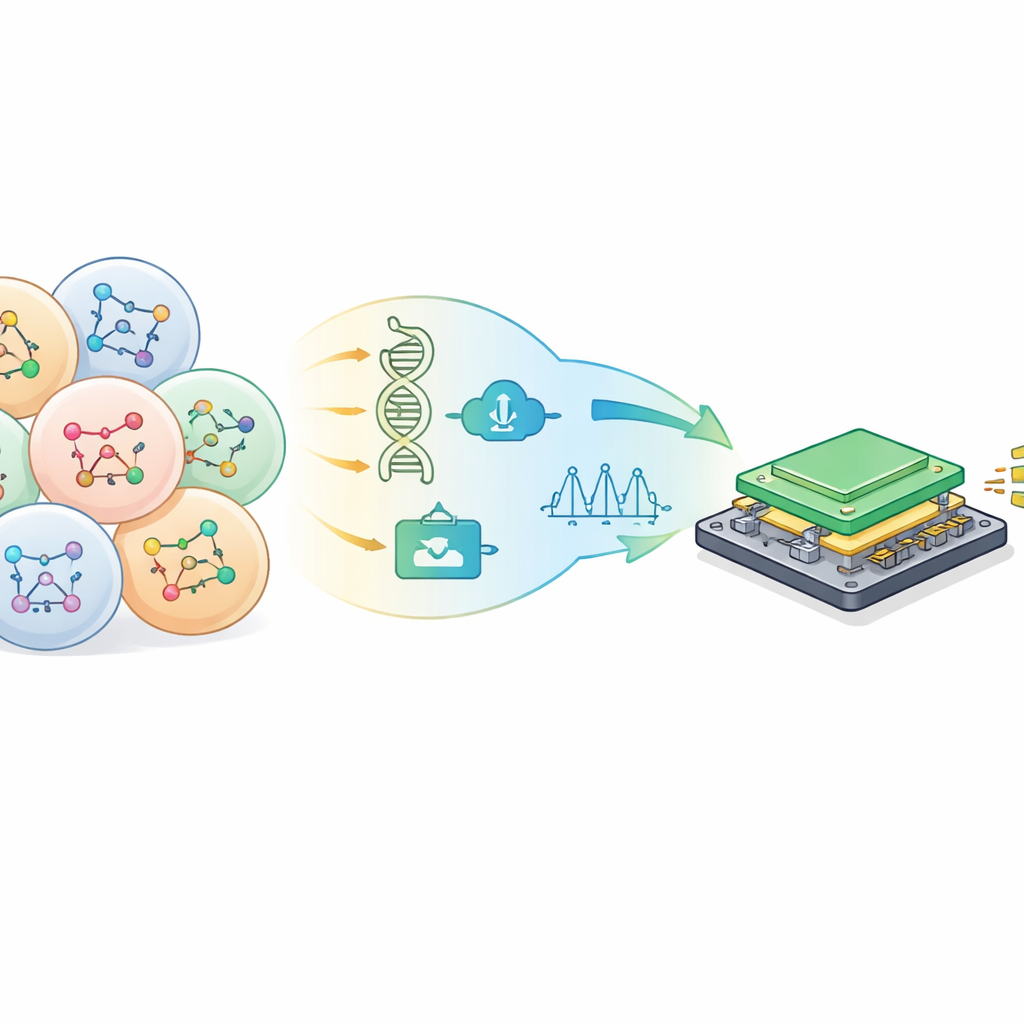
Learning from cells instead of just brains
For years, engineers have copied the brain to build “neuromorphic” chips that mimic neurons and synapses. But this work looks one step deeper, toward the molecular machinery inside individual cells. Cells use biochemical networks of genes and proteins to sense chemicals, measure changes, and make decisions. These networks naturally combine smooth, graded responses with sharp, digital‑like switches, and they do so with astonishing energy frugality. Previous work even built a genetic analog‑to‑digital converter (ADC) inside living cells that encoded chemical concentrations into protein “bits” over a range of 100 billion‑to‑one using less than a picowatt of power. That biological design followed a principle known as Weber’s law: cells respond to relative changes in a signal, not its absolute size, effectively working on a logarithmic scale. The authors ask: can we turn this genetic strategy into an electronic circuit that gains similar efficiency benefits?
Turning gene circuits into circuit diagrams
The team first builds a bridge between molecular biology and electronics. In cells, signals are carried by molecules binding and unbinding, turning genes on and off. Mathematically, these processes often look like smooth curves that rise sharply and then saturate—much like the behavior of a transistor as its voltage increases. The authors create detailed electronic “look‑alikes” for basic gene modules: binding interactions, promoters that control gene activity, and feedback loops that sharpen decisions. In their mapping, electric currents stand in for molecular fluxes, and voltages stand in for concentrations. They then abstract a previously built two‑bit genetic ADC into a compact electronic model that resembles a simple artificial neuron: weighted inputs are fed through a squashing, decision‑like function. This abstraction lets them redesign the concept in silicon while preserving the key biological idea: encode input strength on a logarithmic scale, using mixed analog‑and‑digital behavior and feedback to keep energy use low.
Building a tiny logarithmic data converter
Using this bio‑inspired blueprint, the authors design a three‑bit logarithmic ADC in a standard 180‑nanometer CMOS process. Instead of operating transistors in the usual high‑current mode, they run them in the subthreshold region, where currents are extremely small and naturally follow exponential laws—perfect for logarithmic processing. The circuit works in current mode: an input current that can vary over five orders of magnitude is fed to three interconnected stages that each decide one output bit. Clever internal circuitry mimics power‑law responses and saturation, so each stage effectively compares the incoming signal to a different threshold on a log scale. The resulting three‑bit code compresses an 80‑decibel dynamic range into just eight digital levels. Simulations show the chip consumes less than one microwatt at a sampling rate suitable for biomedical signals and occupies only about 0.02 square millimeters of silicon, all while maintaining good linearity of codes in the logarithmic domain and robustness to temperature, supply, and manufacturing variations.
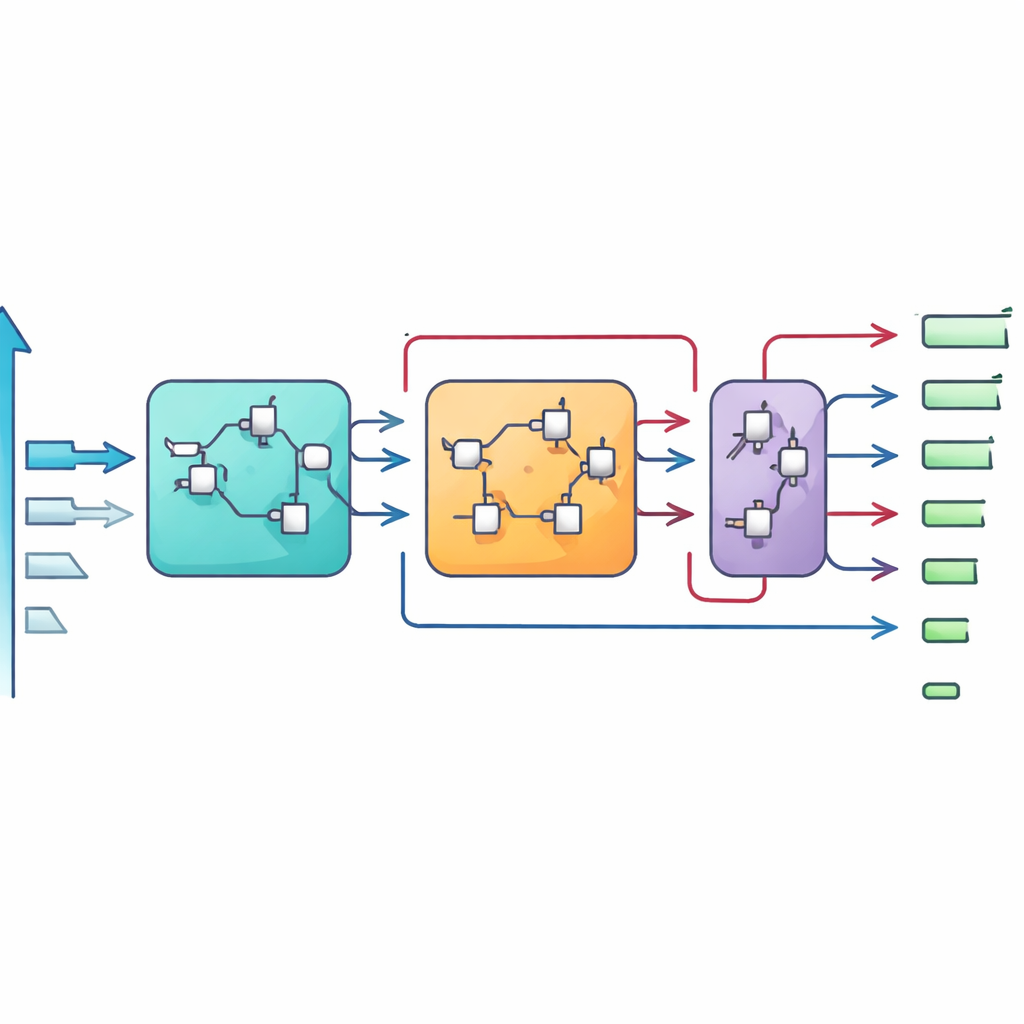
Why logarithmic thinking saves energy and space
Conventional ADCs typically divide their input range into uniform steps and compare the signal against many reference levels. As designers chase higher resolution, the number of required comparisons—and therefore power and area—often grows exponentially with the number of bits. By contrast, the bio‑inspired design spreads its decision thresholds on a logarithmic scale. That means many more fine steps for weak signals, and coarser ones for strong signals where small differences matter less. Mathematically, the authors show that in their architecture the dominant power cost grows only linearly with the number of bits, while the dynamic range can grow exponentially. They also analyze noise and find that quantization—the unavoidable rounding of analog values to digital steps—dominates over thermal noise, so thermal fluctuations do not significantly hurt performance. This mirrors biology, where systems tolerate noisy molecules yet still make reliable decisions by working in the log domain.
What this could mean for future devices
By grounding their design in how gene circuits compute, the authors demonstrate a practical, tape‑out‑ready ADC that compresses wide‑range signals into just a few energy‑efficient bits. This kind of logarithmic converter is especially well suited to low‑bandwidth, high‑dynamic‑range tasks: sensing weak biochemical signals, capturing sound for cochlear implants or hearing aids, or reading out optical and electrochemical sensors in wearable or ingestible health monitors. The broader message is that synthetic biology can be more than just a source of metaphors—it can serve as a template for new electronic architectures where power, accuracy, and chip area are traded off in ways closer to living systems than traditional digital design.
Citation: Oren, I., Gupta, V., Habib, M. et al. Harnessing synthetic biology for energy-efficient bioinspired electronics: applications for logarithmic data converters. Commun Eng 5, 44 (2026). https://doi.org/10.1038/s44172-026-00589-5
Keywords: logarithmic ADC, bio-inspired electronics, synthetic biology, low-power sensors, neuromorphic design