Clear Sky Science · en
Dimensionality reduced antenna array for beamforming/steering
Why shaping radio waves matters
From 5G smartphones and Wi‑Fi routers to satellite links and self‑driving cars, our world runs on invisible beams of radio and light. Pointing those beams precisely—so that energy goes only where it is needed—is essential for fast, reliable, and energy‑efficient communication. This paper presents a new way to build “smart” antennas that can steer beams while using far fewer electronic control parts, potentially making future networks cheaper, lighter, and less power‑hungry.
How antennas learn to point
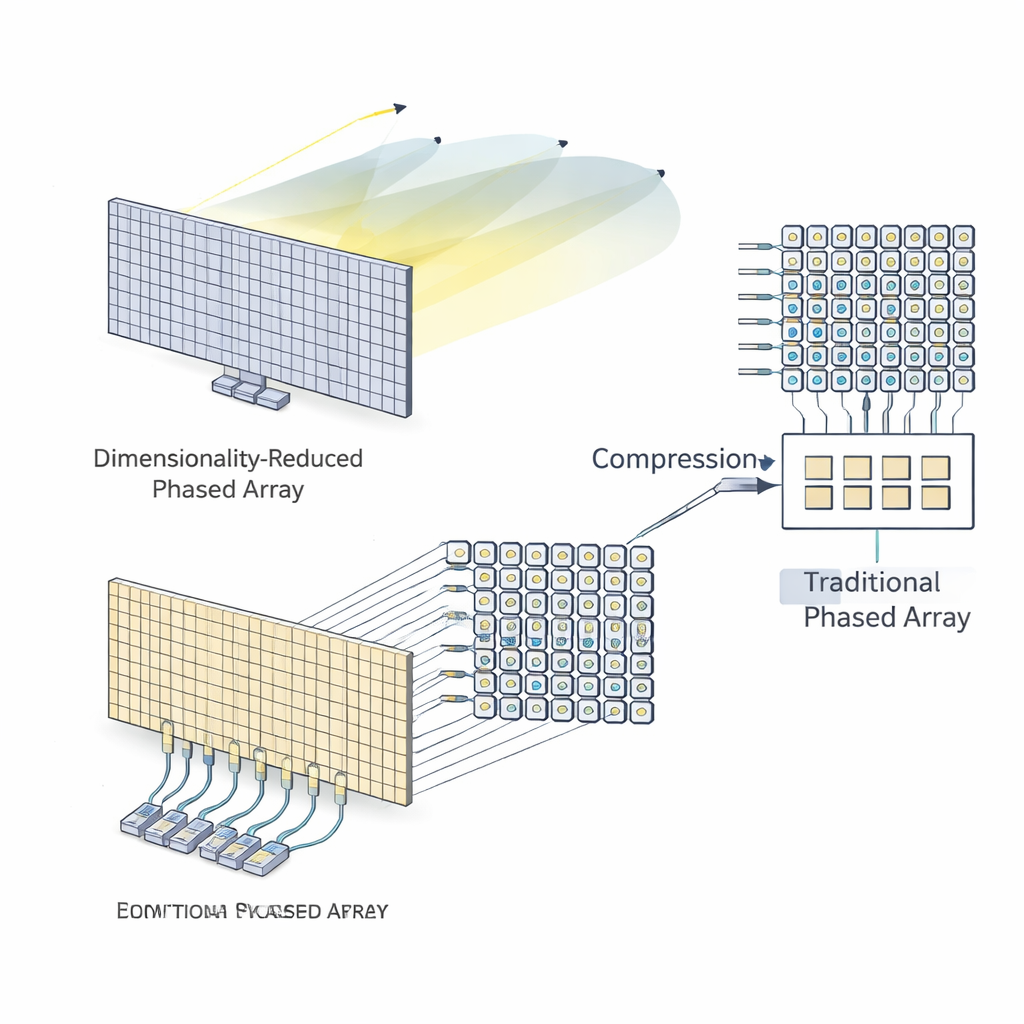
Traditional antennas radiate in all directions, wasting power and picking up unwanted interference. Beamforming changes this by using many small antenna elements that work together. By feeding each element with a carefully chosen delay (or phase) and strength, their waves add up in one preferred direction and cancel out elsewhere. This creates a strong, steerable beam that can track users, separate multiple data streams, and see objects more clearly in radar and LiDAR systems. The catch is that in a classic phased array, every antenna element needs its own adjustable phase shifter and often its own amplifier. As arrays grow to hundreds or thousands of elements—as envisioned for 6G and satellite systems—the hardware, cost, and power required become enormous.
Doing more with fewer controls
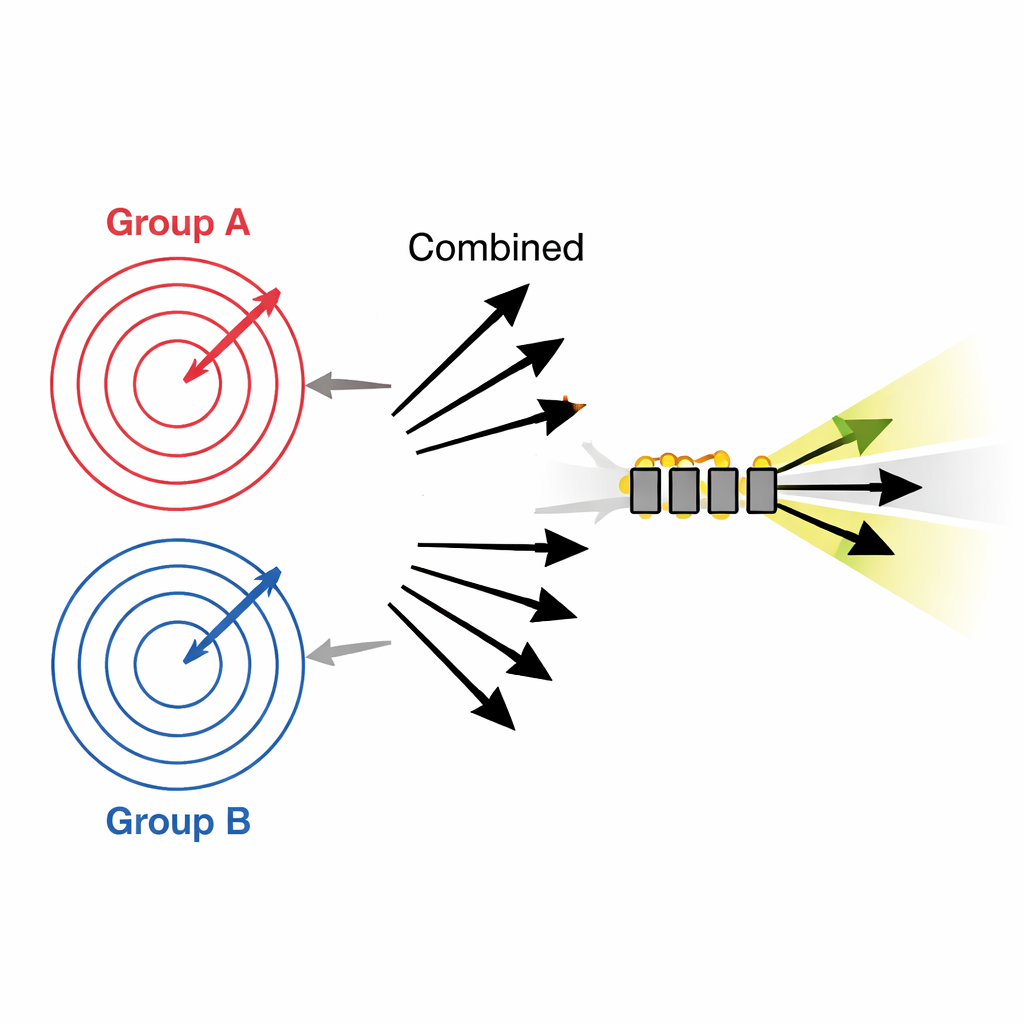
The authors tackle this scaling problem by treating the whole beam steering task as a kind of data compression challenge. Instead of adjusting every antenna element independently, they first describe all the settings needed for many different beam directions as a large matrix. Then they apply a mathematical tool called singular value decomposition (SVD) to find a much smaller set of “basis patterns” that can be blended to recreate those beams with only tiny errors. In their Dimensionality‑Reduced Cascaded Angle Offset Phased Array (DRCAO‑PAA), each basis pattern is hard‑wired into the hardware, and only a small number of variable controllers decide how strongly each pattern is used. In effect, a handful of smart knobs replace dozens or even hundreds of individual controls.
Smart optimization and AI assistance
Simply compressing the matrix is not enough; the remaining patterns must also be practical to realize in hardware. If one pattern demands extremely high amplifier gain or very fine phase precision, it becomes difficult or expensive to build. To avoid this, the team uses an optimization method inspired by flocking birds, known as particle swarm optimization, to search for basis patterns that keep beam errors small while keeping amplifier gains and phase ranges within realistic limits. They then go a step further and train a Transformer‑based deep learning model—similar in spirit to those used in modern language AI—to quickly predict good basis patterns for many different array sizes and scan ranges. This allows engineers to generate near‑optimal designs in seconds instead of repeatedly running heavy numerical searches.
From theory to working hardware
To prove that the concept is more than just mathematics, the researchers built a millimeter‑wave circuit board operating at 28 gigahertz, a key band for 5G and beyond. The board uses commercial beamformer chips arranged in three layers—inputs, a middle routing layer, and outputs—to implement the fixed basis patterns and adjustable blending controls. With this setup, they show that a 16‑element array can be steered over a 0–30° range using only 4 active controller paths instead of 16, and an 8‑element array can be steered with just 3 controller pairs. In an anechoic chamber, a 4‑element antenna is driven by only 2 phase shifters and 2 variable amplifiers while still smoothly sweeping the beam over several degrees, with pointing errors kept to a small fraction of the total scan range.
What this means for future networks
In simple terms, this work shows that large, steerable antenna arrays do not always need a one‑to‑one match between antenna elements and expensive control electronics. By carefully reusing a small library of pre‑designed patterns and mixing them in the right proportions, it is possible to cut the number of active controllers by as much as 75–87.5% while preserving useful steering performance. That reduction translates into lower cost, lower power consumption, and simpler hardware—advantages that are crucial for dense 6G base stations, massive satellite constellations, and compact sensing systems. Although current experiments focus on linear arrays, the same matrix‑compression idea can be extended to two‑dimensional panels for full 3D steering, pointing toward future communication and sensing devices that are both smarter and leaner.
Citation: Xia, S., Zhao, M., Ma, Q. et al. Dimensionality reduced antenna array for beamforming/steering. Commun Eng 5, 38 (2026). https://doi.org/10.1038/s44172-026-00588-6
Keywords: beamforming, phased arrays, 6G communications, satellite links, antenna design