Clear Sky Science · en
Degradation modelling of chaotic systems via random walks in phase space
Why chaos matters for everyday machines
Many devices we rely on—from car gearboxes to electronics that secure our data—behave in ways that look random but are actually governed by a type of orderly unpredictability called chaos. Because chaotic systems are extremely sensitive to tiny changes, engineers struggle to predict how these machines will wear out over years of use. The paper described here introduces a new way to forecast long‑term wear and tear in such systems, promising faster design cycles and more reliable products.
Hidden patterns inside apparent randomness
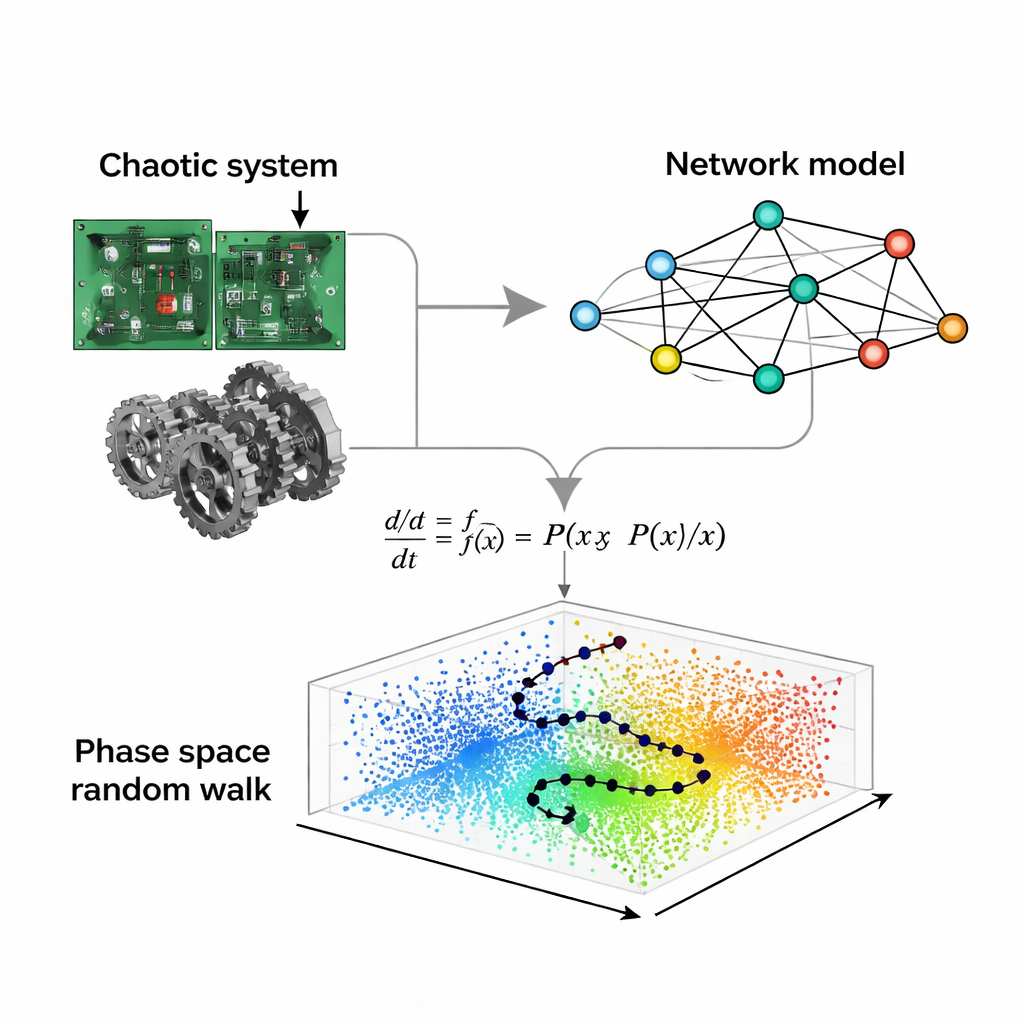
Traditional reliability models assume that performance wiggles around a smooth, predictable trend, treating irregular fluctuations as mere noise. Recent research, however, shows that in many machines these fluctuations arise from deterministic chaotic dynamics. In raw time‑series data—say, a noisy vibration signal—this hidden order is hard to see. But when engineers look in “phase space,” a mathematical space where each point represents the complete state of a system, the motion traces out complex yet confined paths. To design long‑lived chaotic systems, engineers need to understand how these paths evolve as parts slowly degrade, something that is difficult to do with existing tools.
Why old methods fall short
Current approaches to modeling degradation fall into three broad camps: physics‑based models, data‑driven machine learning, and hybrids that mix both. Physics‑based models work well for simple systems where wear progresses almost independently of the system’s fast dynamics. In chaotic systems, by contrast, the wear rate of each component is tightly linked to the overall state of the machine, forcing simulators to use extremely small time steps and high numerical precision just to remain accurate. Data‑driven and hybrid methods need large volumes of high‑quality aging data to learn patterns, but such data typically does not exist when a system is still on the drawing board. None of these strategies can easily capture the abrupt transitions between calm and highly chaotic behavior that often occur as a machine ages.
A new map: random walks in degradation phase space
The authors propose a different perspective: instead of tracking every tick of time, they build a “degradation phase space,” a map whose coordinates are measures of damage in the most critical components. For each point in this map, they run only short, detailed simulations of the system’s fast dynamics and average these over time to estimate how quickly each component is wearing at that state, along with the uncertainty in this rate. These local wear rates define an effective velocity field on the degradation map. Long‑term behavior is then reconstructed as a random walk that hops through this phase space, nudged by the average wear directions but allowed to wander within the calculated uncertainty. With this strategy, the model sidesteps the need for ultra‑fine, long time‑domain simulations while still respecting the underlying physics.
From circuits and gearboxes to general rules
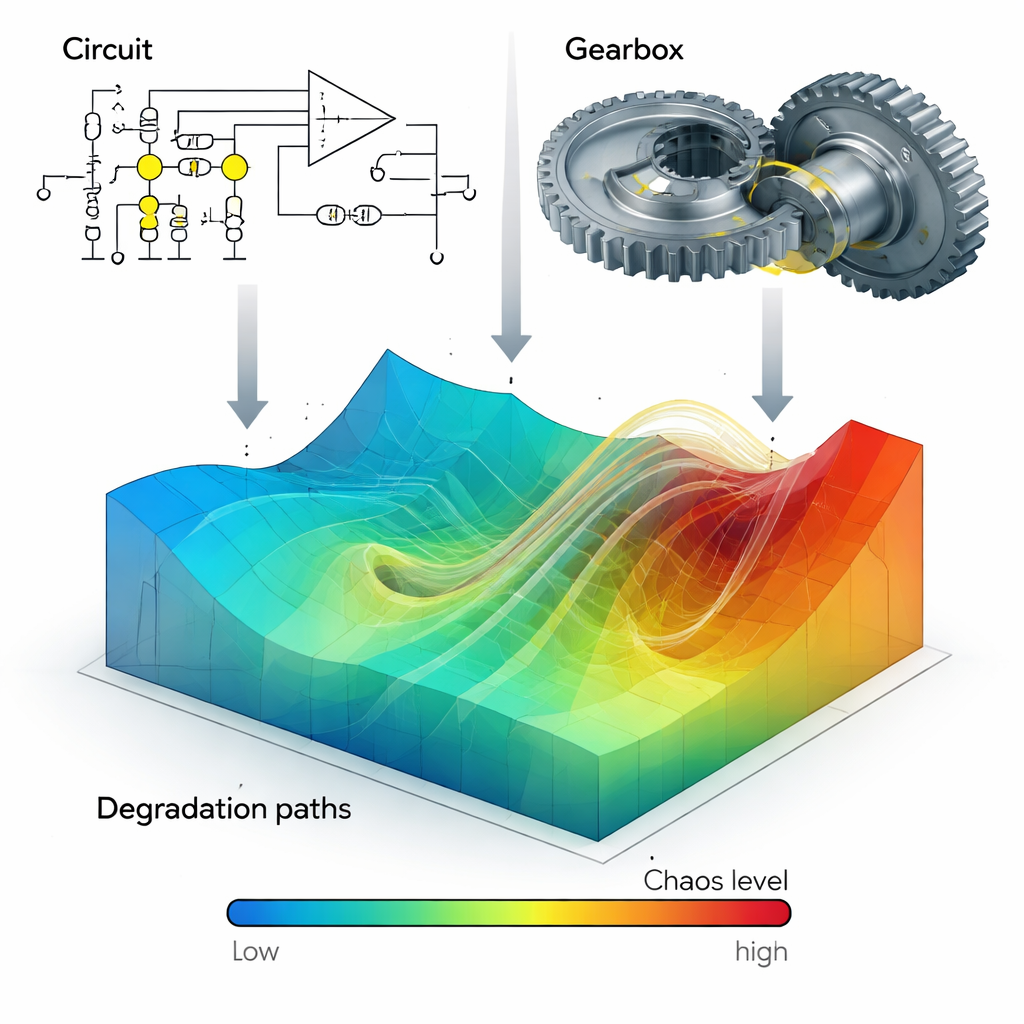
To show that the method is broadly useful, the researchers apply it to two very different yet chaotic systems: an electronic circuit (the Lars circuit) that generates complex electrical signals, and a two‑shaft gearbox whose vibrations can become chaotic as teeth degrade. Both systems are first expressed in a unified network model that treats electronic and mechanical elements in a consistent way using generalized flows and potentials. The team then constructs degradation phase spaces—for instance, by tracking how three key resistors age in the circuit, or how gear tooth cracks and surface pitting grow in the gearbox—and simulates random‑walk bundles starting from different initial conditions. These bundles reveal how aging paths bend and spread when the system moves between regions of low and high chaos.
What the new model reveals about aging
The phase‑space trajectories show common patterns across the electronic and mechanical examples. When the system operates in a low‑chaos or non‑chaotic regime, degradation paths are smooth and tightly clustered, reflecting relatively predictable wear. As the system drifts into a more chaotic regime, the paths develop pronounced kinks and fan out, signaling increased uncertainty in how and when components will fail. Yet even in strongly chaotic regions, the paths remain confined to bounded bundles, suggesting that long‑term outcomes are still statistically controllable. When the system returns from a highly chaotic region to a calmer one, the direction and spread of the paths tend to follow the outlines of earlier states, hinting at a kind of “memory” in how damage accumulates.
Why this matters for future technology
For engineers, this framework offers a way to predict the long‑term health of chaotic systems during the design phase, without relying on decades of test data or prohibitive computational effort. In numerical tests on the chaotic circuit, the random‑walk model matched conventional fine‑step simulations while cutting computation time by more than a hundredfold, and kept prediction errors within about five percent. Because the method is built on general network representations and averaged physical laws, it could be extended to many other chaotic systems, from complex mechanical drives to communication networks and even models of population dynamics. In practical terms, it provides a faster, more reliable way to anticipate how “orderly randomness” in today’s machines will shape their lifetimes and safety.
Citation: Lu, Z., Wang, C., Zhang, Y. et al. Degradation modelling of chaotic systems via random walks in phase space. Commun Eng 5, 34 (2026). https://doi.org/10.1038/s44172-026-00587-7
Keywords: chaotic systems, degradation modeling, phase space, random walk, reliability engineering