Clear Sky Science · en
Multi-contrast magnetic particle imaging for tomographic pH monitoring using stimuli-responsive hydrogels
Why Measuring Acidity Deep Inside the Body Matters
Doctors know that subtle changes in acidity—measured as pH—often signal trouble before other symptoms appear. Inflamed tissues, infected implants, and growing tumors can all shift their local pH, but today it is hard to measure that safely and precisely inside the body. This paper presents a proof-of-concept imaging method that could one day let clinicians “see” pH deep in the body without needles or radiation, using tiny magnetic particles embedded in smart gels.
A New Way to See Magnetic Particles
Magnetic particle imaging (MPI) is an emerging medical imaging technology that does not look at anatomy directly. Instead, it detects only specially designed magnetic nanoparticles injected or implanted in the body. Unlike MRI, where tissue creates the signal and contrast agents merely tweak it, in MPI the particles themselves are the entire source of signal. This makes it possible to count and track them very precisely. Over the past years, researchers have learned to turn MPI into a kind of “multi-contrast” tool, where changes in the particles’ surroundings—such as temperature or fluid thickness—alter the signal in measurable ways. The current work adds another crucial environmental factor to that list: pH.
Smart Gels That Swell with Acidity
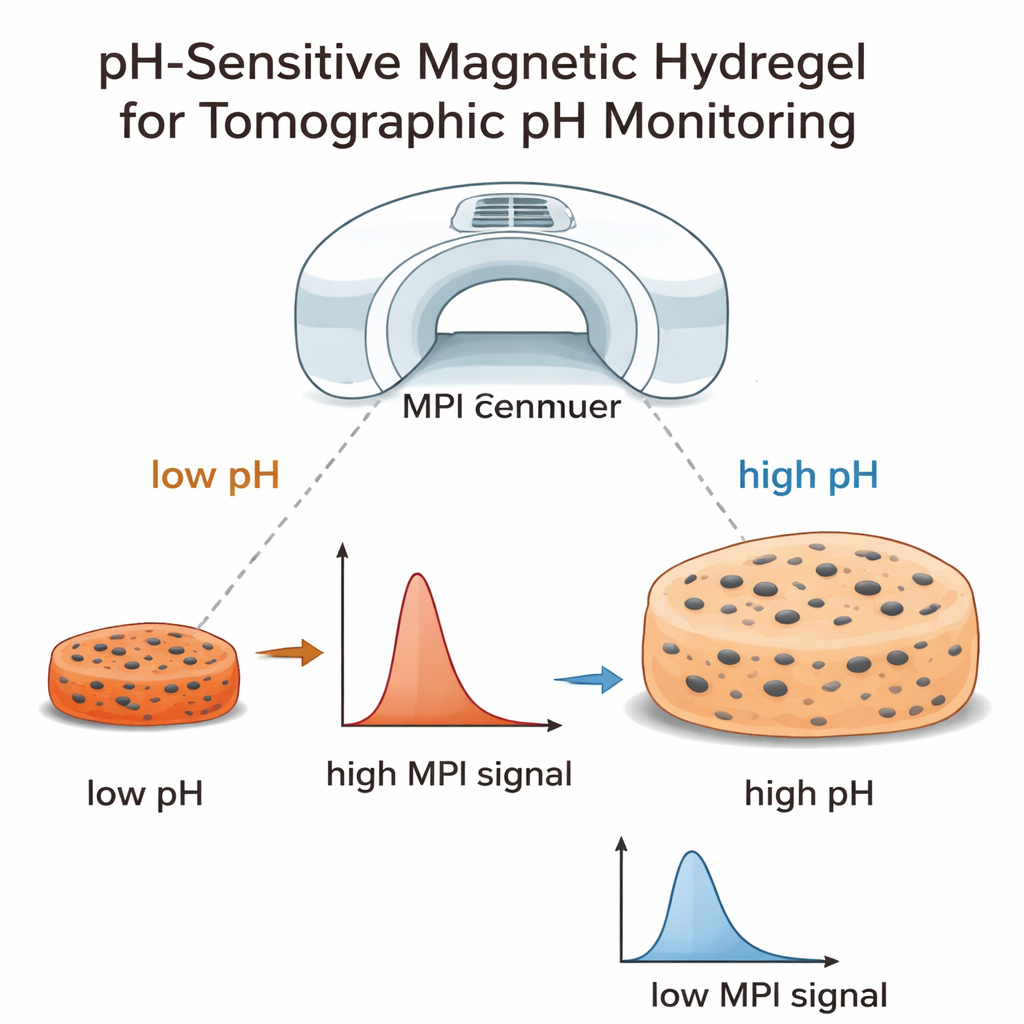
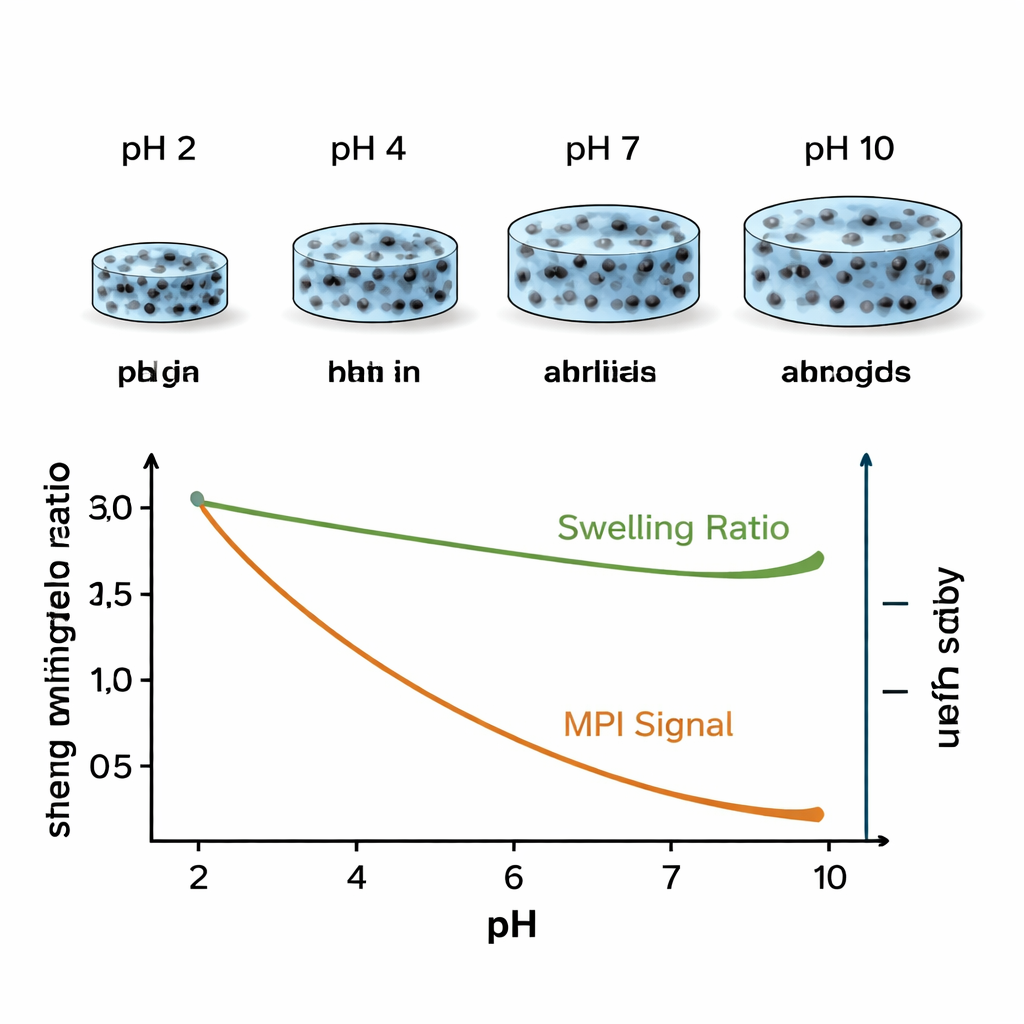
The key ingredient in this study is a soft, water-loving material known as a hydrogel. The team used a synthetic hydrogel that contains chemical groups which gain or lose charge depending on pH. At low pH (more acidic), these groups are less charged and the gel stays relatively compact. At higher pH (more basic), they become strongly charged and repel each other, causing the gel to swell dramatically, taking up more water and increasing in volume by several hundred percent. By soaking these gels in a solution of superparamagnetic iron oxide nanoparticles, the researchers turned them into tiny magnetic pH sensors. In acidic solutions the particles are packed closely in a small volume; in basic solutions the gel expands and the particles spread out.
How Swelling Changes the Magnetic Signal
To test how swelling affects what an MPI scanner would see, the team first used a companion technique called magnetic particle spectrometry. They measured the magnetic response of dry gels and gels swollen at different pH values. As the pH increased and the gels swelled, the measured signal grew weaker and the spectrum of frequencies in the signal became narrower. In other words, the more the gel expanded, the fewer strong “harmonics” the detector picked up. This behavior likely reflects changes in how the particles interact with each other and with the gel network as their spacing increases. Importantly, the effect was reproducible and showed a clear, statistically significant trend: in the medically relevant acidic range, higher pH led to more swelling and a lower magnetic signal, with a reasonably linear relationship.
Turning Signal Changes into pH Maps
Next, the researchers demonstrated that these signal differences can be turned into images that distinguish pH values. They placed several gel patches in a 3D-printed holder and let them swell in solutions with different pH levels. Using a preclinical MPI scanner, they acquired images while also recording separate “system matrices” for gels held at specific reference pH values. By reconstructing the images with multiple channels—one tuned to each reference pH—they were able to assign different colors to different pH responses. In these multi-color images, gels in more acidic solutions lit up strongly in the corresponding channels, while gels in more basic solutions either appeared weaker or, at very high pH, nearly vanished because their signal was too small with the current setup. This confirmed that, at least for well-separated pH values such as 2, 4, and 7, MPI can differentiate pH in space.
Where This Could Lead in Medicine
In summary, this work shows that pH-responsive magnetic hydrogels can convert invisible chemical acidity into a magnetic signal that MPI scanners can detect and separate. The authors demonstrate that, in acidic ranges important for diseases, gel swelling and magnetic signal change track pH in a predictable way and can be visualized as distinct colors in an image. Although this is an early laboratory study with millimeter-sized patches, it lays the groundwork for future miniaturized sensors that might be injected or implanted to monitor inflammation, infections, or tumor environments non-invasively. With further refinement to improve sensitivity around normal body pH and to handle small pH shifts, this approach could add “chemical vision” to MPI, letting clinicians not just see where tissues are, but also how sick they might be based on their local acidity.
Citation: Kluwe, B., Ackers, J., Graeser, M. et al. Multi-contrast magnetic particle imaging for tomographic pH monitoring using stimuli-responsive hydrogels. Commun Eng 5, 33 (2026). https://doi.org/10.1038/s44172-026-00586-8
Keywords: magnetic particle imaging, pH sensing, smart hydrogels, nanoparticle imaging, noninvasive diagnostics