Clear Sky Science · en
Network separation modeling and quantum computing for developing wildfire fuelbreak strategy
Why smarter fire lines matter
Across the American West and around the world, wildfires are burning bigger, hotter, and closer to where people live. One of the few tools land managers can put in place before a blaze starts is the fuelbreak: a band of thinned or cleared vegetation that slows a fire’s advance. But deciding exactly where to carve these strips into real landscapes is a difficult puzzle. This study shows how ideas from network science and quantum computing can help place fuelbreaks more strategically, so that less land needs to be disturbed while more forest – and nearby communities – are protected in a worst‑case fire.
Turning a forest into a network map
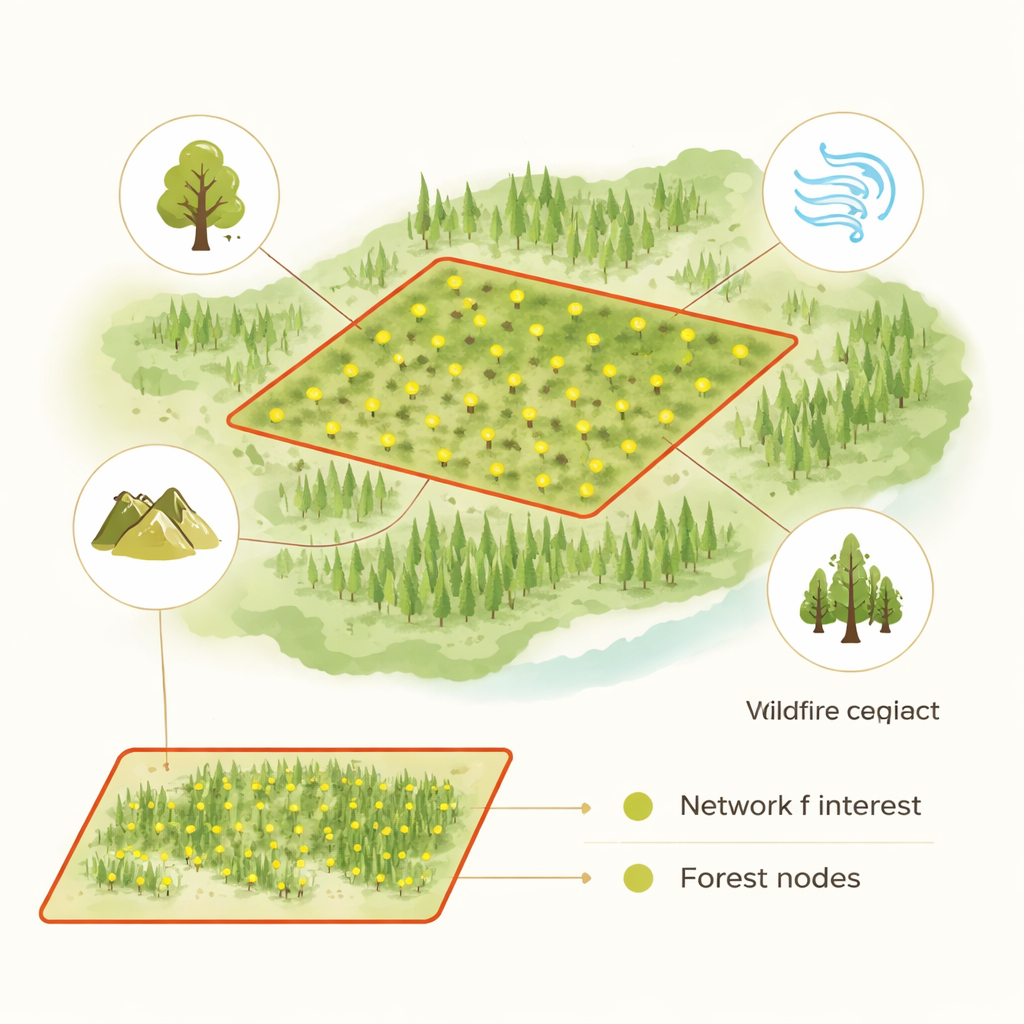
To tackle the problem, the researchers first reimagined a real forest in California as a network, similar to the way epidemiologists model the spread of disease. They focused on a specific region of interest and laid a fine grid of points across the map. Every point that fell within forested land became a node in the network, representing a location where fire could burn. Information such as elevation was pulled from online data sources, while simple assumptions were made about tree height and strong winds that could blow embers across the landscape. By connecting nodes that were close enough for embers to plausibly travel between them, the team created a web of nearly 1,500 forest nodes and more than 4,600 links along which fire could spread.
Designing fire lines as a cutting problem
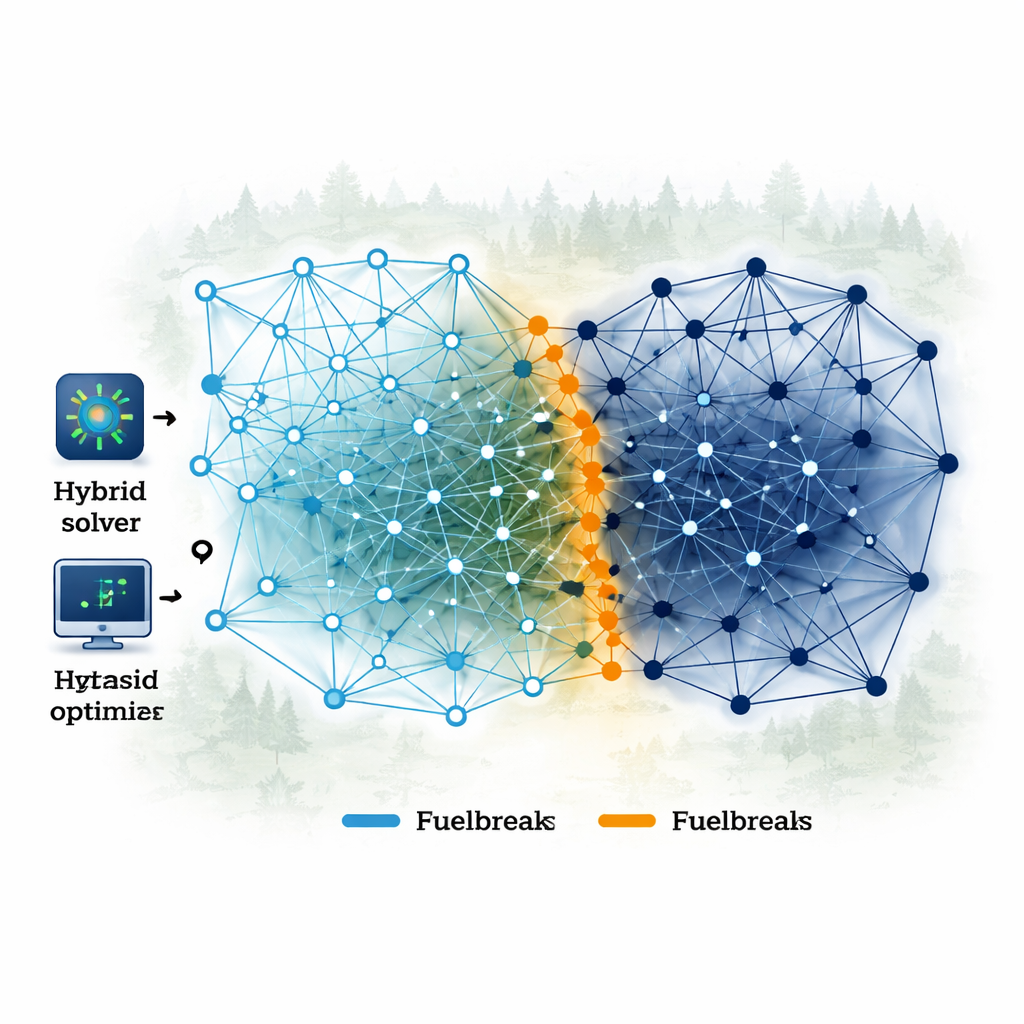
Once the forest was represented as a network, the question of where to build fuelbreaks became a question of how to “cut” the web. The goal was to split the network into two large, disconnected chunks of forest, with a third set of nodes in between representing the fuelbreak. If a fire starts anywhere in one chunk, it should not be able to jump to the other. The researchers also assumed a worst‑case situation: no advance knowledge of where a fire will ignite and that it will burn everything it can reach. Under those conditions, it is safer if the two forest chunks are as equal in size as possible. That way, no matter where the fire starts, the maximum area that can burn is limited to about half the landscape, instead of most of it.
Letting quantum machines search for better cuts
Finding the best way to slice a large network into two equal pieces with the fewest cuts is an extremely difficult mathematical task, especially as the number of possible combinations explodes. The team expressed the problem as a form of constrained yes‑or‑no question for each node: Is it on the left side, the right side, or in the fuelbreak? They then used D‑Wave’s “hybrid” quantum solver, which combines a quantum annealer with classical computers, to search for near‑optimal answers in seconds. For comparison, they also ran versions of the same problem on two traditional optimization programs, CPLEX and SCIP. On a smaller test network, all three methods found equally good solutions, with CPLEX the fastest, D‑Wave close behind, and SCIP much slower. But unlike CPLEX, the quantum‑assisted approach could also handle the full‑scale forest network.
Beating the traditional ridgeline rule
To judge whether this high‑tech approach is worth the effort, the researchers compared it to a simple rule of thumb often used in practice: put fuelbreaks along a ridgeline. On the California network, the ridgeline method required clearing the equivalent of 190 acres and left one side of the forest much larger than the other. In contrast, one optimized solution needed only about 114 acres of fuelbreak – 76 acres less than the ridgeline – while keeping the two forest chunks similarly unbalanced. Another solution used slightly more area than the ridgeline, about 209 acres, but produced a far more even split, sharply reducing the maximum area that could burn in the worst case by nearly 18 percent. These examples highlight a key trade‑off: more or wider fuelbreaks can give better protection, but at the cost of disturbing more land.
What this means for future fire management
For non‑specialists, the main message is that we can use advanced math and emerging quantum hardware not just for abstract puzzles, but to solve pressing environmental problems. By treating wildfire spread like the spread of a virus over a contact network, and by carefully choosing which “links” to sever with fuelbreaks, managers can protect more forest while clearing fewer acres. The specific numbers in this study are tied to one region and to simplified fire assumptions, but the approach is general: as better data on winds, fuels, and weather become available, similar optimization tools could support more nuanced decisions that balance safety, cost, and ecological impact. In a world facing more frequent and intense wildfires, smarter planning of where to put fire lines could make the difference between losing half a landscape and losing almost all of it.
Citation: Dent, S., Stoddard, K., Smith, M. et al. Network separation modeling and quantum computing for developing wildfire fuelbreak strategy. Commun Eng 5, 32 (2026). https://doi.org/10.1038/s44172-026-00585-9
Keywords: wildfire mitigation, fuelbreak planning, network modeling, quantum computing, forest management