Clear Sky Science · en
Enhancing energy capture: single- and dual-chamber oscillating water column devices under converging waves
Turning Waves into Reliable Power
Ocean waves carry enormous amounts of energy, but capturing that energy efficiently has proved tricky and expensive. This research explores how to combine special coastal walls with a simple kind of wave machine, called an oscillating water column (OWC), to squeeze far more electricity out of each passing wave. For coastal communities looking for clean, predictable power, these smarter designs could make wave energy a much more practical option.
Focusing the Ocean’s Strength
Instead of placing devices randomly offshore, the study looks at shaping the coast itself to help do the work. A curved, parabolic wall acts like a giant mirror for waves: as waves roll in, the wall bends and redirects them toward a single focal region where their heights and energy levels build up. The authors place an OWC device right at this hot spot. An OWC is essentially a hollow chamber open to the sea below, with air trapped above the water and a turbine mounted on top. As waves raise and lower the water inside the chamber, the air is pushed back and forth through the turbine, generating power. By pairing this simple device with a carefully shaped coast, the team aims to multiply the energy available without adding moving parts in the water. 
Tuning a Single Chamber for Maximum Punch
The first part of the work asks a basic question: how big should that chamber be to best match the focused waves? Using a detailed computer model, checked against laboratory experiments, the researchers vary the radius and depth of a single cylindrical OWC at the focal point. They find that the wall-device system naturally supports two main resonant wave periods, where the device responds especially strongly. At these sweet spots, an optimally sized chamber can absorb up to 17 times more power than the same device sitting alone in open water. However, making the chamber too large backfires. A big structure reflects a lot of the concentrated waves instead of letting them drive water motion inside the chamber, sharply cutting performance for shorter, more frequent waves.
Letting Waves In from the Back
Next, the authors consider what happens just behind the device. Because the real focal point of the converging waves can wander slightly, a zone of very high wave energy often forms on the “leeward” side, downstream from the main chamber. To tap this overlooked resource, they introduce a leeward perforation—a kind of cut-out or opening on the back of the OWC so that more of the concentrated waves can enter. By reducing how deep this back section extends under water and widening the opening, the device becomes much more transparent to high-frequency waves, which can then rush into the chamber more easily. In their optimized design, the capture width ratio—a standard measure of how much wave energy a device can harvest—jumps to about 25 times that of an isolated OWC, showing how simple geometric tweaks can unlock major gains.
Adding a Second Chamber for Broader Reach
Even with tuning and perforations, a single chamber can only be perfectly tuned to a narrow band of wave periods. To widen the useful range, the study proposes adding a second, semicircular chamber on the leeward side, creating a dual-chamber device. Each chamber has its own preferred wave period, so together they act like a pair of overlapping receivers. The models reveal that the second chamber not only captures the high-energy region behind the first device, it also fills in gaps where the front chamber performs poorly. As a result, the two main power peaks for the combined system are boosted by about 41% and 22%, and the device maintains strong performance across a broader spread of wave conditions. Careful choices of chamber depth and radius further refine this effect, with certain size combinations maximizing both total captured energy and the useful operating bandwidth. 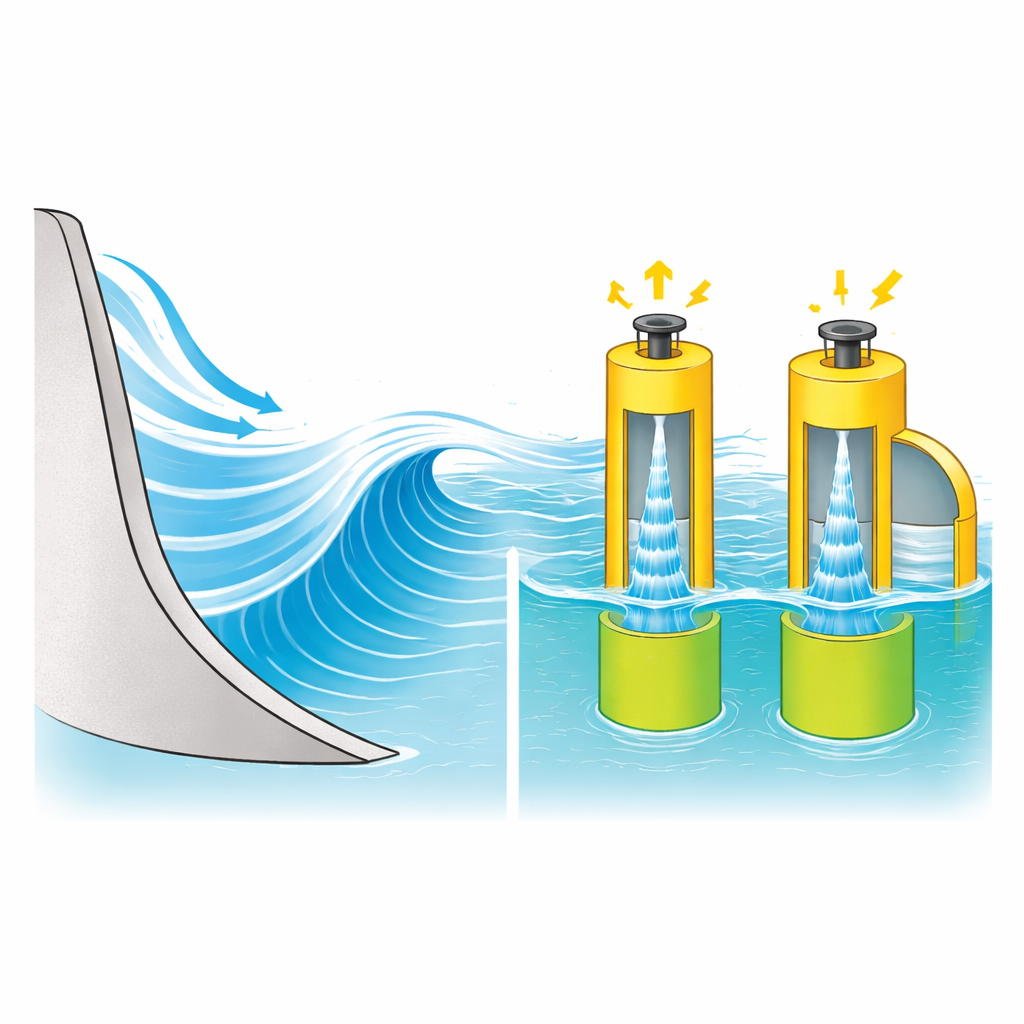
From Laboratory Coasts to Real-World Shores
For a non-specialist, the bottom line is that thoughtfully shaping both the shoreline and the wave device can transform wave power from a niche technology into a more efficient, flexible source of renewable electricity. By using a parabolic wall to concentrate waves and tailoring single- and dual-chamber OWCs to tap that focused energy, the researchers show that it is possible to multiply energy capture many times over without adding mechanical complexity in the sea. While the current work focuses on idealized wave conditions, it lays out practical design rules that engineers can adapt to real coasts, bringing the prospect of reliable, wave-driven power for coastal communities a step closer.
Citation: Zhou, Y., Wang, Z. & Geng, J. Enhancing energy capture: single- and dual-chamber oscillating water column devices under converging waves. Commun Eng 5, 29 (2026). https://doi.org/10.1038/s44172-026-00584-w
Keywords: wave energy, oscillating water column, parabolic coastal wall, renewable power, marine engineering