Clear Sky Science · en
Carbon market development in Africa: Ethiopia as a model
Why This Matters for Everyday Life
As the world scrambles to slow climate change, a key question is how to cut planet-warming gases while still allowing countries to grow and feed their people. This paper looks at Ethiopia, a country with fast population growth, limited industry, and enormous rural landscapes, to ask: can it earn money by storing carbon in its land and, at the same time, support farms, forests, and local communities? The answer may provide a model for many African nations with similar histories, laws, and development needs.
Turning Land into a Climate Asset
Ethiopia’s land is both a challenge and an opportunity. Agriculture dominates the economy and employs most of the population, yet food security remains fragile. At the same time, much of the country’s terrain—forests, grasslands, shrubs, and croplands—can absorb and store large amounts of carbon in plants and soils. Using detailed maps and existing scientific studies, the authors estimate that applying better land management across Ethiopia’s 112 million hectares could, in theory, store up to about 700 million tons of climate-warming gases and generate several billion dollars in revenue from carbon markets. 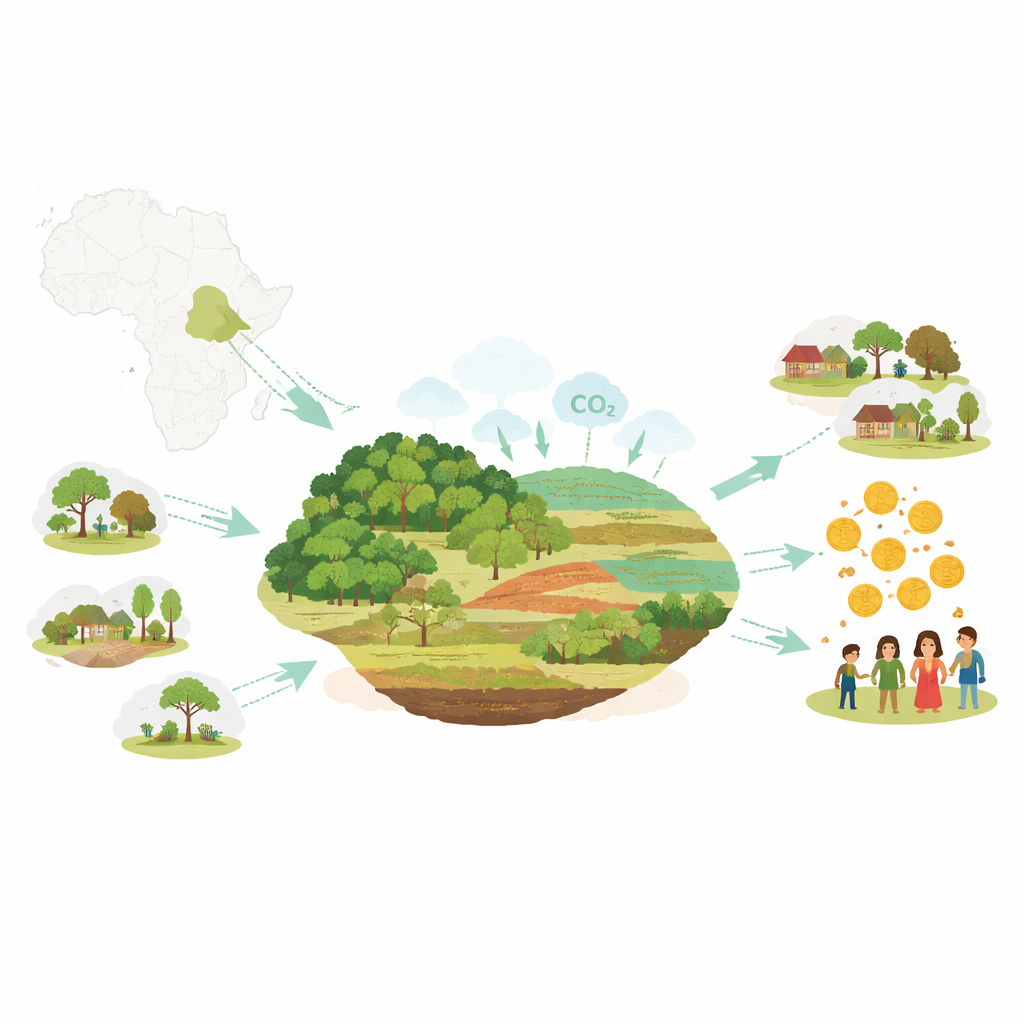
Who Owns the Land and the Carbon?
These promising numbers run into a basic legal reality: in Ethiopia, all land is owned by the government. People and communities only hold use rights, whether they farm, herd livestock, or manage local forests. Carbon markets usually assume that private landowners can be paid directly for changes in land management. In Ethiopia, that simple model does not fit. The paper walks through the country’s complex web of land administration institutions—separate agencies for urban and rural land, and multiple levels of regional and local government. To make carbon markets work, Ethiopia needs clear rules that link land rights to carbon rights so buyers can trust that the credits they purchase truly correspond to a specific place and practice and will not be undermined by later disputes or policy shifts.
Protected Areas as a Starting Point
The authors argue that the most practical first step is to focus on protected areas such as national parks and government-managed forests. These regions cover about one-fifth of the country and are already under public control, which reduces conflicts over ownership and decision-making. Many of these lands have suffered from deforestation, overgrazing, and encroaching farms and towns, but that degradation also means there is room for improvement: restoring vegetation and soils can both heal ecosystems and store more carbon. Using soil data, the study suggests that better management in protected areas alone could sequester roughly 340 million tons of climate-warming gases, potentially worth billions of dollars, though only if projects are carefully monitored and prices hold over time. 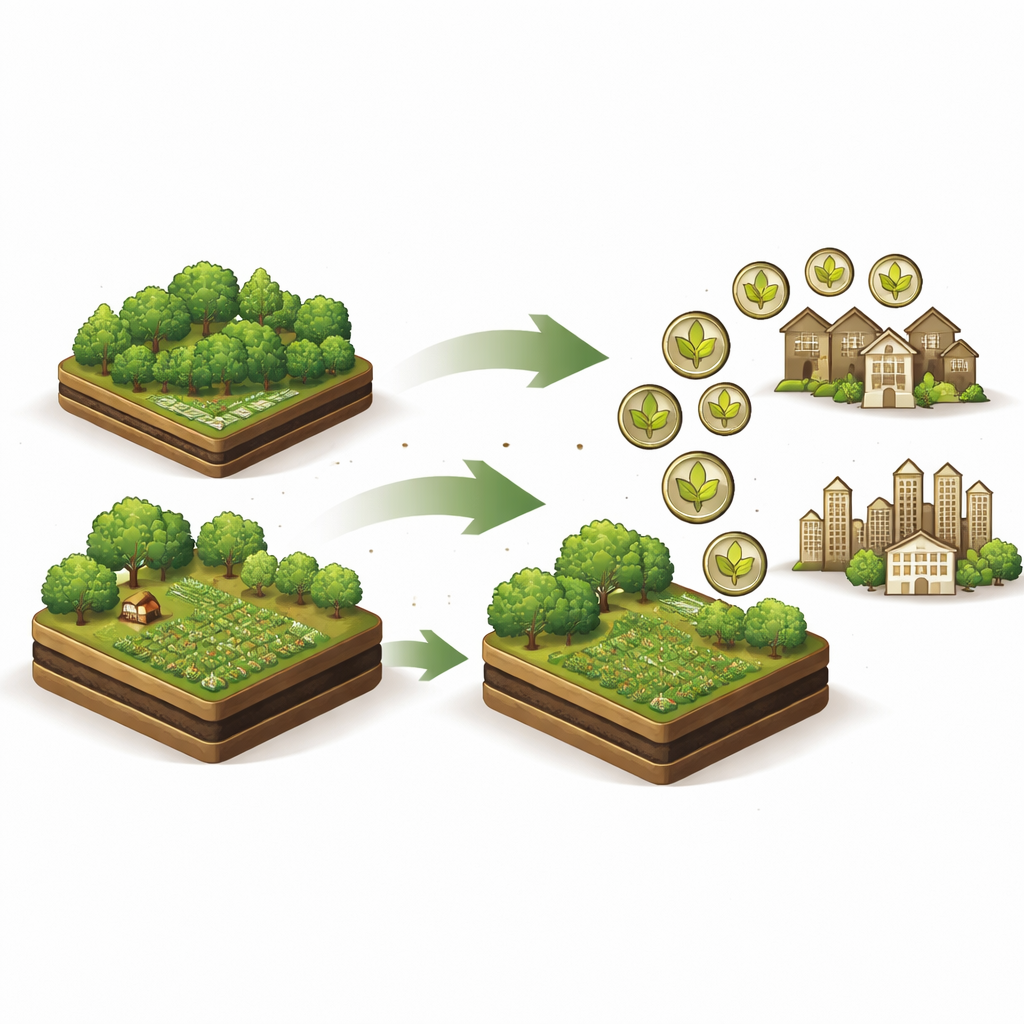
Balancing Risks, Cities, and Food
Building such markets is not just a technical exercise. Investors face real risks from changing land use, rapid urban expansion, weak coordination among agencies, and limited local experience with measuring and tracking carbon. Farmland is still desperately needed to feed a growing population, so any project that ties land to carbon storage must avoid undermining food production. The authors propose a systems view: first, map where land, conservation priorities, and economic needs overlap; second, improve cooperation between ministries responsible for urban growth and rural areas; and third, manage risks by setting stable, transparent rules for what happens if land is converted or projects fail. Strengthening local scientific capacity to measure soil and ecosystem carbon is also essential, because current data are sparse and uncertain.
A Pathway for Ethiopia and Beyond
In plain terms, this paper concludes that Ethiopia could become a net absorber of climate pollution while still growing its economy, but only if it builds strong institutions and fair rules around its land. Starting with government-run protected areas, the country can demonstrate how restoring landscapes can generate reliable income from carbon markets without sacrificing food or development goals. If Ethiopia succeeds in aligning land administration, conservation, and community benefits, it can offer a blueprint for other nations where land is publicly owned but locally used, turning carbon markets into tools not just for global climate goals, but for everyday livelihoods across Africa.
Citation: Tessema, B.G., Masiello, C.A., Medlock, K.B. et al. Carbon market development in Africa: Ethiopia as a model. npj Clim. Action 5, 43 (2026). https://doi.org/10.1038/s44168-026-00365-3
Keywords: carbon markets, Ethiopia, soil carbon, protected areas, sustainable agriculture