Clear Sky Science · en
Exploring patterns of distributional justice in global climate change mitigation scenarios
Why Fairness Matters for Climate Futures
When people imagine a low‑carbon future, they do not only ask whether it will stop global warming—they also ask whether it will be fair. Who gets cleaner homes, better transport, and healthier diets, and who must cut back the most? This paper tackles that question by examining how ideas of fairness are built into computer models that explore different global climate futures. By making those hidden assumptions visible, the authors aim to help design climate strategies that people around the world are more willing to support.
Different Ways to Share the Pie
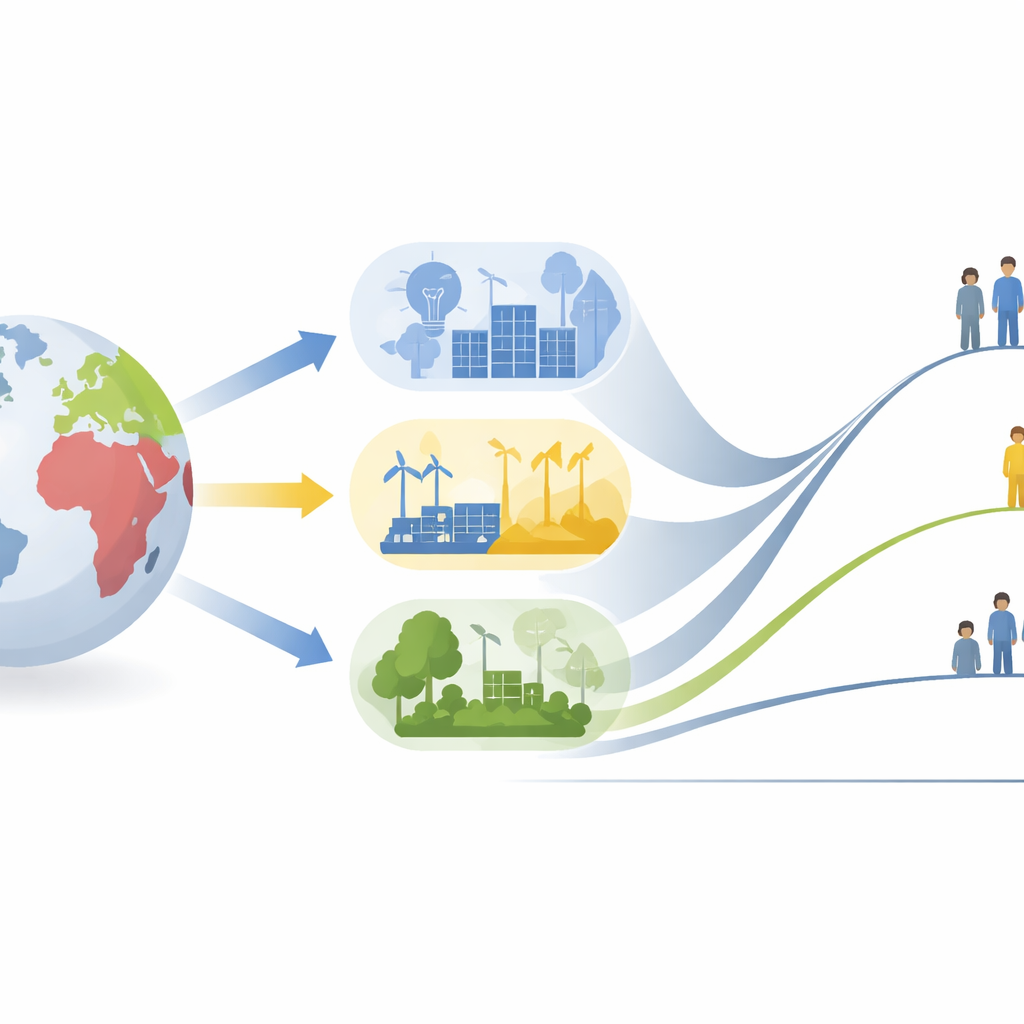
The study focuses on “distributional justice,” a term that simply refers to how benefits and burdens are shared. Philosophers have long debated what a fair outcome looks like. Some say the goal is to increase total well‑being, others want to lift up those who are worst off, and still others care that everyone has enough or that nobody has too much. The authors group these views into five patterns of justice: making the total better for everyone together; giving extra weight to improvements for poorer groups; bringing everyone closer to the same level; guaranteeing a basic minimum; and setting an upper limit so consumption does not spiral out of control. Crucially, they show how each of these patterns can be represented as simple lines over time—trajectories of things like energy use or meat consumption in different world regions.
Turning Moral Ideas into Model Pathways
Climate researchers use large computer models to simulate how energy systems, land use, and the economy might evolve under different policies. These models produce time‑series data—trajectories—for many variables in each region of the world. The authors translate the five justice patterns into concrete mathematical tests applied to these trajectories. For example, a “prioritarian” outcome is one where regions that currently have low access to energy or low meat consumption see faster improvements than better‑off regions. An “egalitarian” outcome is one where gaps between regions shrink. “Sufficientarian” and “limitarian” outcomes are those in which everyone rises above a chosen floor or stays below a chosen ceiling. This approach lets researchers scan existing model results and ask: which kinds of fairness, if any, are these futures actually following?
What Today’s Climate Futures Assume About Fairness
The authors apply their framework to hundreds of scenarios from the database used in the latest UN climate assessment. They look in particular at regional patterns of energy use for housing, energy use for transport, and meat consumption, and they group scenarios by broad mitigation strategies such as cutting energy demand, expanding renewable energy, or relying heavily on carbon removal technologies. They find that most scenarios are consistent with at least one justice pattern for these variables. The most common is the prioritarian pattern: many futures assume that currently poorer regions increase their energy or meat consumption more rapidly than richer ones. Egalitarian and “everyone‑has‑enough” patterns also appear in many cases, sometimes in combination, suggesting that models often embed several overlapping notions of fairness at once.
Where Our Models Fall Short
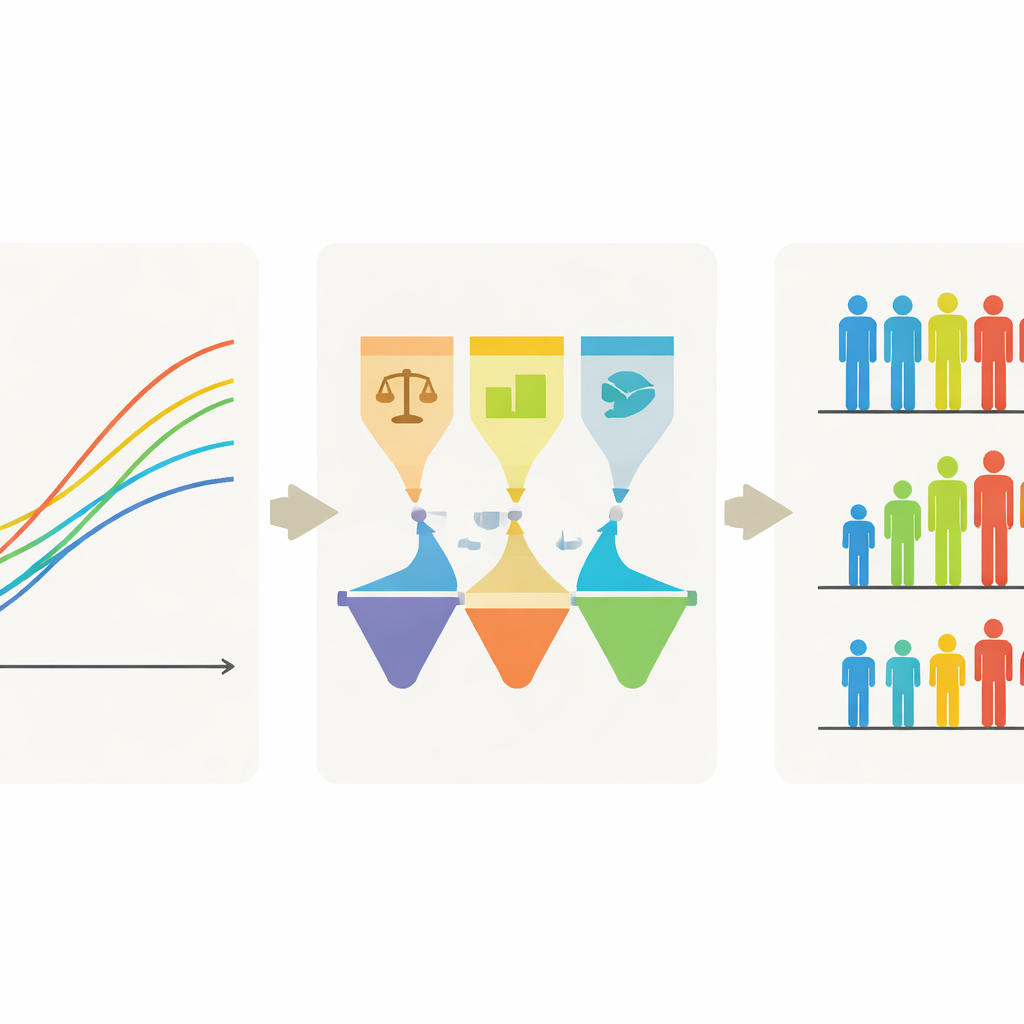
One striking gap is that almost no scenario explores futures where energy or meat consumption is kept below clear upper limits. In other words, “limitarian” worlds—where societies decide that there should be a ceiling on certain kinds of consumption—are rarely modeled, even though medical and environmental research provides strong reasons to consider limits on meat intake and on very high levels of energy use. The study also shows that a scenario can reflect a fairness pattern for one variable, such as transport energy, but not for another, like household energy. Overall, the patterns that emerge are strongly shaped by the shared storylines that many modeling teams use about future population and economic growth, rather than by deliberate choices to represent specific moral principles.
Building Fairness In From the Start
To help align climate planning with public notions of fairness, the authors propose using their framework not just to analyze existing scenarios, but to co‑create new ones with stakeholders. By showing people clear, visual representations of different future trajectories—for instance, how regional energy access might rise under different justice patterns—researchers can ask which paths seem most fair and why. These preferences can then guide how new scenarios are designed. The main takeaway for non‑experts is that low‑carbon futures can be shaped to respect many different ideas of fairness, and that our current tools are flexible enough to do so. What matters is making those value choices explicit and involving a wider range of voices in deciding which fair futures are worth aiming for.
Citation: Scheifinger, K., Brutschin, E., Mintz-Woo, K. et al. Exploring patterns of distributional justice in global climate change mitigation scenarios. npj Clim. Action 5, 39 (2026). https://doi.org/10.1038/s44168-026-00364-4
Keywords: climate justice, mitigation scenarios, energy consumption, meat consumption, fair distribution