Clear Sky Science · en
The actors of building modernization in small municipal administrations and their challenges
Why Town Halls Matter for Climate Action
Across Germany, many schools, fire stations, and town halls are old, drafty, and expensive to heat. This study looks not at new technologies, but at the people inside small-town administrations who must actually plan and carry out building upgrades. By following local officials in a dozen municipalities in the German state of Hessen, the authors show who really drives modernization of public buildings, which obstacles they encounter, and why better rules, organization, and support may be just as important as better insulation or solar panels.
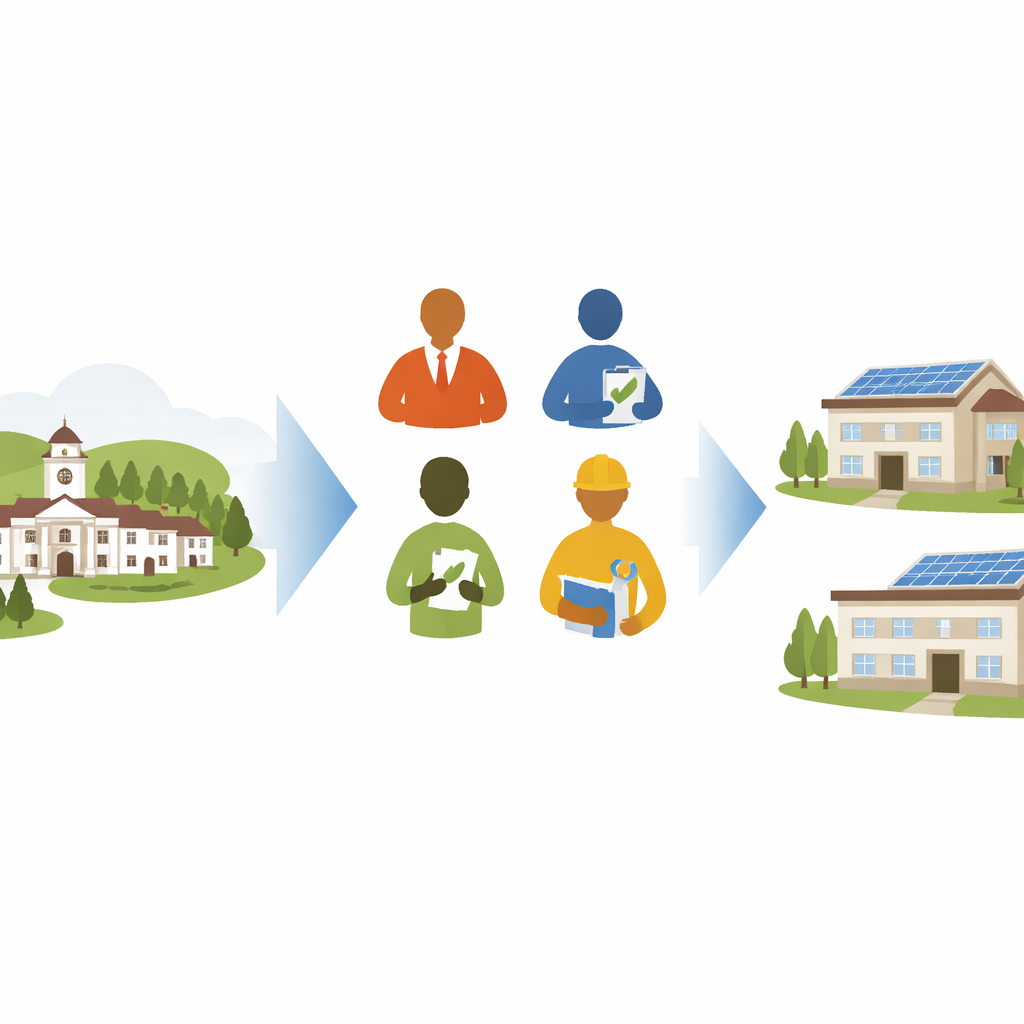
Who Runs the Show in Small Town Halls
The researchers worked closely with 12 small and medium-sized municipalities, observing meetings and co-developing ideas with local politicians and administrators. They focused on buildings owned or used by municipalities, such as community centers, schools, and offices. Rather than assuming that “the municipality” is a single actor, they mapped the different roles involved in planning and implementing building upgrades. This people-centered view reveals how responsibilities are spread across political leaders, generalist staff, climate coordinators, and technical experts.
Four Types of Local Problem-Solvers
The team identified a simple but powerful typology of actors. First are mayors and other top administrators, who decide how important modernization is compared with other local needs and how staff and budgets are allocated. Second are “jack-of-all-trades” generalists, common in very small towns, who handle a bit of everything—from building permits to citizen services—but often lack deep technical knowledge about construction or energy use. Third are climate managers, a relatively new role funded by higher levels of government in many places; they typically coordinate climate activities across departments and may link long-term goals with concrete projects. Fourth are building specialists—architects and engineers within the administration—who bring technical know-how but may be less familiar with political bargaining or complex funding rules. In some cases, one person combines several of these roles.

Obstacles Beyond Bricks and Boilers
When the researchers asked these local actors about their biggest hurdles, most did not start with technical issues like insulation thickness or boiler choice. Instead, they highlighted governance challenges. Officials struggle to keep up with constantly changing laws, funding programs, and requirements for expert assessments. Many older buildings lack reliable plans or digital records, making it hard to plan upgrades. Funding itself is a maze of short-lived programs, complex applications, and co-financing rules that small towns with tight budgets and few staff find hard to navigate. Even if money is available, it may not cover the extra personnel needed to prepare and manage projects over several years.
Why Capacity, Trust, and Time Are in Short Supply
Staff shortages run through the story. In small administrations, one person’s parental leave or illness can halt modernization plans for months. Day-to-day tasks—such as maintaining existing buildings or delivering legally required services—tend to crowd out long-term planning. Internal decision chains can be slow, especially if cooperation between administrators and elected officials is marked by mistrust. At the same time, small municipalities often own many scattered buildings, including cherished but aging community centers in formerly independent villages, which are politically hard to close or demolish. All this pushes towns toward piecemeal repairs instead of strategic upgrades aligned with climate targets.
What This Means for Climate-Friendly Towns
In plain terms, the study shows that getting town halls, schools, and fire stations ready for a climate-neutral future is not just a matter of choosing the right insulation or solar panels. Success depends on whether small municipalities have the people, information, and stable rules they need to plan ahead. Certain local officials—especially well-connected “street-level” problem-solvers—can make remarkable progress by creatively combining funding sources, building alliances, and pushing climate-friendly projects despite limited resources. But relying on such “positive exceptions” is not enough. The authors argue that higher levels of government should design support and rules that fit the realities of small towns, rather than copying solutions from big cities or focusing only on technology. Tailor-made help with organization, funding, and knowledge could unlock a quieter but vital front line of climate action: the everyday work of modernizing public buildings in thousands of small communities.
Citation: Schoenefeld, J.J., Wasmer, A. The actors of building modernization in small municipal administrations and their challenges. npj Clim. Action 5, 35 (2026). https://doi.org/10.1038/s44168-026-00357-3
Keywords: municipal climate action, public building renovation, small towns, local governance, energy-efficient buildings