Clear Sky Science · en
Narrative and quantitative analysis of democratic principles in the Shared Socioeconomic Pathways
Why how we govern shapes the climate future
When people think about climate change, they often picture smokestacks, solar panels, or electric cars—not parliaments, courts, or voting booths. Yet this study shows that the kind of political systems we build, and how fair and responsive they are, strongly influences whether we can cut emissions and protect people from climate impacts. By digging into the global scenarios that guide major reports like those of the Intergovernmental Panel on Climate Change (IPCC), the authors ask a simple but overlooked question: where is democracy in our visions of the future?
Stories we tell about the future
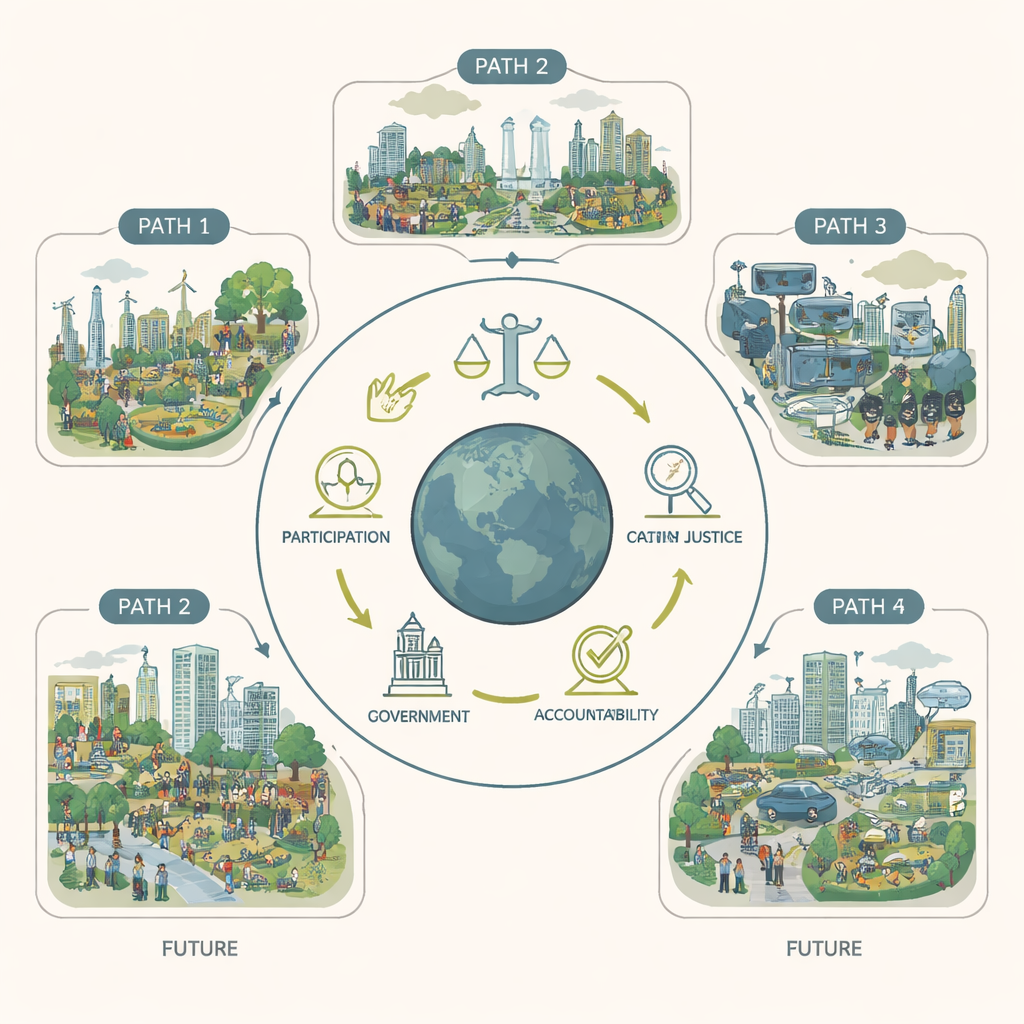
Climate researchers use a set of “Shared Socioeconomic Pathways” (SSPs) to imagine how the world might develop this century. Each SSP is a narrative about society—richer or poorer, more cooperative or more divided—which then feeds into computer models of emissions and temperature. The authors use a narrative analysis approach to read these storylines as political tales: Who has power? Who participates? Who benefits? They find that only one pathway, a sustainability-focused future known as SSP1, consistently paints a world with high public participation, fair representation, accountable institutions, and strong attention to justice. Others either present a slow, complacent democracy, slide toward authoritarianism and conflict, or depict highly unequal societies where elites call the shots and many people are effectively shut out of decisions.
Numbers that don’t match the stories
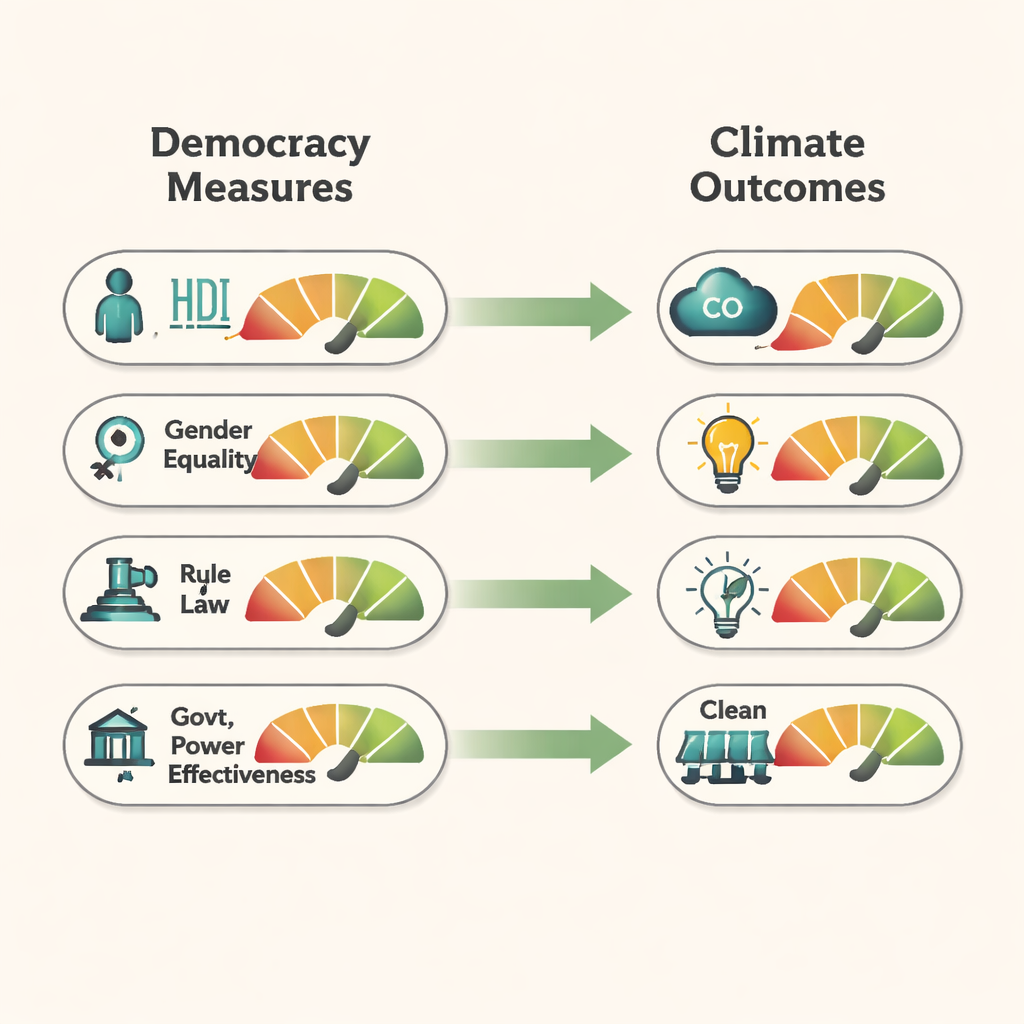
Beyond storylines, the SSPs also provide numbers—projections of education, income, governance quality, inequality, and more—for use in climate models. The authors match several of these indicators to basic democratic principles such as participation (proxied by human development and education), representation (gender equality), accountability (rule of law and corruption control), effectiveness (government performance), and justice (income inequality and extreme poverty). They then track how these measures change from 2020 to 2050 across the five SSPs. Surprisingly, most of the indicators improve in almost every future, even in those that were written to show democratic backsliding, rising inequality, or mounting conflict. In other words, the numbers often tell a rosier story about democracy than the text that supposedly defines each pathway.
What better democracy means for climate action
To see how politics and climate outcomes might move together, the authors combine these democracy-related measures with mitigation results from the IPCC’s Sixth Assessment Report scenario database. They look at broad world regions and ask whether places that start with stronger human development, greater gender equality, firmer rule of law, lower corruption, and more effective governments tend to perform better on climate tasks like cutting carbon dioxide emissions, improving energy efficiency, and expanding clean power. Across many scenarios that follow the more mainstream SSPs (especially SSP1, SSP2, and SSP5), regions with higher scores on these democratic indicators generally make deeper emissions cuts and more progress on efficiency, while weaker or less democratic regions lag behind. The picture is less clear for pure fairness measures such as income inequality and extreme poverty, suggesting that justice is harder to capture in current models.
Gaps in our climate imagination
These results reveal a double blind spot. First, most of the widely used future pathways quietly assume that societies will become more educated, better governed, and in some respects more equal—even when their narratives describe nationalism, authoritarianism, or deep social divides. Second, the climate models that build on these pathways rarely treat politics as something that can change the pace or shape of the transition in explicit ways. Instead, governance quality shows up only indirectly through background data. The authors argue that this leaves out plausible futures where democracy could falter, where participation and justice drive ambitious action, or where effective but unjust regimes pursue climate policies that deepen social harm.
What this means for everyday citizens
For non-specialists, the message is straightforward: democracy is not a distracting side issue—it is one of the engines of real climate progress. Places that protect rights, encourage participation, limit corruption, and give voice to women and other underrepresented groups are, in today’s evidence and in these scenarios, more likely to cut emissions and modernize their energy systems. Yet the standard tools guiding global climate planning still underplay these political dynamics and sometimes assume an unrealistically smooth path toward better governance. The authors call for closer collaboration between political scientists and climate modellers to build scenarios where institutions, participation, and justice are treated as central design choices, not background noise. Such richer futures would help policymakers and citizens see that defending and deepening democracy may be one of the most powerful climate strategies we have.
Citation: Xexakis, G., Spatharidou, D., Bala, I. et al. Narrative and quantitative analysis of democratic principles in the Shared Socioeconomic Pathways. npj Clim. Action 5, 24 (2026). https://doi.org/10.1038/s44168-026-00351-9
Keywords: climate governance, democracy, Shared Socioeconomic Pathways, climate policy, institutional quality