Clear Sky Science · en
The forest carbon paradox: novel insights into China’s forest-economy-emissions relationships
When More Trees Don’t Mean Less Carbon
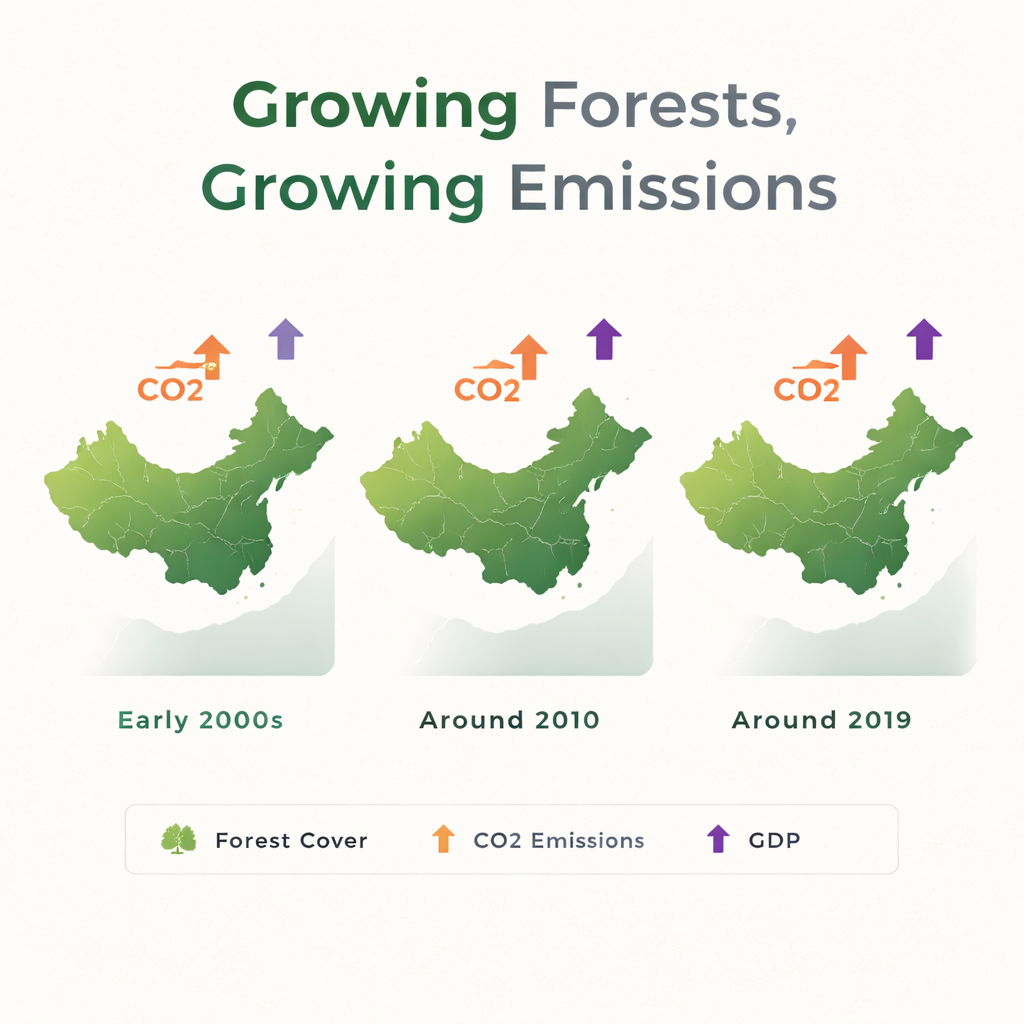
Planting trees is often promoted as a simple fix for climate change: grow enough forests, the story goes, and they will soak up the carbon dioxide pouring out of our factories, power plants, and cars. This study looks closely at that idea in China—a country that has planted trees on a massive scale over recent decades—and finds a surprising result: even as forests have expanded dramatically, carbon emissions and the economy have continued to rise in ways that tree planting alone has not yet been able to counter.
China’s Big Tree-Planting Experiment
Since the late 1970s, China has launched some of the largest forest programs on Earth, turning farmland and barren areas into new woodlands and protecting existing trees. As a result, the share of land covered by forest has climbed from under 9% in the 1950s to more than 23% by 2020. These efforts are now tightly linked to China’s climate pledges: forests are being folded into carbon markets, where landowners can, in principle, sell “forest carbon” as a tradable asset. The authors saw China as a natural testing ground for a key question: does rapidly expanding forest area actually show up, in the near term, as lower carbon emissions for the country as a whole?
How Forests Grow Versus How Economies Burn Energy
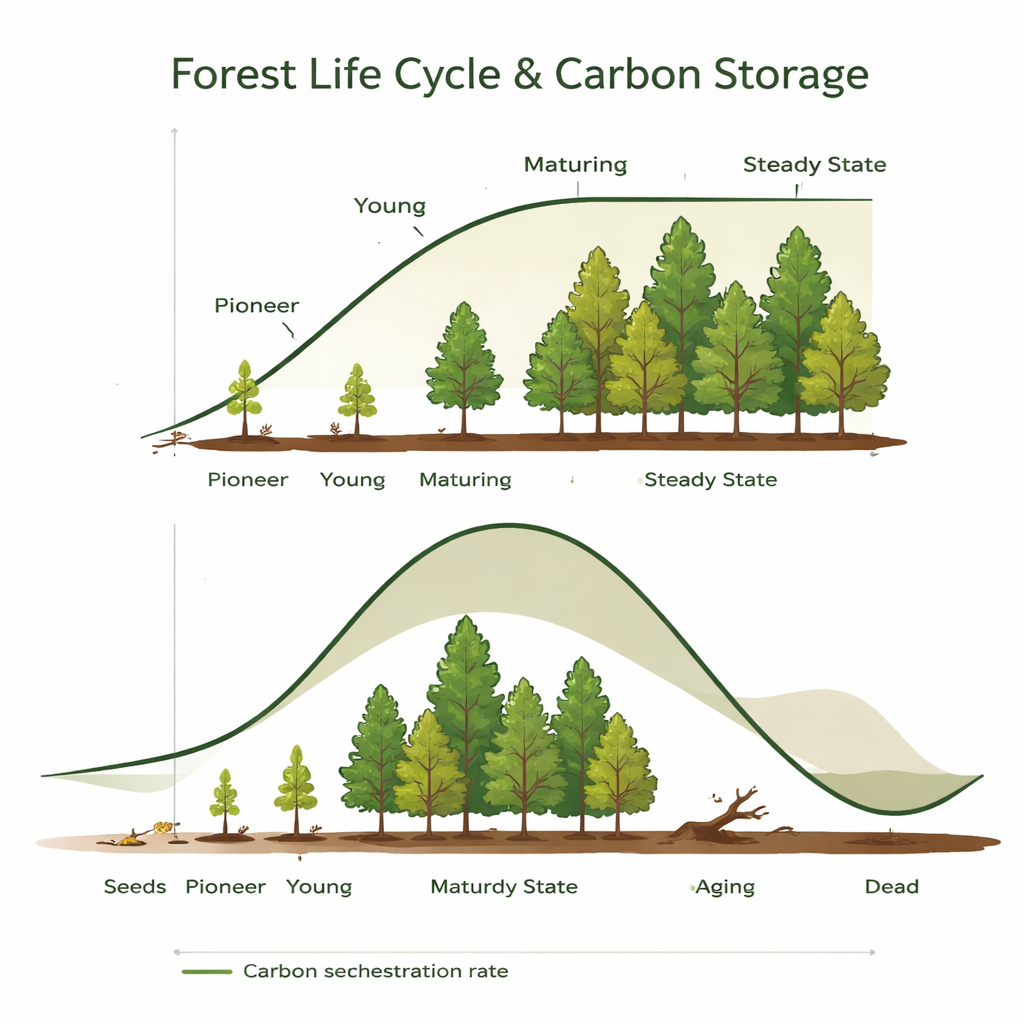
One important complication is biological time. A forest does not absorb carbon at a steady pace from the moment it is planted. Young, fast-growing stands take up carbon quickly, older forests slow down, and disturbances such as fire, logging, or drought can suddenly release decades of stored carbon. The researchers highlight this life-cycle pattern to stress that more forest area today does not automatically translate into big, immediate climate benefits. At the same time, emissions from coal, oil, gas, and electricity use can surge within just a few years when heavy industry or cities expand. This mismatch—slow, uneven forest growth versus rapid, energy-driven pollution—lies at the heart of what the authors call the “forest carbon paradox.”
What the Data Say About Trees, Emissions, and Growth
Using information from 30 Chinese provinces between 2000 and 2019, the team fed economic statistics, energy use, forest coverage, and carbon emissions into advanced prediction models. These models are designed to pick out which factors matter most for explaining changes in emissions and gross domestic product (GDP). The clear winners were energy variables, especially electricity and natural gas use, followed by fuels like gasoline. When these were included, the models could reproduce emissions and GDP with very high accuracy. Forest coverage, in contrast, contributed almost nothing to improving the predictions: even provinces that dramatically increased forest area still saw their emissions and economies rise sharply.
Who Drives Whom: Causality in the System
To move beyond simple correlations, the authors used a causal analysis method that looks for time-lagged cause-and-effect links across provinces. They found that higher energy use pushes GDP upward, and that GDP and emissions influence one another over time. The most striking result concerned forests: changes in emissions strongly “predicted” later changes in forest coverage, but not the other way around. In other words, when emissions rose and environmental concerns mounted, policies to expand forests tended to follow—but newly planted forests did not quickly push emissions down. This pattern suggests that forest growth has mainly been a response to pollution and policy priorities, rather than a force that is yet reshaping the country’s carbon trajectory.
Rethinking Forests in Climate Policy
The authors conclude that China’s forests are building up long-term potential to store carbon, but that expecting them to deliver rapid, large-scale cuts in emissions is unrealistic under current conditions. Forest-based carbon credits risk overstating near-term climate benefits if they treat new forest area as an instant offset to fossil fuel use. For policymakers and the public, the message is twofold: protecting and expanding forests remains vital for the climate and many other reasons, but it must be paired with swift changes in how energy is produced and consumed. In simple terms, planting trees can help with climate change in the long run, but it cannot substitute for burning less coal, oil, and gas today.
Citation: Sheng, Z., Zhang, K., Ling, C. et al. The forest carbon paradox: novel insights into China’s forest-economy-emissions relationships. npj Clim. Action 5, 26 (2026). https://doi.org/10.1038/s44168-026-00350-w
Keywords: forest carbon paradox, China afforestation, carbon emissions, energy consumption, carbon markets