Clear Sky Science · en
Assessing claims of counterproductivity of Just Stop Oil’s civil disobedience
Why noisy climate protests matter to everyday life
In recent years, colorful and sometimes infuriating climate protests—from blocking roads to throwing soup at famous paintings—have become hard to ignore. This article digs into one of the best-known groups behind such actions in the UK, Just Stop Oil, and asks a simple question with big consequences: do these headline‑grabbing stunts actually backfire, turning people and politicians against climate action, or do they quietly help keep the issue on the agenda?
A new way to judge if protests backfire
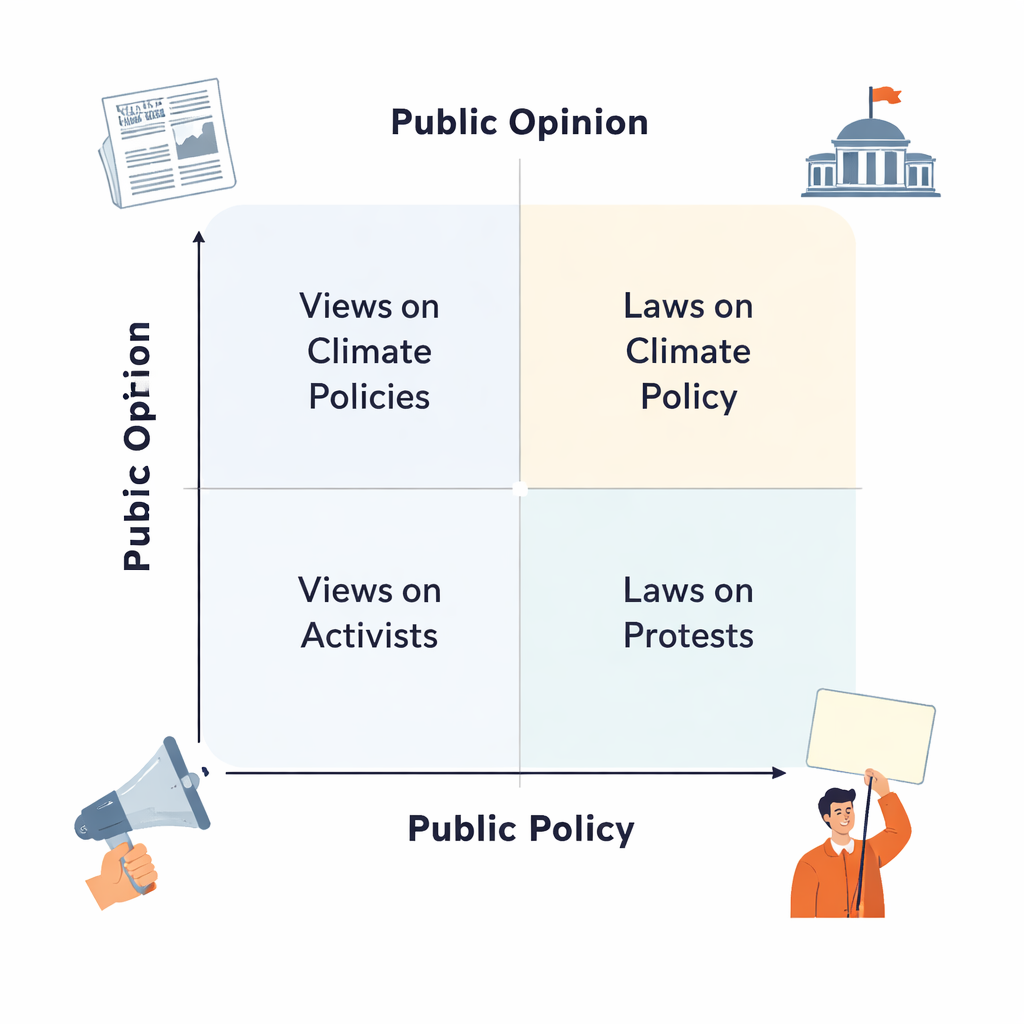
The authors propose a straightforward framework for thinking about whether a protest movement is “counterproductive.” They suggest looking along two axes: public opinion and government policy, and then asking about two things in each: attitudes and rules about the movement’s specific demand, and attitudes and rules about the climate movement more broadly. In practice, that means asking four questions: do protests turn people against climate policies like Net Zero? Do they sour people on climate activists in general? Do they lead to weaker climate laws? And do they invite tougher crackdowns on protest itself?
Massive attention, muddled message
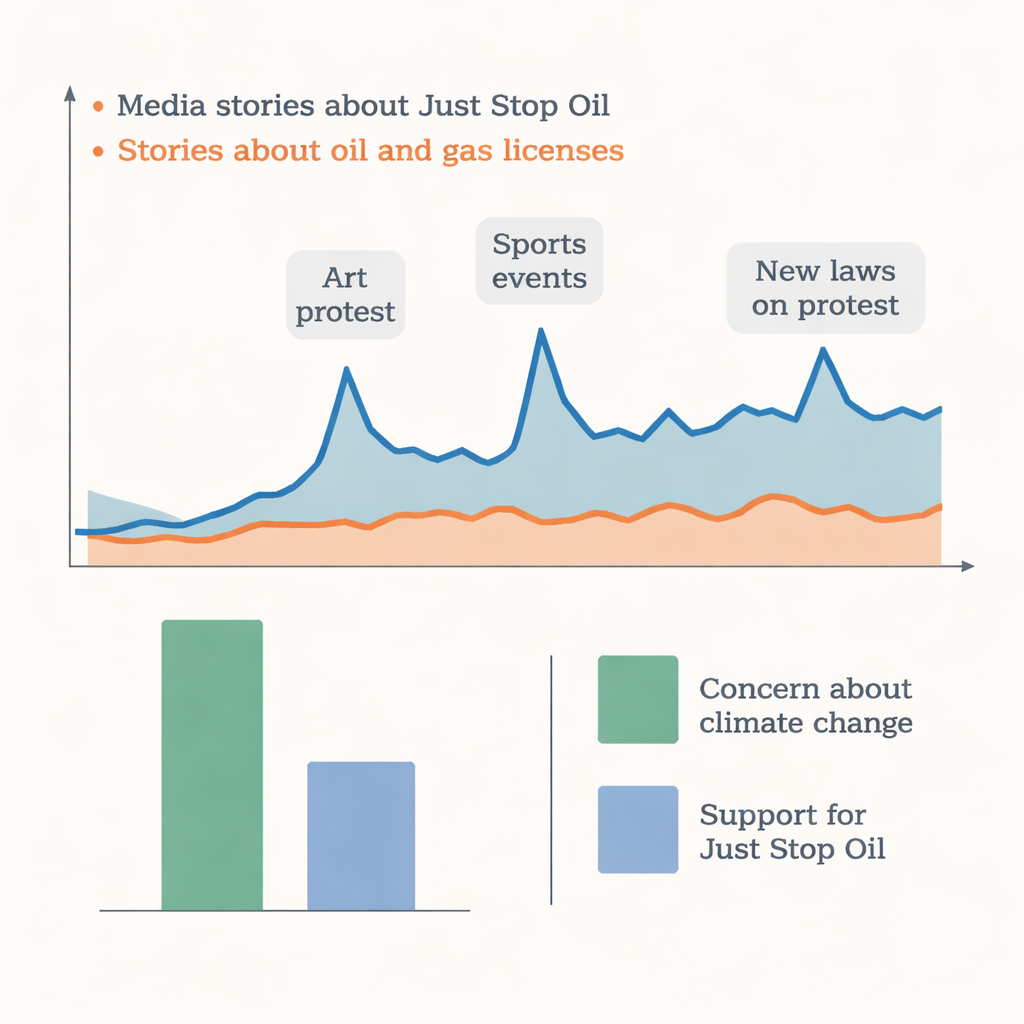
To answer these questions, the researchers combined media analysis with public opinion surveys from 2022 to 2025. They show that Just Stop Oil, a small group demanding a halt to new oil and gas licences in the North Sea, managed to dominate UK press coverage of climate activism. Their actions—like throwing soup at Van Gogh’s Sunflowers or stopping major sporting events—produced sharp spikes in newspaper stories and far more mentions than long‑established groups such as Greenpeace or Friends of the Earth. Yet this visibility came at a cost: coverage focused heavily on disruption, crime, and “mayhem,” especially in right‑leaning papers that labelled activists “eco‑zealots” and worse. Over time, journalists quoted activists less and angry bystanders, politicians, and business owners more, making it harder for the group to explain what it actually wanted.
Raising the right issue, but not winning hearts
Despite the hostile tone, the protests did help push one specific topic into the news: new oil and gas licences. Mentions of Just Stop Oil in the press rose and fell in step with stories about North Sea licences, suggesting that their actions helped make this once‑technical policy question something the public heard about. However, surveys showed that only a tiny share of people could correctly describe the group’s main demand. Many assumed they wanted to shut off all fossil fuels overnight. At the same time, concern about climate change in Britain stayed high and stable, while Just Stop Oil itself remained deeply unpopular—liked by only a small minority of the public, with strong political divides between left‑ and right‑leaning voters.
Politics, punishment, and protest crackdowns
The study also examines how protests interacted with party politics and new “law and order” measures. The Conservative government repeatedly used Just Stop Oil as a symbol of extreme environmentalism, arguing that new protest powers and long jail sentences were needed to control them, and portraying Labour as being on the activists’ side. Public support for a temporary expansion of North Sea oil and gas grew, but the authors argue this was more likely driven by government messaging about energy security and Russia’s war in Ukraine than by the protests themselves—especially since most people did not know what the group was demanding. While earlier surveys found limited support for harsh penalties on non‑violent disruption in general, later polls that mentioned Just Stop Oil by name revealed much greater backing for jailing its activists, showing how a disliked group can make tough laws easier to sell.
So, did these protests do more harm than good?
Overall, the authors conclude that Just Stop Oil’s disruptive tactics were not the climate disaster that many commentators claimed—but they were not a clear success either. The group did not turn the British public against climate science or Net Zero goals, and current policies still include a ban on new North Sea oil and gas licences. At the same time, the protests did little to increase support for specific climate measures or for the activists themselves, and they may have helped justify tougher anti‑protest laws. For everyday readers, the take‑home message is that loud, inconvenient protests can raise the profile of climate issues without necessarily changing minds—and that how the media chooses to tell the story can matter as much as what protesters actually do or say.
Citation: Berglund, O., Davis, C.J. & Finnerty, S. Assessing claims of counterproductivity of Just Stop Oil’s civil disobedience. npj Clim. Action 5, 27 (2026). https://doi.org/10.1038/s44168-026-00347-5
Keywords: climate protest, public opinion, media coverage, civil disobedience, climate policy