Clear Sky Science · en
Red flags in green promises: a framework for identifying greenwashing risk in corporate climate pledges
Why bold climate promises may not be what they seem
All around us, big companies are announcing “net-zero” or “carbon neutral” goals, suggesting they are doing their part to fight climate change. This study asks a simple but vital question: how many of those promises are actually backed up by real action, and how many amount to clever marketing? By examining climate pledges from more than 4,000 firms worldwide, the authors offer one of the clearest pictures yet of how widespread climate-related greenwashing may be—and what warning signs the public, investors, and regulators should watch for.
Looking under the hood of green claims
Instead of treating “greenwashing” as a vague buzzword, the researchers build a concrete checklist for judging corporate climate promises. They focus on seven straightforward “red flags”: no short-term goals to guide long-term promises, failure to include supply‑chain and product‑use emissions (known as Scope 3), lack of a public plan, heavy or poorly explained use of carbon offsets, incomplete coverage of greenhouse gases, lobbying against climate policy, and a lack of real progress toward stated targets. Using data from CDP disclosure forms, the Net Zero Tracker, and the lobbying watchdog InfluenceMap, they score 4,131 companies from multiple regions and sectors on each of these points. 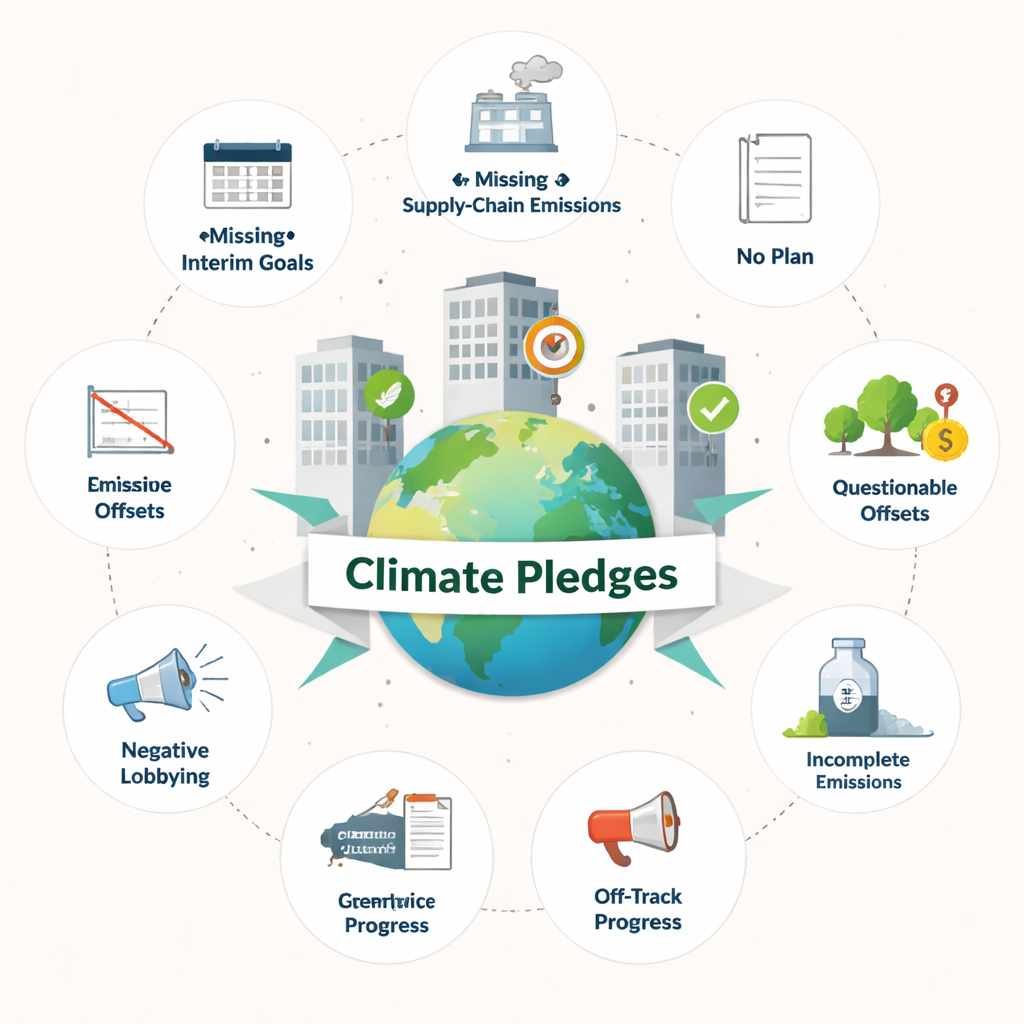
Red flags almost everywhere
The findings are stark. Of the 3,574 firms that have made some kind of climate pledge, 96 percent show at least one red flag. The most common weakness is leaving out Scope 3 emissions—often the bulk of a company’s climate footprint—with about 70 percent failing to fully cover them. Many also lean on questionable carbon offsets, have no interim milestones, lack a transition plan, or show little progress toward their own goals. Net‑zero claims, which sound especially ambitious, are not necessarily better: while these companies are somewhat more likely to include Scope 3 emissions, they are also more likely to rely on offsets and to lack detailed plans. In other words, a bolder headline pledge does not guarantee a cleaner underlying strategy.
Patterns across regions and industries
Greenwashing risk turns out to be a global problem, not confined to a few “bad actors.” Companies in Europe and the Global South have slightly fewer red flags, but even there about 95 percent of pledging firms show at least one warning sign. North American and East Asian firms fare marginally worse, with around 97 percent showing problems, and higher rates of missing interim targets, heavy offset use, and negative lobbying in North America in particular. Sector differences are also striking. Fossil fuel and metals and mining companies have the highest greenwashing risk, driven by offset dependence, failure to count value‑chain emissions, and lobbying against climate rules. But even relatively “clean” sectors like retail, information technology, and services still show red flags for roughly 95 percent of firms, often tied to gaps in Scope 3 coverage and planning.
How ambition, money, and lobbying fit together
One might expect that more ambitious targets or better performance would clearly separate sincere climate leaders from greenwashers. The data tell a subtler story. When the authors look at whether a company shows any red flag at all, ambition and progress make almost no difference—the predicted chance of having at least one issue is above 99 percent across the board. However, when they zoom in on individual warning signs, some patterns emerge. Companies with steeper planned emission cuts are less likely to ignore Scope 3 emissions or to lobby against climate policies. Higher‑revenue firms are somewhat less likely to lack plans or to report incomplete gas coverage, perhaps because they have more resources for detailed accounting. Crucially, firms flagged for anti‑climate lobbying are also more likely to lack solid plans and to lean on dubious offsets, suggesting that obstructive policy behavior and weak internal action often go hand in hand. 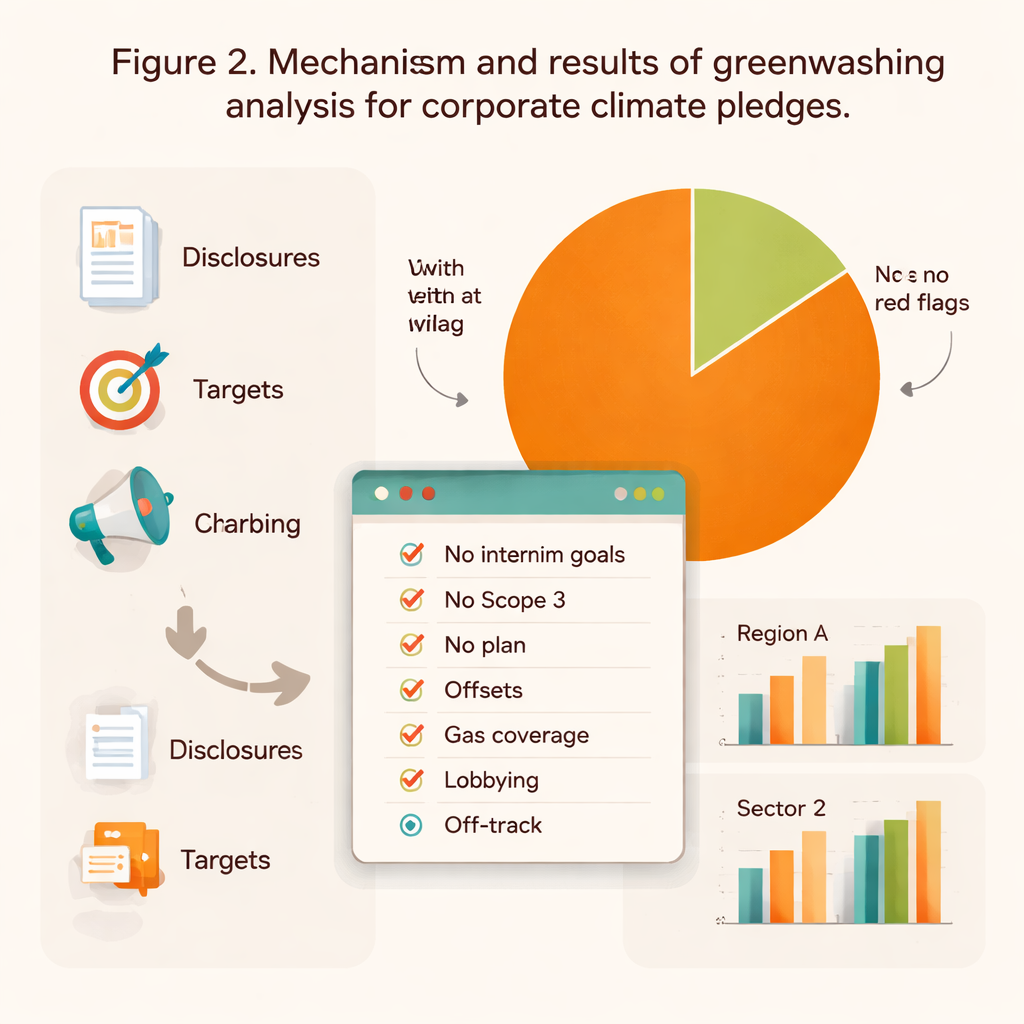
What this means for climate watchdogs and the public
For non‑experts trying to judge whether a company’s climate promises are trustworthy, the study offers both a warning and a toolkit. The warning is that almost every major company with a climate pledge still shows at least one meaningful gap between words and deeds, especially around hidden supply‑chain emissions, overuse of offsets, and behind‑the‑scenes lobbying. The toolkit is the seven‑point checklist itself: ask whether a firm has near‑term goals, covers its whole value chain, publishes a clear plan, relies narrowly on high‑quality offsets, counts all key greenhouse gases, avoids lobbying against climate action, and is actually cutting emissions on schedule. The authors argue that regulators are beginning to turn these questions into law, especially in Europe and other jurisdictions cracking down on unverified green claims. They suggest that as standards tighten and enforcement improves, some of today’s red flags may fade—but only if pledges are treated not as advertising slogans, but as promises that must be backed by transparent, measurable action.
Citation: Brown, E., Hsu, A. & Manya, D. Red flags in green promises: a framework for identifying greenwashing risk in corporate climate pledges. npj Clim. Action 5, 19 (2026). https://doi.org/10.1038/s44168-026-00346-6
Keywords: greenwashing, net-zero pledges, corporate climate action, carbon offsets, scope 3 emissions