Clear Sky Science · en
Stakeholder preferences and perceived effectiveness of coastal adaptation measures in Seychelles
Why This Island Story Matters
For many people, beaches and palm-fringed bays are places of escape. For the people of Seychelles, a low-lying island nation in the Indian Ocean, they are home—and they are under threat from rising seas. This article looks at how the people responsible for protecting Seychelles’ coasts weigh different options, from concrete walls to restored wetlands. Their views reveal why some defences feel reassuring in the short term but may prove risky or costly over time, and why working with nature is gaining ground as a promising way to live with a changing ocean.
Rising Seas, Limited Space
Seychelles is made up of more than 100 islands, with most people, roads, and key services squeezed onto narrow strips of low-lying coast. Sea-level rise and stronger coastal floods are expected to grow much worse during this century. Without effective action, many more people and buildings could be exposed to flooding. Yet space is limited by steep mountains and protected forests, money and technical staff are scarce, and tourism pressures make it hard to move buildings away from the shore. In this tight setting, every shoreline decision—whether to build a wall, add sand, or restore mangroves—carries long-term consequences for safety, livelihoods, and local nature.
Three Ways to Hold Back the Sea
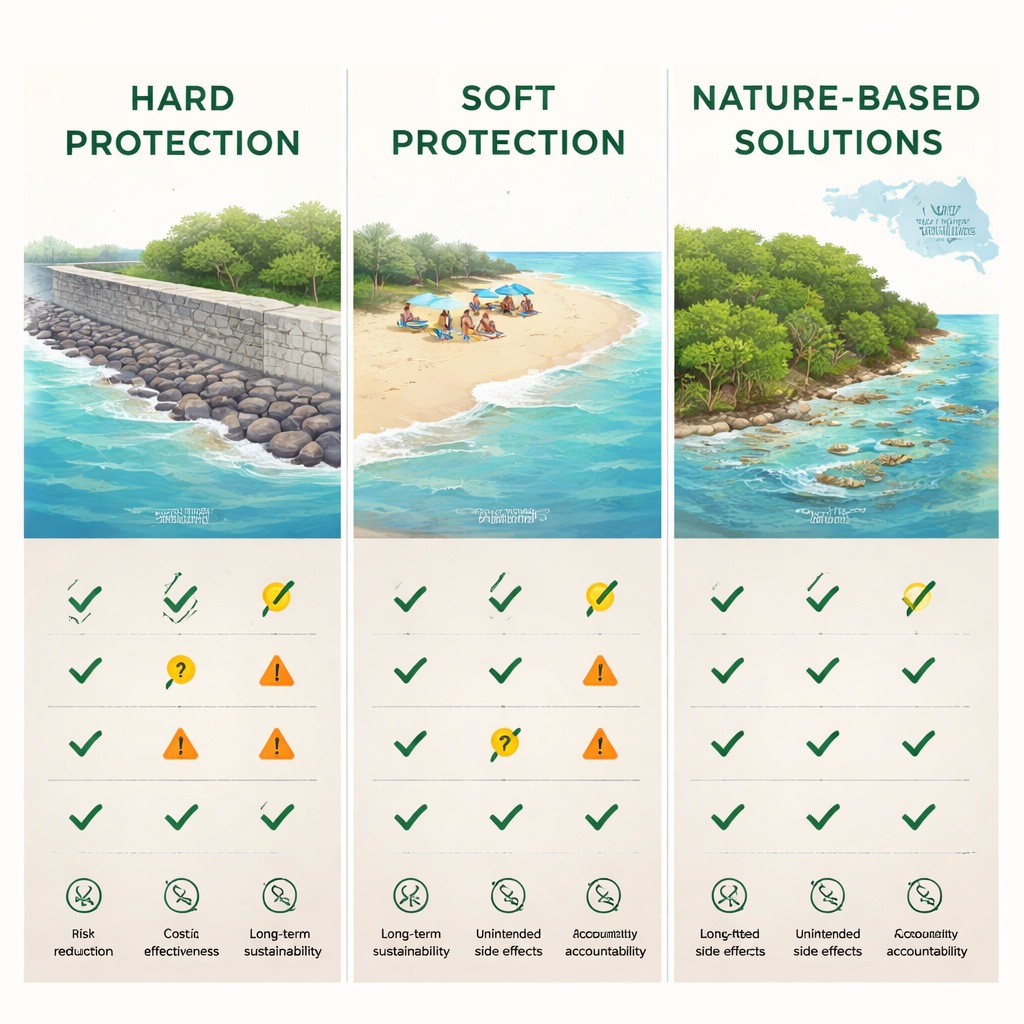
The study is based on in-depth interviews with 19 people who work directly on coastal adaptation in Seychelles, including government officials, non-profit staff, scientists, and private consultants. The researchers asked these stakeholders to compare three broad types of measures. “Hard” protection includes engineered structures such as seawalls and rock armouring. “Soft” protection covers measures like beach nourishment and timber piling that add or rearrange sand without massive concrete. “Nature-based solutions” draw on ecosystems such as wetlands, mangroves, and coral reefs to absorb wave energy. To move beyond simple cost or damage numbers, the team organised people’s answers into five down-to-earth questions: Does it cut risk? Is it worth the money? Will it last? Can it backfire? And who can be held to account?
Quick Fixes Versus Lasting Change
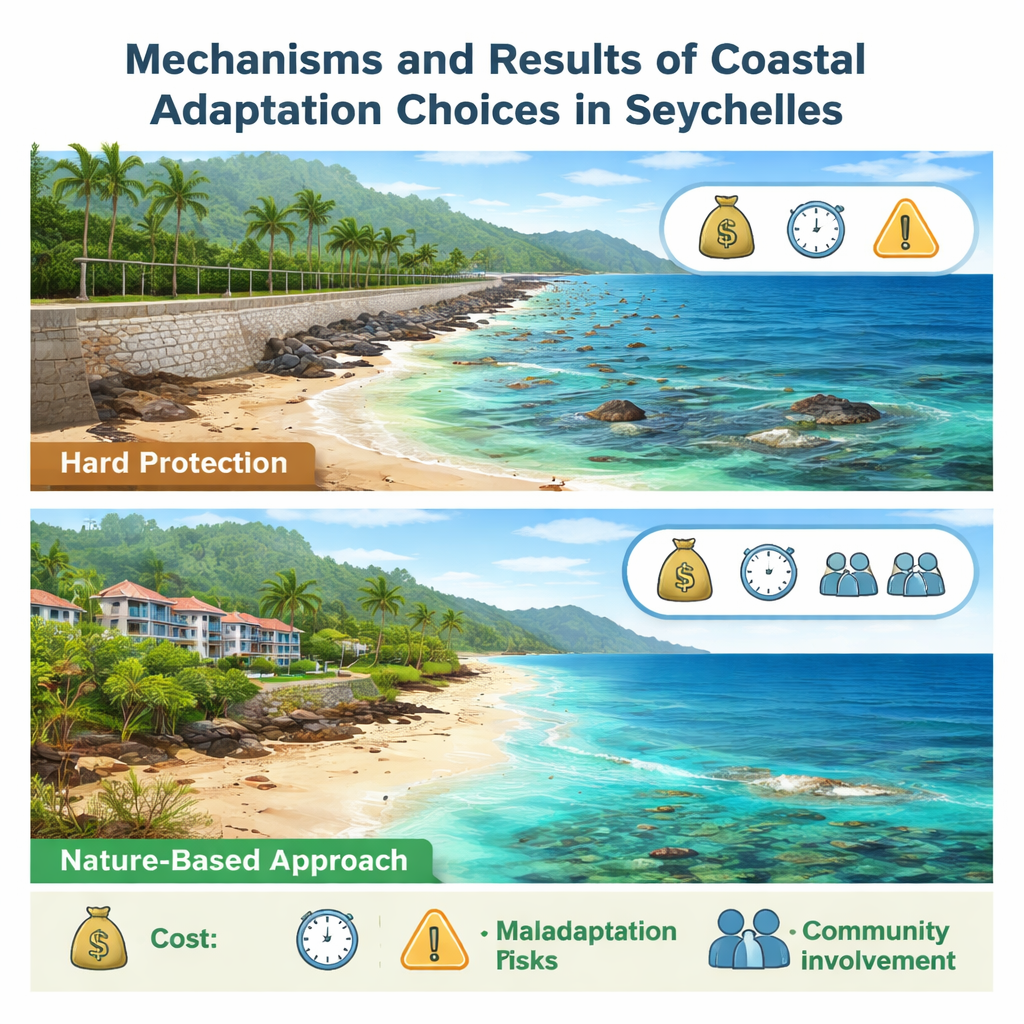
Stakeholders widely praised hard protection for one reason: it feels immediately effective. A seawall or rock barrier is visible, solid, and gives a strong sense of security when waves are already biting at homes and roads. This made such structures the most popular choice for cutting short-term flood risk. Yet the very same measures were also the most heavily criticised. Interviewees pointed to high construction costs, dependence on imported materials, frequent damage within a few years, and troubling side-effects such as worsening beach erosion or blocking stormwater from draining back to the sea. Soft measures attracted little enthusiasm; many interviewees saw them as too fragile for exposed coasts and too short-lived to justify the effort, especially when money and technical skills are limited.
Working With Nature—and With People
Nature-based solutions drew more mixed but often hopeful reactions. Many stakeholders viewed restored wetlands, mangroves, and coral reefs as the most sustainable option in the long run. They highlighted benefits that go beyond flood protection: healthier ecosystems, better water quality, wildlife habitat, and projects that invite community involvement. People also associated these measures with clearer responsibilities and easier local organisation. At the same time, several interviewees worried that such approaches act too slowly to handle urgent threats, and noted that some nature-based projects faded when external funding or expert support ended. These tensions led some to suggest hybrid approaches that blend natural features with carefully designed structures as a way to balance speed, cost, and long-term resilience.
Hidden Obstacles Behind the Shoreline
When asked about what really holds back better adaptation, stakeholders focused less on engineering and more on institutions. They pointed to over-stretched government staff, gaps in data, weak coordination between departments, unclear rules, and chronic funding shortages. Social issues such as limited public awareness, land ownership disputes, and uneven access to information also played a role, but were mentioned less often. Many respondents called for stronger organisations, better planning frameworks, and more education rather than new technologies. Throughout, they drew heavily on local observations—watching how particular beaches, walls, or wetlands had behaved over years—showing that lived experience is central to how they judge what “works.”
What This Means for Island Futures
In simple terms, the article concludes that there is no single best way to protect Seychelles’ coasts from rising seas. Concrete walls may buy time and reassure people today, but they can be expensive, short-lived, and sometimes make problems worse. Nature-based options look more promising for the long haul and enjoy strong public appeal, yet they do not always deliver instant protection. The study argues that future plans should be shaped not only by technical models and global guidelines, but also by the grounded knowledge of those who live and work along the shore. By listening carefully to these perspectives, Seychelles and other small islands can design smarter mixes of hard, soft, and nature-based measures that keep people safe while respecting the limits of their coastlines.
Citation: Weishaupt, J., Kuhn, A., Baatz, C. et al. Stakeholder preferences and perceived effectiveness of coastal adaptation measures in Seychelles. npj Clim. Action 5, 16 (2026). https://doi.org/10.1038/s44168-026-00345-7
Keywords: sea-level rise, coastal adaptation, nature-based solutions, small island states, Seychelles