Clear Sky Science · en
Differences in government support for private sector climate change adaptation in developing versus developed countries
Why this research matters for coastal communities
For many tropical coastal communities, healthy coral reefs are more than beautiful scenery—they are the foundation of local jobs, tourism income, and protection from storms. As climate change drives mass coral bleaching and stronger cyclones, reef-based tourism operators are scrambling to adapt. This study asks a practical question with global relevance: when climate disasters hit, what kind of government help actually reaches small tourism businesses, and does that support look different in developing versus developed countries?
Who was studied and what the researchers asked
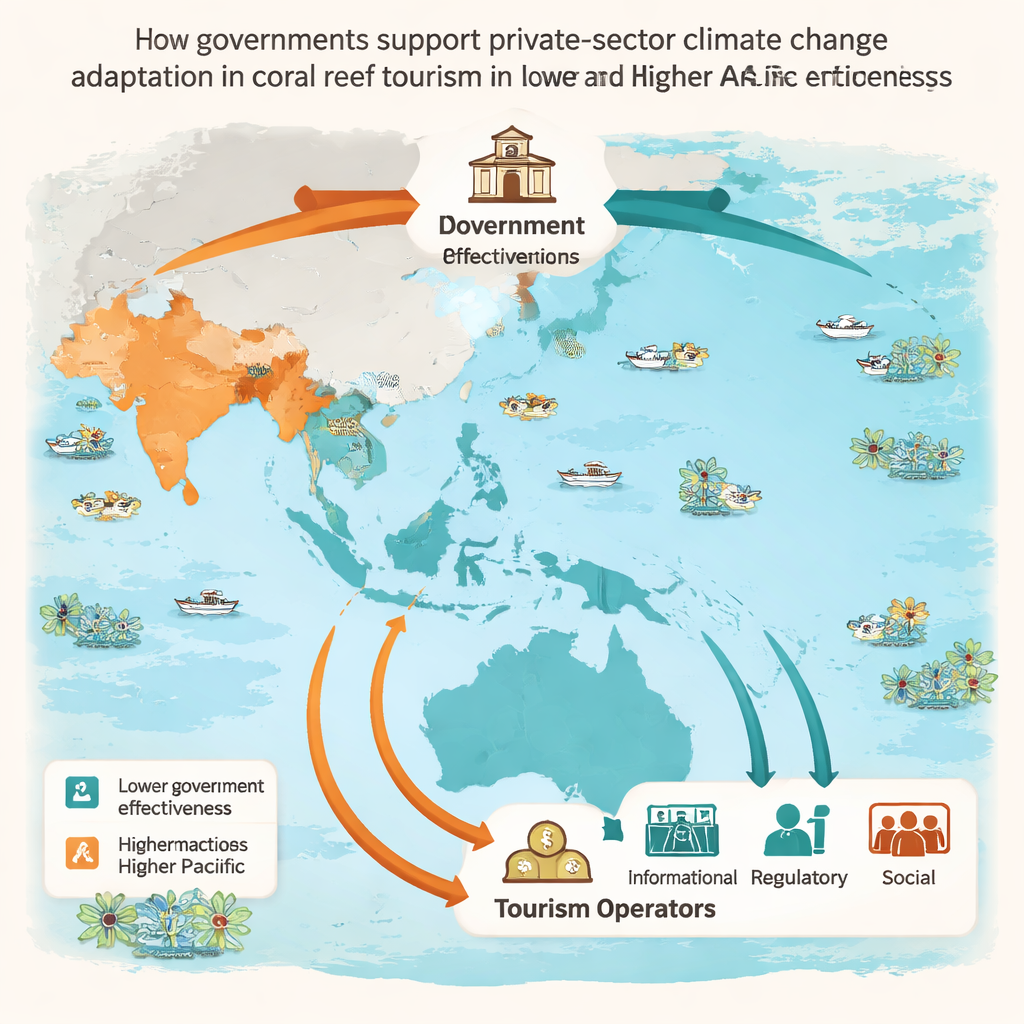
The authors surveyed 231 coral reef tourism operators—ranging from small dive shops to larger tour companies—across eight Asia-Pacific locations, including both developing and developed countries. All of these businesses had direct experience with climate impacts on reefs, either from mass coral bleaching or from tropical cyclones. The team asked two main things: first, what types of government actions did operators actually receive after these events, and did those actions help or hinder their ability to adapt? Second, what kinds of support did operators wish their governments had provided? To keep the focus on real-world decisions, support was grouped into everyday categories like financial help, information and training, infrastructure, marketing, social programs, and rules or regulations affecting reefs and coastal development.
How much help businesses really got
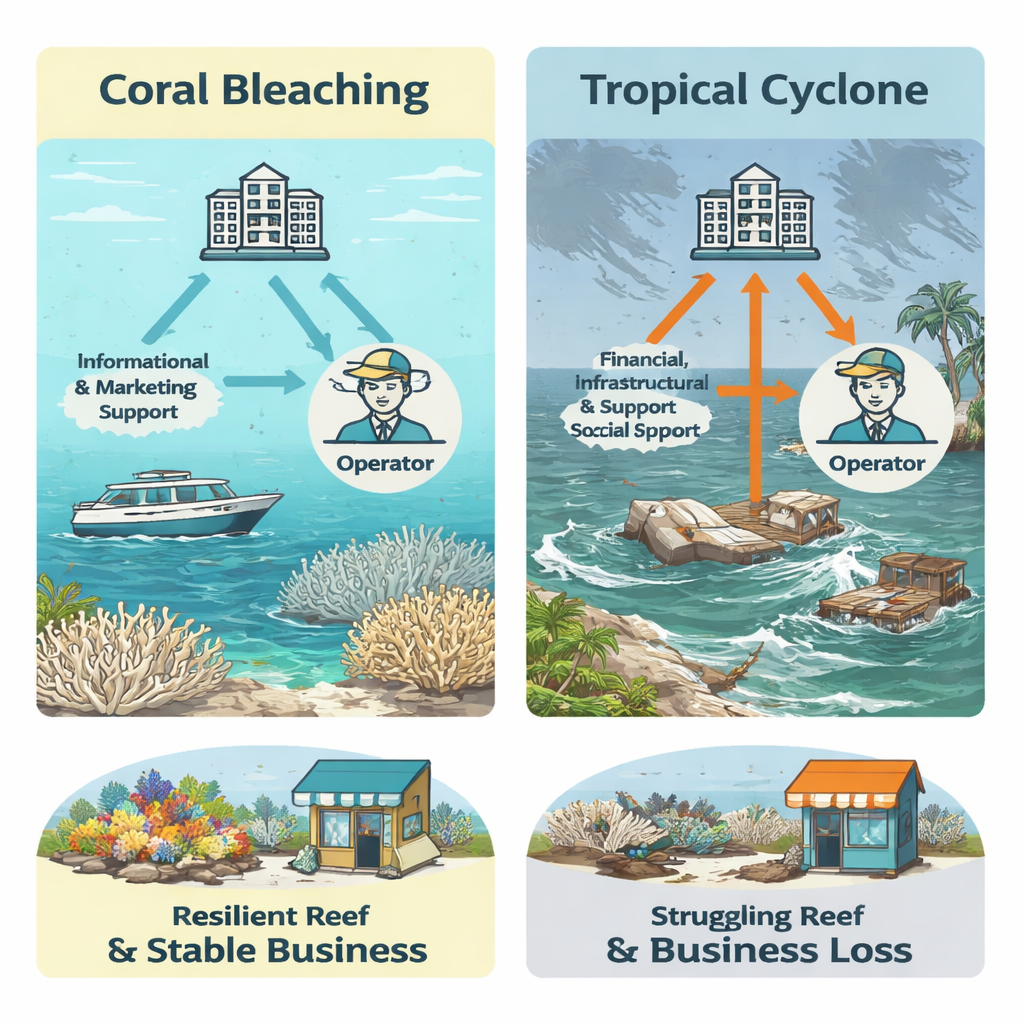
The study reveals that for coral bleaching, government help was limited. Only about 29% of operators whose reefs bleached said they received any helpful support, and the most common forms were information—such as seminars or reef monitoring programs—and tourism marketing. In contrast, three-quarters of operators affected by tropical cyclones reported receiving some form of useful support, often in the form of promotional campaigns, infrastructure repairs, or new rules to manage damaged areas. Even so, many operators hit by cyclones felt financial assistance lagged far behind the scale of damage. Across both types of events, some government actions even backfired: for example, intense media focus on reef damage, supported by official science messaging, scared away visitors, while rapid growth in low-cost tourism created extra pressure on already stressed reefs.
Surprising patterns between rich and poorer countries
Conventional wisdom suggests that businesses in developing countries are left with less government backing when climate disasters strike. Surprisingly, this study found the opposite for this sector: reef tourism operators in countries with lower overall government effectiveness were more likely to report receiving some helpful support, especially information and basic social assistance. However, these same operators also expressed a stronger desire for deeper, longer-term changes—especially better rules to protect reefs and control land-based pollution, and more systematic restoration of damaged coral. In wealthier countries with stronger institutions, many of these protections and programs already exist in the background, which may explain why operators there said they needed less new informational and regulatory support. The results suggest that what is missing in many developing countries is not immediate contact with government, but a solid institutional foundation—a strong "enabling environment" for ongoing adaptation.
Who gets help and what kind of help they want
The analysis also shows that support is not distributed evenly. Operators with closer ties to reef-related government agencies were much more likely to receive help of any kind, regardless of how badly their reefs were damaged. By contrast, the businesses that asked for more help tended to be those that suffered the most severe impacts, or those hit by intense cyclones who needed financial relief to stay afloat. Many operators in poorer countries called for stronger in-water rules, such as limiting boat numbers, illegal fishing, and damaging water sports, and on-land controls on sewage, rubbish, coastal construction, and other pollution. Cyclone-affected operators highlighted the need for tax breaks, grants, duty-free imports for rebuilding, and support for reef restoration work. Together, these answers paint a picture of governments that respond most readily where relationships are already strong, rather than where damage is greatest.
What this means for climate adaptation
To a layperson, the core message is straightforward: government help for climate-hit small businesses is often too little, unevenly shared, and not always shaped by those who suffer most. For coral reef tourism, quick fixes like information campaigns or short-term financial aid matter, but they are not enough on their own. The study suggests that lasting adaptation will depend on building fairer and more consistent systems—strong rules that protect reefs, reliable information before and after disasters, and funding that reaches the most affected operators rather than just the best connected. In developing countries especially, pairing targeted climate support with long-term institutional reforms could make the difference between a tourism industry that slowly collapses as reefs decline and one that learns, adjusts, and continues to support coastal communities in a warming world.
Citation: Bartelet, H.A., Barnes, M.L., Bakti, L.A.A. et al. Differences in government support for private sector climate change adaptation in developing versus developed countries. npj Clim. Action 5, 20 (2026). https://doi.org/10.1038/s44168-026-00343-9
Keywords: coral reef tourism, climate change adaptation, government support, developing vs developed countries, cyclones and coral bleaching