Clear Sky Science · en
A blockchain-based carbon registry platform for credible climate action in transportation
Why tracking climate promises really matters
Many cities and companies now promise to slash their greenhouse gas emissions. But how can we tell whether those promises are real progress or just clever accounting? This paper presents a new digital platform, built on blockchain technology, that aims to make climate promises in transportation more trustworthy, easier to verify, and harder to fake. By following New York City’s transportation emissions over several decades, the authors show how better tracking and clear credibility scores can push climate action from slogans to results. 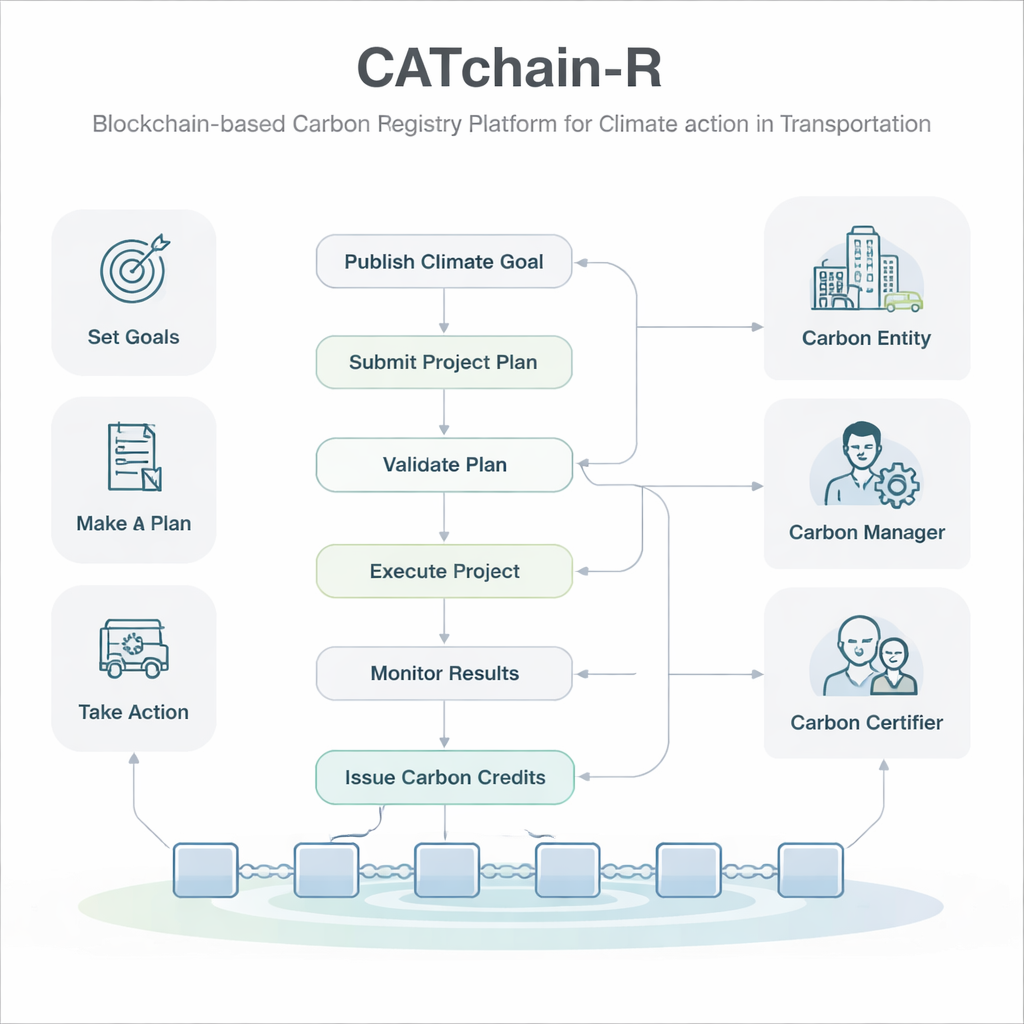
Promises, plans, and real-world action
To fight climate change, governments and businesses set carbon goals (what they aim to cut), make carbon plans (how they will do it), and carry out carbon actions (what they actually implement and report. Today, these steps are usually logged in scattered documents and checked by auditors hired by the very projects they review, which raises concerns about weak verification, possible double counting of emission cuts, and limited public transparency. The authors argue that climate promises should be judged not just by what is pledged but by what is delivered, and that this requires a clearer, shared record of goals, plans, and outcomes across time.
A digital ledger for climate accountability
The proposed platform, called CATchain-R, uses a permissioned blockchain to act as a tamper-evident registry for climate action in transportation. In plain terms, it is a shared digital ledger where every key step—setting a yearly emission target, registering a project (such as electrifying buses), validating its design, monitoring performance, and issuing carbon credits—is time-stamped and stored in a way that is very hard to alter after the fact. Instead of project developers choosing and paying their own auditors, the registry itself selects independent experts and uses smart contracts—pieces of code that execute rules automatically—to run objective checks. This design aims to lower conflicts of interest, increase transparency, and ensure that carbon credits truly correspond to measured reductions.
Turning climate performance into a trust score
Beyond record-keeping, CATchain-R assigns each participating entity a “carbon credibility index” that works like a trust score. This index blends hard numbers, such as how fast emissions are actually falling, whether projects are completed on time, how fully annual goals are specified, and how open the reporting is, with expert judgments about innovation, community impact, and alignment with global climate standards. Using a well-known decision method to weigh these factors, the system turns many pieces of information into a single score. That score then controls how many tradeable carbon credits an entity receives versus how much is held back in a shared safety buffer, so consistent, truthful performance is directly rewarded.
What New York City’s transport emissions reveal
To show how this works in practice, the authors simulate New York City’s transportation emissions from 2005 to 2050 under two futures. In a “business as usual” path, emissions fall only slowly, roughly matching the city’s past reduction pace. In a “U.S.-aligned” path, cuts speed up to match national long-term climate goals. The model tracks how far each path sits above or below the target emissions each year. That gap is translated into tokenized carbon credits: when emissions stay above the target, the city must rely on more external credits to claim it has met its goal; when emissions fall below the target, fewer external credits are needed. 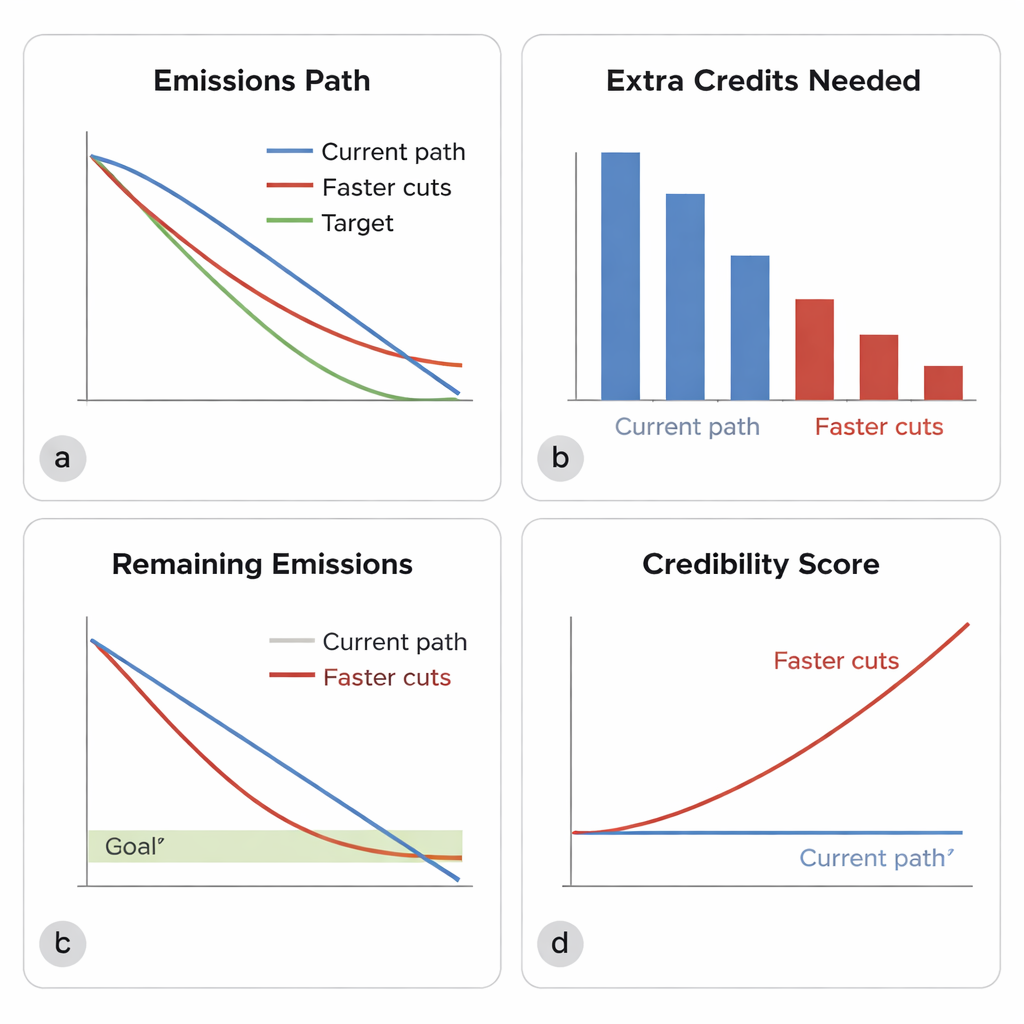
Why deeper cuts also build trust
The simulations show that under business as usual, New York City’s transportation emissions never reach the promised 80 percent cut by 2050, and the credibility index stays low because shortfalls keep piling up. The city would have to buy a growing volume of credits from elsewhere just to keep its climate claims alive. Under the U.S.-aligned path, emissions bend down much more sharply, the remaining share of emissions shrinks toward the target level, the need for external credits falls, and the credibility index rises steadily. In effect, the system sends a clear signal: relying on offsets cannot substitute for actually cleaning up local transport—only sustained, on-target reductions build a strong credibility score.
What this means for everyday climate action
For a layperson, the message is straightforward. This research shows how a carefully designed digital registry can make climate promises in transportation more honest and easier to compare, by tracking goals, actions, and outcomes year by year and turning that history into a clear credibility score. When that score also controls how many carbon credits an organization earns, it nudges cities and companies to deliver real emission cuts rather than just pay for paper fixes. If widely adopted, such systems could help turn climate pledges from hopeful statements into verifiable progress that the public can see and trust.
Citation: Liu, X., Bagchi, T., Sy, C.L. et al. A blockchain-based carbon registry platform for credible climate action in transportation. npj Clim. Action 5, 23 (2026). https://doi.org/10.1038/s44168-026-00342-w
Keywords: carbon credits, blockchain registry, transport emissions, climate accountability, New York City climate goals