Clear Sky Science · en
Inequality in PM2.5 Exposure and Health burden attributable in China
Why cleaner air does not help everyone equally
Fine particles in the air, known as PM2.5, are tiny enough to slip deep into our lungs and bloodstream, raising the risk of heart attacks, strokes, and other serious illnesses. China has launched some of the world’s most aggressive clean‑air campaigns and has dramatically cut these particles over the past decade. But this study asks a question that matters to anyone who cares about fairness: as the air gets cleaner on average, are the health benefits shared evenly, or are certain regions and communities still left breathing the dirtiest air — and paying the highest price?
Big progress in cutting dangerous particles
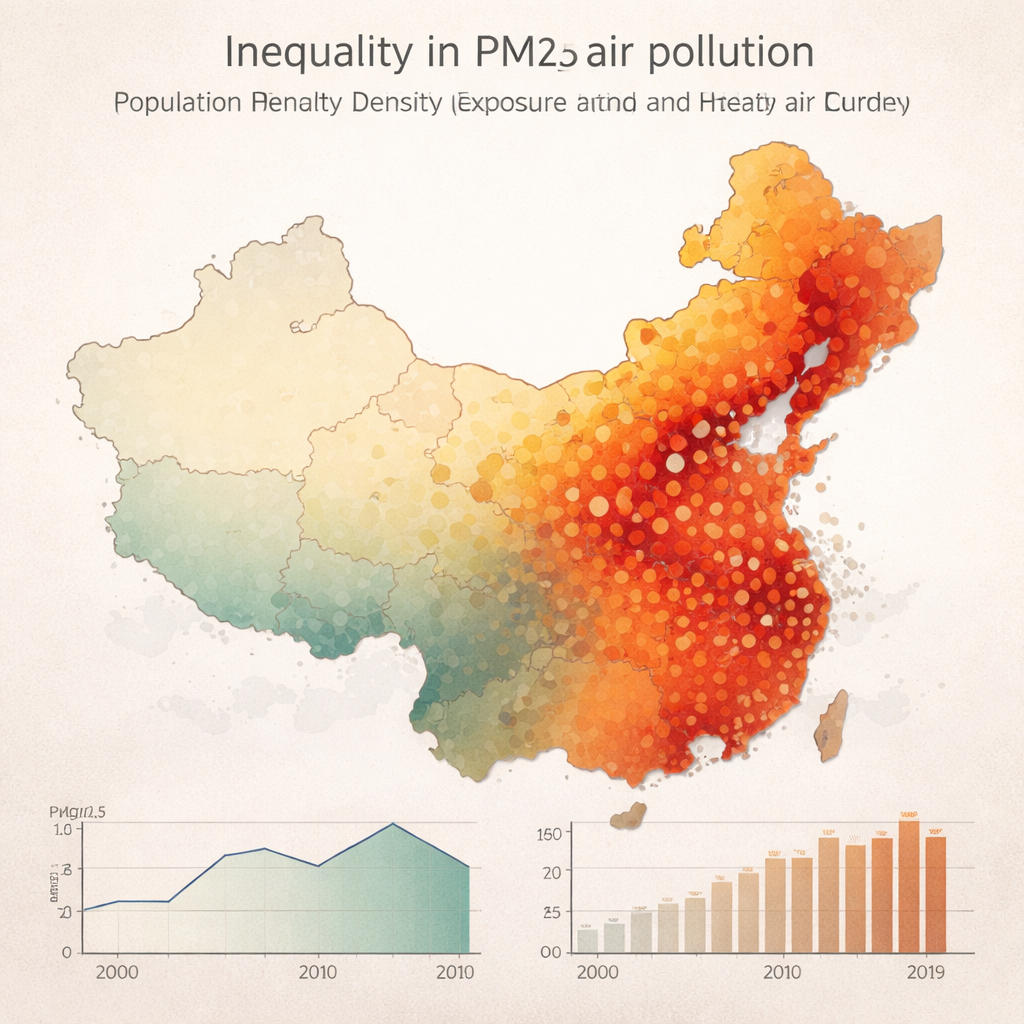
The researchers pieced together high‑resolution maps of air pollution, population, and deaths across China from 2000 to 2019. They focused on PM2.5, the fine soot and dust produced by burning coal, vehicle exhaust, industry, and biomass. Although the country’s population‑weighted average PM2.5 exposure in 2019 was still high at 38 micrograms per cubic meter — well above World Health Organization guidelines — it marked a sharp improvement. Levels had climbed from about 47 in 2000 to a peak of 66 in 2013, then dropped by 42% after major clean‑air actions began. By 2019, nearly half of China’s people were living in areas that at least met the country’s basic PM2.5 standard, up from just 5% in 2013.
Hidden health costs behind the averages
Behind these averages lie stark numbers: the study estimates that about 29 million premature deaths between 2000 and 2019 were linked to long‑term PM2.5 exposure. Stroke was the leading killer, followed by heart disease. When the team broke down what drove changes in these deaths over time, they found that pollution levels were the single biggest factor. Rising PM2.5 helped push deaths upward before 2013, while cleaner air after 2013 prevented an estimated 85,500 premature deaths, a 25% drop compared with what would have happened without the reduction. At the same time, China’s growing and aging population and changes in underlying health risks nudged the death toll upward, partially canceling out the gains from cleaner air.
Where you live shapes your risk
The study shows that where people live in China strongly shapes their exposure and health risk. Industrialized eastern provinces such as Henan, Hebei, Tianjin, and Beijing consistently had the highest PM2.5 levels, while southwestern regions such as Yunnan and Tibet were much cleaner. Using measures of inequality similar to those used for income, the authors found that PM2.5 exposure became more uneven over the two decades: the Gini coefficient for exposure rose, meaning pollution became more concentrated in certain areas. Differences between provinces and between cities accounted for the vast majority of this inequality, while most individual cities showed relatively even exposure among their own residents.
The burden of disease is becoming more unequal
Inequality was even clearer when the team examined deaths linked to PM2.5. High‑risk areas — mostly in eastern China and parts of Xinjiang — saw increasing premature mortality rates, while some northern and southwestern areas improved. The share of people living in very high‑risk zones, with more than 180 PM2.5‑related deaths per 100,000 people each year, jumped from less than 1% in 2000 to nearly one in five by 2019. Over the same period, a national inequality index for PM2.5‑related deaths climbed by almost 20%, showing that the health burden is becoming more polarized: some regions benefit greatly from cleaner air, while others remain trapped in a cycle of heavy pollution and vulnerable populations.
Making clean air fairer for everyone
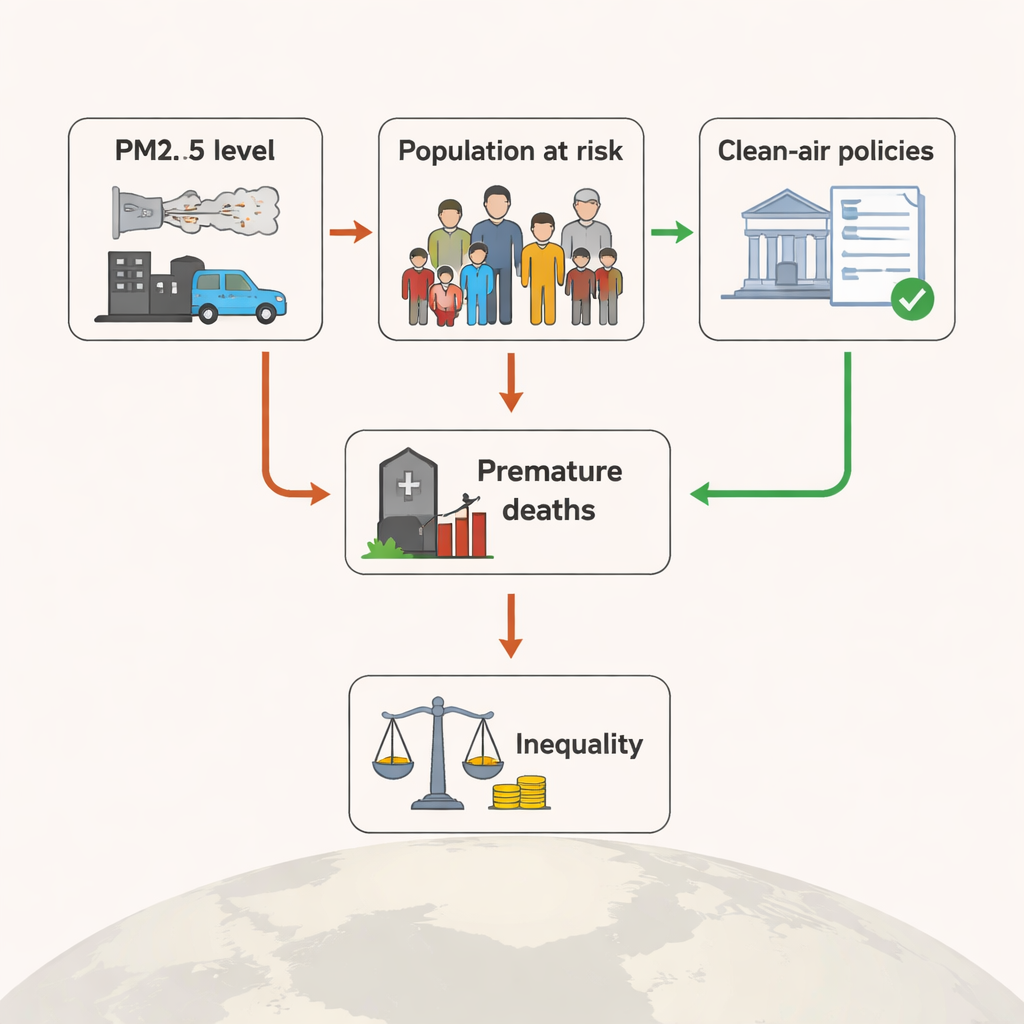
For a lay reader, the core message is that China has made remarkable strides in cutting air pollution and saving lives, but those gains are not shared equally. Older adults and residents of certain provinces and cities still face much higher risks of dying early because of the air they breathe. The authors argue that future clean‑air policies must not only push pollution levels down but also focus on the regions and groups bearing the heaviest burden, with tighter local emission controls, better health care, and stronger coordination between provinces. In short, cleaner air is possible — the challenge now is to ensure that every community, not just a fortunate few, can breathe it.
Citation: Xia, K., Huang, Z., Deng, Q. et al. Inequality in PM2.5 Exposure and Health burden attributable in China. npj Clim. Action 5, 14 (2026). https://doi.org/10.1038/s44168-026-00340-y
Keywords: air pollution, PM2.5, China, health inequality, premature mortality