Clear Sky Science · en
Mathematical and Ethical Considerations in Economics Modelling
Why the fine print in climate economics matters
When governments debate how fast to cut emissions or how high a carbon tax should be, they often lean on complex economic models. This paper shows that some of the quiet mathematical choices behind those models can drastically change what looks like an “optimal” climate policy—and, in doing so, can shift costs and risks onto future generations. Understanding these hidden assumptions is crucial for anyone who cares about climate justice, long‑term prosperity, and how science informs public decisions. 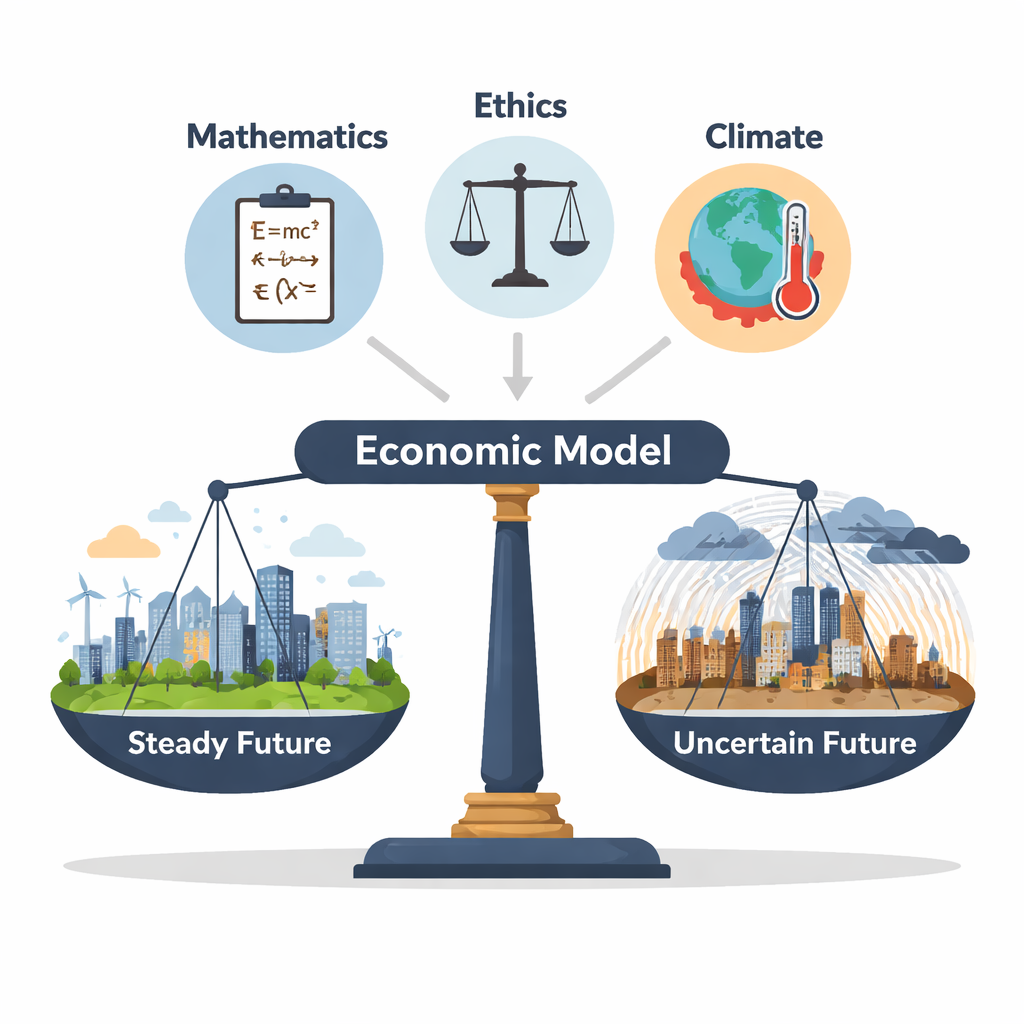
How climate and economy models try to pick the “best” future
Many influential climate–economy tools, such as integrated assessment models, are built on a framework called optimal control. In simple terms, these models imagine an economy that evolves over time, where decision makers choose policies—like carbon taxes or investment levels—to maximise a single number that represents “value” or “social welfare” over the long run. This way of thinking is deeply embedded in neoclassical economics. It often treats growth in measured output as a proxy for human well‑being and assumes that people or governments behave as value‑maximisers. The authors argue that such a narrow focus can already miss important questions of fairness, environmental limits, and human motivations.
Hidden assumptions about the distant future
The central technical issue the paper exposes is an often unspoken assumption: that the economy will eventually settle into a steady state—a stable pattern that does not explode or collapse. Many solution methods used in economics, especially Lagrangian techniques and what are known as Blanchard–Kahn conditions, effectively build this assumption in. The authors construct very simple, transparent mathematical examples to show that, for the same model, the “optimal” path under a forced steady‑state assumption can be completely different from the path you get if you simply ask, “What maximises value?” without requiring long‑run stability. In some cases, removing the stability requirement makes it mathematically attractive to push variables to extremes, leading to trajectories that grow without bound and bear little resemblance to a realistic or just economic path. 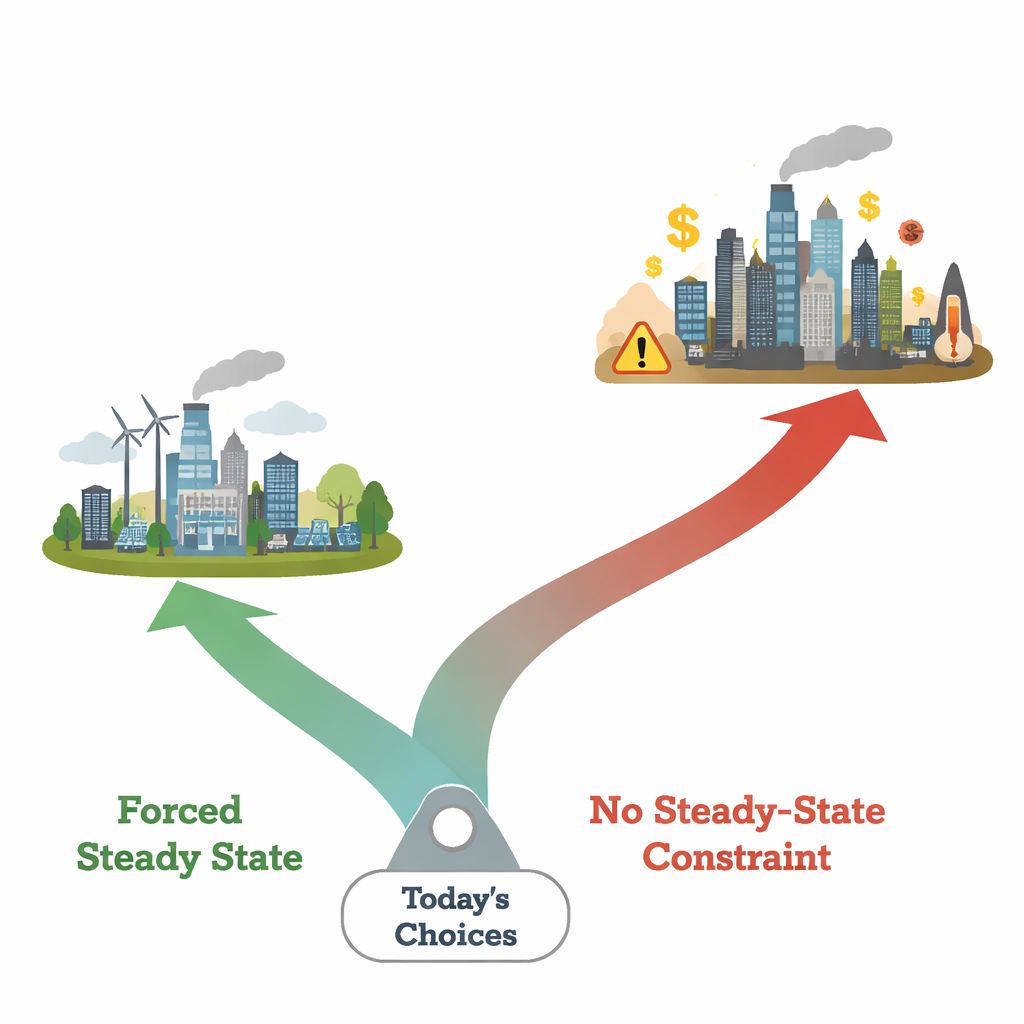
Discounting the future and intergenerational fairness
The paper also revisits a long‑running controversy in climate economics: discounting, the practice of valuing benefits and harms in the future less than those today. Discounting was originally introduced to make certain mathematical problems easier to solve, not because it was ethically justified. Yet, when applied to climate policy, even seemingly small discount rates can drastically reduce the weight given to people living decades or centuries from now. The authors review historical debates and recent surveys of economists, noting that many now favour very low—or even zero—pure time discounting when evaluating social policies. They stress that technical convenience is not a sound reason to treat future lives as less important, especially in a world already marked by deep inequality and environmental overshoot.
Why this challenges mainstream climate modelling
Beyond their own mathematical critique, the authors connect their results to broader concerns about standard climate–economy models. Such models often ignore how impacts and responsibilities are distributed across countries and social groups, treat environmental harm as a side effect that can be “priced in,” and assume that markets, individuals, and technologies behave in simplified, highly rational ways. Alternatives—such as agent‑based models, expert surveys, and diverse schools of economic thought—can capture uncertainty, social dynamics, and power imbalances more realistically, even if they are harder to calibrate or use for precise forecasts. The message is not to abandon modelling, but to recognise that models embody value judgments and to use them more humbly and transparently.
What it means for climate policy and public debate
For non‑specialists, the main takeaway is that the “optimal” climate policy emerging from a sophisticated economic model is only as sound as the assumptions buried inside it. If a model quietly assumes the economy must end up stable, or heavily discounts the welfare of future generations, it may recommend slower action on climate than justice or prudence would suggest. The authors call for clearer communication of these assumptions, more public and democratic involvement in defining what counts as value, and greater openness to economic approaches that prioritise precaution, equity, and collective well‑being over narrow efficiency. In a time of immense climate risks, they argue, we should treat economic models as tools for reflection and dialogue, not as oracles that dictate our shared future.
Citation: Hughes, T., Branford, E. Mathematical and Ethical Considerations in Economics Modelling. npj Clim. Action 5, 15 (2026). https://doi.org/10.1038/s44168-026-00338-6
Keywords: climate economics, integrated assessment models, discounting, intergenerational justice, economic modelling assumptions