Clear Sky Science · en
Charting our forest future: national supply curves for forest-based CO₂ mitigation
Why forests matter for our climate future
Forests already hold more carbon in their trees and soils than is currently floating in the air as CO₂. Yet we are still cutting them down, even as countries pledge to fight climate change. This study asks two simple but crucial questions: how much more CO₂ could the world’s forests realistically remove from the atmosphere, and what level of financial incentives would it take to unlock that potential in different countries?
Putting a price on forest carbon
To explore these questions, the authors used a global economic model of the timber sector that mimics how landowners respond to prices for wood and for carbon storage. They compared a future in which there is no specific reward for storing carbon in forests with futures where governments or markets pay increasing amounts per ton of CO₂ kept out of the air. The model tracks how landowners around the world might react: slowing deforestation, planting new trees on available land, and managing existing forests so they store more carbon for longer. It also respects physical limits on where trees can grow and how quickly forest area can expand, based on recent scientific estimates.
How much CO₂ forests could remove
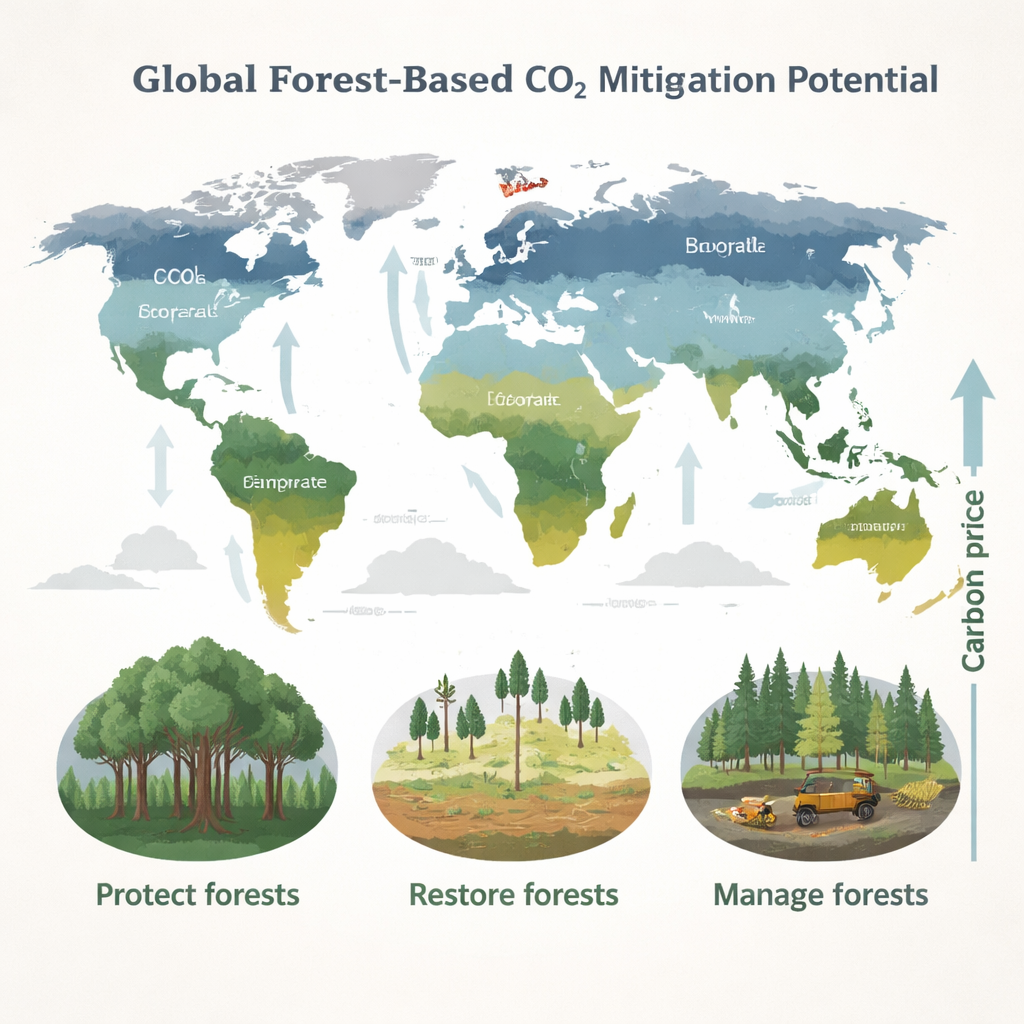
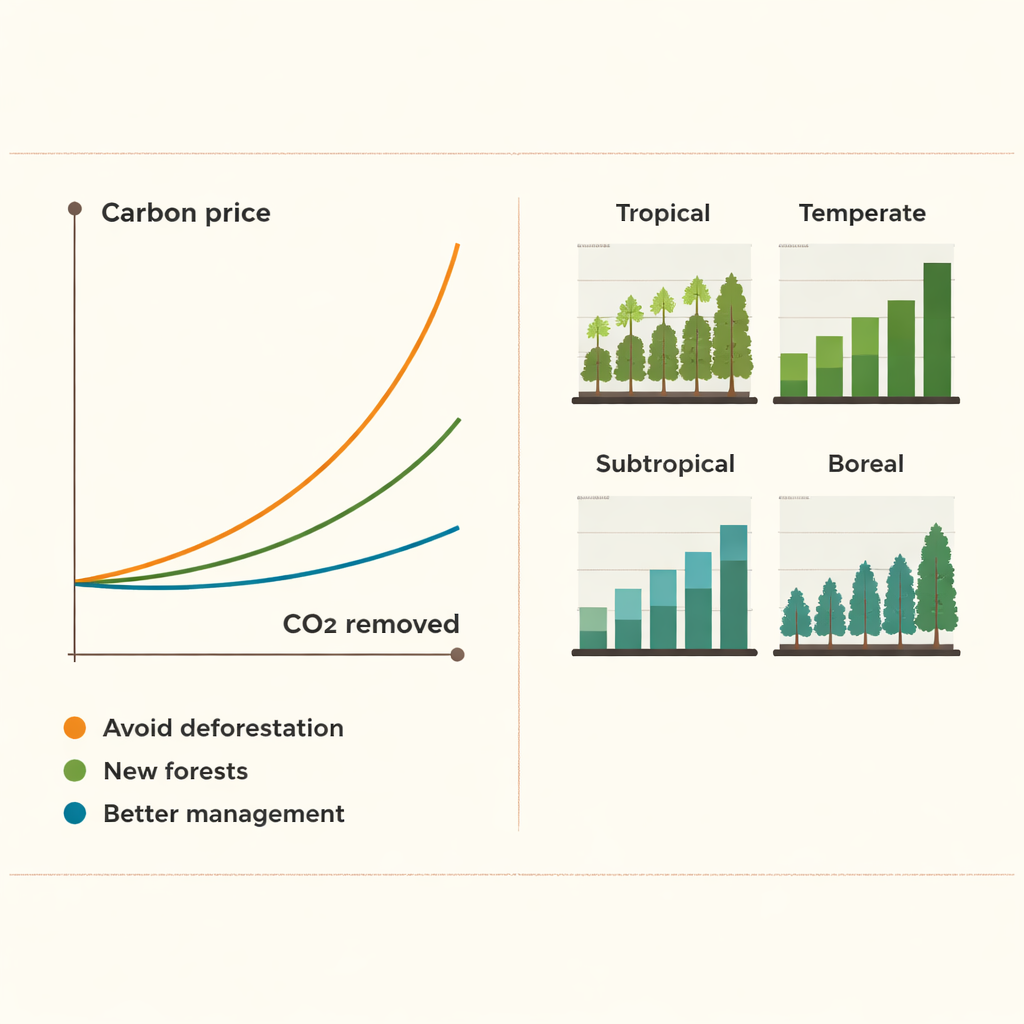
The results show that forests remain a powerful climate ally. Even without new incentives, global forests are expected to absorb about 1.8 billion tons (gigatons) of CO₂ per year by 2050, though this varies widely by country. When carbon storage is rewarded at $100 per ton in 2050, the model suggests forests could remove about 8 gigatons of CO₂ that year compared with a no-policy future. Roughly 38% of that comes from planting or naturally regenerating forests on suitable land, 26% from avoided deforestation, and 37% from changes in how forests are managed, such as lengthening harvest cycles. As the carbon price rises, total mitigation keeps increasing, but each extra dollar buys a bit less additional CO₂ removal, revealing where the cheapest options are quickly used up.
Where the biggest opportunities are
Mitigation potential is far from evenly spread. Tropical and temperate forests dominate the picture, together providing more than four‑fifths of the global potential at high carbon prices. Brazil, Indonesia, the Democratic Republic of the Congo and several other tropical nations could supply a large share of low-cost reductions by slowing forest loss and restoring degraded lands. In many of these countries, even modest payments—on the order of $5 to $20 per ton of CO₂—could halt net deforestation or turn forests from a source of emissions into a net sink. Temperate regions such as the United States and Europe offer especially strong gains at higher prices, mainly through expanding forest area and improving management, while boreal and subtropical forests add smaller but still meaningful contributions.
Real-world limits and slower planting
The study also tests a more cautious scenario in which nations cannot plant or restore forests faster than they have historically done. Under this constraint, global forest-based mitigation in 2050 falls by 20% to over 40%, with the largest percentage losses in temperate regions that would otherwise expand forests quickly. This highlights that the speed of on‑the‑ground activities—such as producing seedlings, training workers, and preparing land—can be just as limiting as the amount of suitable land. The authors note further uncertainties, including land tenure disputes, uneven access to information, and unmodeled climate impacts like fires and pests, all of which could affect how much mitigation is actually achieved.
What this means for climate action
For non-specialists, the main takeaway is that forests could make a major, but not unlimited, contribution to slowing climate change if societies choose to pay for the climate service they provide. With well-designed incentives, forests worldwide could remove several gigatons of CO₂ per year by mid-century through a mix of protecting existing trees, restoring lost forests, and managing working forests more carefully. However, this potential relies on realistic planting rates, strong institutions, and attention to other goals such as food production and biodiversity. Forests are therefore a powerful pillar of climate strategy, but not a silver bullet: they work best when integrated with broader efforts to cut fossil fuel use and support resilient, well-managed landscapes.
Citation: Favero, A., Austin, K. Charting our forest future: national supply curves for forest-based CO₂ mitigation. npj Clim. Action 5, 6 (2026). https://doi.org/10.1038/s44168-026-00335-9
Keywords: forest carbon, reforestation, carbon pricing, avoided deforestation, climate mitigation