Clear Sky Science · en
Long COVID disability burden in US adults
Why this matters for everyday life
Millions of people recovered from their initial COVID-19 infection only to find that months later they were still exhausted, short of breath, or unable to think clearly. This lingering illness, known as Long COVID, can make working, studying, or caring for family extremely difficult. The study behind this article asks a pressing question: how big is the disability burden from Long COVID in the United States, and does federal research funding match the scale of the problem—especially for women, who are affected most?

How the hidden toll was measured
The researchers focused on how much day-to-day life is limited by Long COVID, rather than on deaths. They used a standard public health yardstick called “years lived with disability,” which combines how common a condition is with how severely it affects people’s lives. To estimate how many U.S. adults have disabling Long COVID, they analyzed a year of data from the Census Bureau’s Household Pulse Survey, which repeatedly asks a large, nationally representative sample of adults about their health. People counted as having disabling Long COVID had persistent symptoms at least three months after infection that they said reduced their ability to carry out daily activities “a lot.”
How Long COVID compares with other illnesses
When the team translated these survey responses into years lived with disability, Long COVID’s burden turned out to be strikingly high. Its impact on daily function was similar to that of traumatic brain injury or moderate chronic lung disease, and more severe than uncomplicated diabetes or mild Alzheimer’s disease. In terms of how much disability it causes across the population, Long COVID ranked in the top quarter of roughly 70 major conditions, with a burden slightly higher than Alzheimer’s disease and just below asthma and schizophrenia. Nearly four million U.S. adults currently live with Long COVID that seriously limits everyday activities, and about half of them are under age 50, meaning many are in their prime working and caregiving years.
Following the money for different diseases
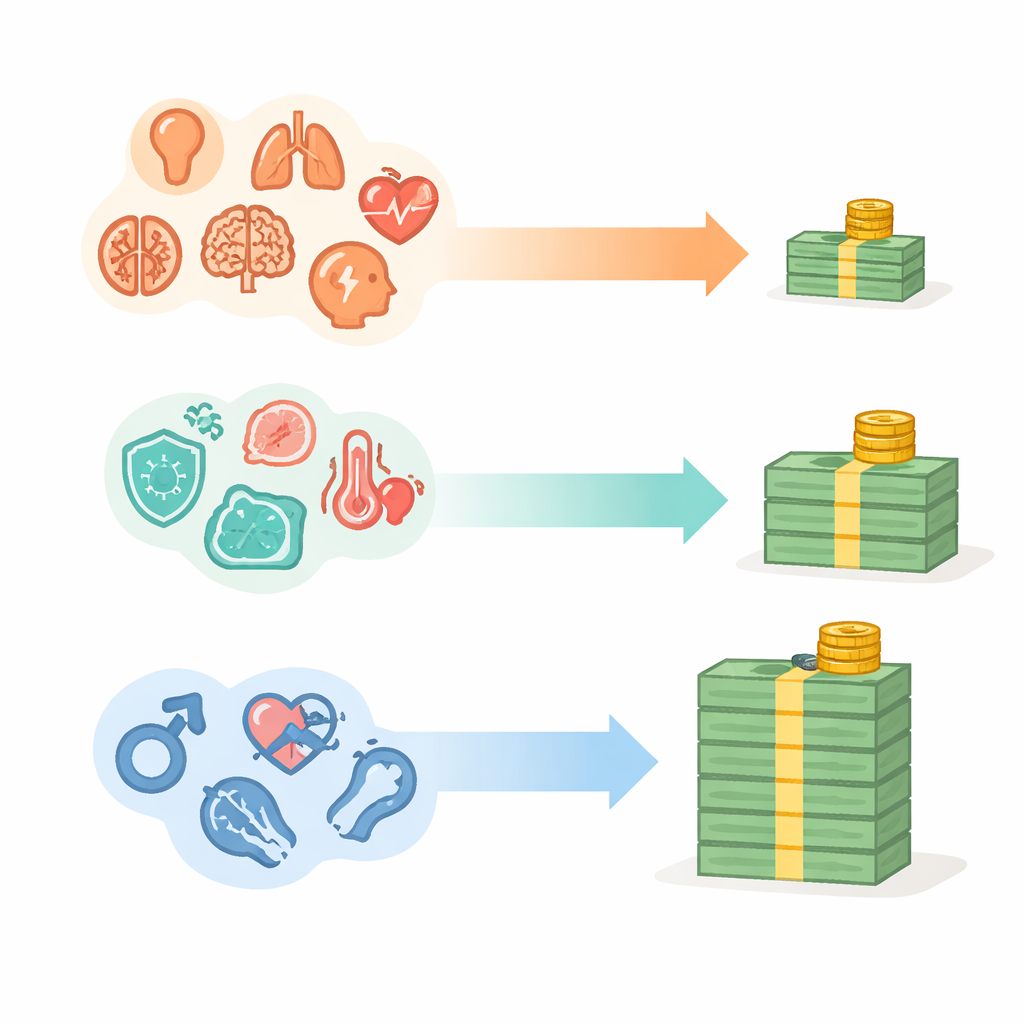
The authors then compared this disability burden to how much research funding each condition received from the U.S. National Institutes of Health (NIH) between 2022 and 2024. They asked: if money were handed out strictly in proportion to disability burden, how far off are current allocations? For Long COVID, the gap was wide. Based on its share of total disability across the 68 conditions examined, Long COVID would receive about $740 million per year. Instead, it received about $106 million through standard NIH categories—only 14 percent of what its disability level would suggest. Even when the researchers added in extra, one-time federal funding from the RECOVER initiative, Long COVID still received only about half of its disability-commensurate amount.
Women’s illnesses and unequal support
The study also probed whether funding patterns differ for conditions that mostly affect women versus those that mostly affect men. They grouped each condition as female-predominant, male-predominant, or neutral if at least 60 percent of patients were one sex. Long COVID, myalgic encephalomyelitis/chronic fatigue syndrome (ME/CFS), and several other disabling, often invisible illnesses fall into the female-predominant group. Among the 12 conditions that had higher-than-median disability but lower-than-median funding, seven primarily affected women and none primarily affected men. When the authors calculated how many research dollars were spent per unit of disability, male-predominant conditions received more than five times as much support as female-predominant ones. Overall, disability burden explained only about 6.5 percent of the differences in funding between diseases, and this link was clearly detectable only for male-predominant conditions.
What this means for patients and policy
Put simply, the study finds that Long COVID causes a level of disability on par with some of the most serious chronic diseases, but U.S. research funding has not caught up, especially for conditions that mainly affect women. The authors argue that as medicine shifts from saving lives in emergencies to managing long-term illness, measures of disability should play a much larger role in deciding research priorities. They call for Long COVID to be fully recognized as a disability, not just a condition that may qualify some people for help, and for funding decisions to better reflect both the scale of suffering and sex-based disparities. Their analysis suggests that aligning research dollars with real-world disability could speed progress toward effective treatments—not only for Long COVID, but for other long-neglected chronic conditions as well.
Citation: Bonuck, K., Gao, Q., Congdon, S. et al. Long COVID disability burden in US adults. Commun Med 6, 177 (2026). https://doi.org/10.1038/s43856-026-01516-7
Keywords: Long COVID, disability burden, NIH funding, women’s health, chronic illness