Clear Sky Science · en
Rapid functional reorganization of the targeted contralesional hemisphere induced by one week of noninvasive closed-loop neurofeedback guides motor recovery in post-stroke patients with chronic motor impairment: a phase I trial
Rewiring Movement After Stroke
Many people who survive a stroke are left with a paralyzed arm that barely responds, even after months or years of standard therapy. This study explores a new way to "wake up" hidden brain pathways on the healthy side of the brain and link them directly to the weak arm using a brain–computer interface and a robotic exoskeleton. For people who have been told they have reached a recovery plateau, this approach hints that meaningful improvement may still be possible.
A New Route Around Brain Damage
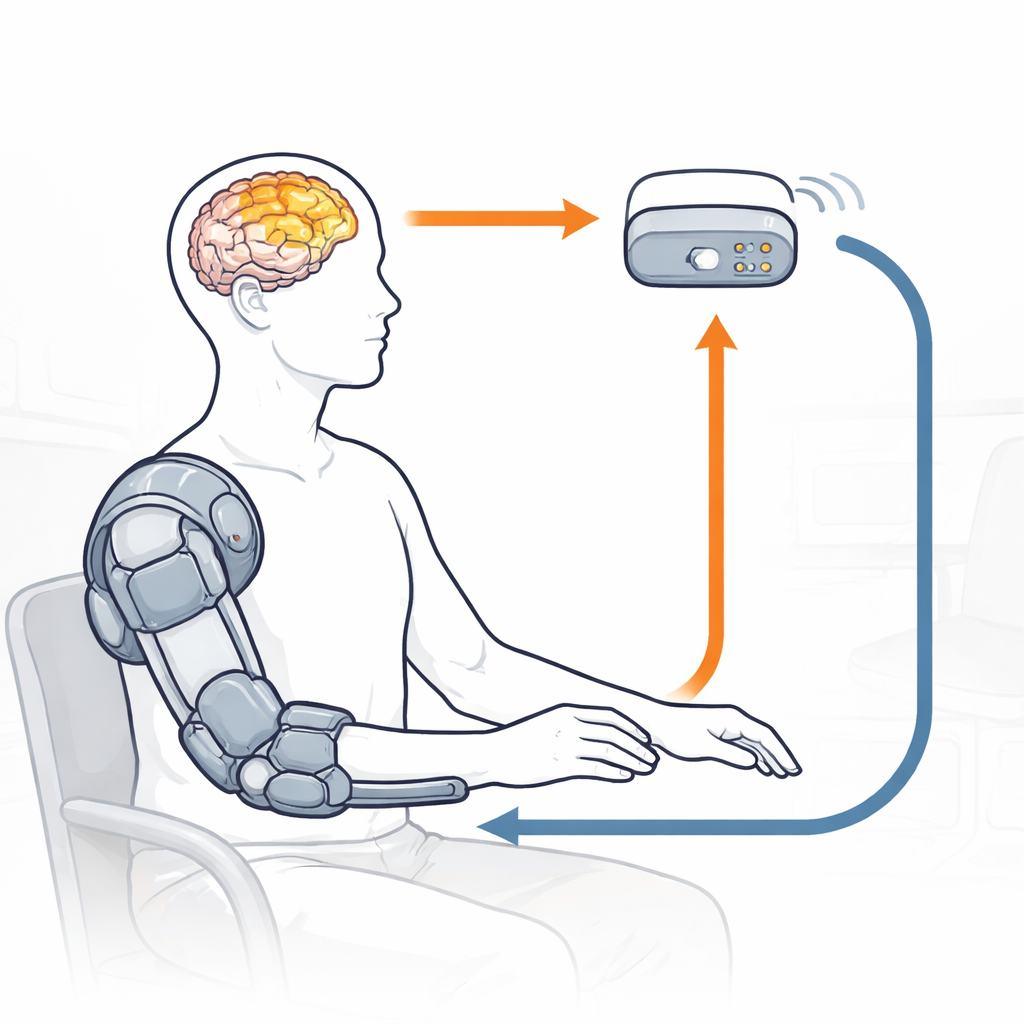
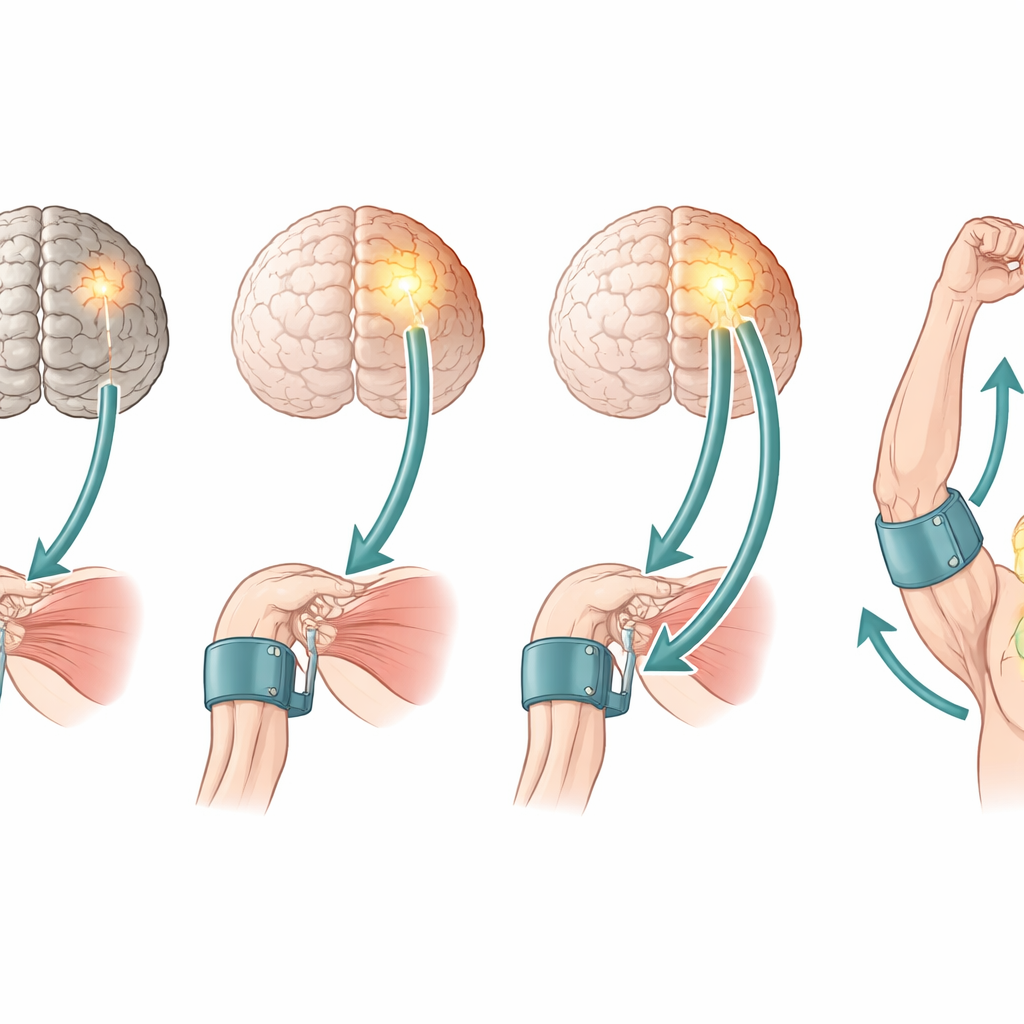
When a stroke damages the brain, the usual nerve highways that control movement from the injured side of the brain to the opposite arm can be severely disrupted. Yet some backup routes remain: nerve fibers that travel from the opposite, uninjured hemisphere down the same side of the body. This study set out to deliberately strengthen those spare routes. Instead of asking the damaged hemisphere to do more, the researchers built a system that listens to activity in the intact motor area on the other side of the brain and uses that signal to move the paralyzed shoulder through a robotic exoskeleton and electrical stimulation of the shoulder muscles.
Training the Brain With a Closed Feedback Loop
Eight adults with long-standing, severe arm paralysis took part. All were more than six months past their stroke and had great difficulty lifting the affected arm at the shoulder. Each day for one week, they wore an EEG cap so that tiny voltage changes on the scalp—reflecting activity in the intact motor area—could be monitored. They also wore a custom shoulder exoskeleton and received mild electrical pulses to the shoulder muscle. During training, they tried to lift the paralyzed arm. When their brain activity in the targeted region crossed a preset threshold, the computer triggered the robot and stimulation, lifting the arm and providing a natural combination of movement and body sensation. In this way, every successful attempt linked a specific pattern of brain activity to real movement of the weak limb.
Measurable Gains in Everyday Movement
The main question was whether this one-week training could translate into real-world improvement. Before and after the intervention, therapists who did not run the training assessed arm function using standard stroke scales that score how well a person can move different joints. On average, participants improved by about seven points on a widely used test of upper-limb movement—more than what is generally considered a meaningful change for patients with chronic stroke. Six of the eight patients exceeded this threshold. Many could lift the arm higher, and some showed better control at the wrist as well. Importantly, these gains largely persisted when the patients were re-tested a month later, and no safety problems such as shoulder pain or skin injury were observed.
Watching the Brain Adapt in Real Time
Beyond behavior, the team wanted to know whether the targeted hemisphere really reorganized its activity. EEG recordings showed that, after training, the specific rhythm over the intact motor area became more strongly suppressed during movement attempts, a sign that this region was more actively engaged. Connections within the same hemisphere, particularly around motor and premotor areas, also strengthened when the brain was at rest. In a subset of patients tested with magnetic brain stimulation, signals from the intact hemisphere to the shoulder muscle became larger or even reappeared when they had been absent before, suggesting that previously weak pathways had been reinforced.
What This Could Mean for Stroke Survivors
For people living with chronic, severe arm paralysis, this early-phase trial suggests that the brain’s healthy side can be harnessed in a focused way to restore movement. By closing the loop—detecting helpful brain activity in real time and immediately pairing it with movement and sensation of the weak arm—the system appears to drive rapid reorganization of brain networks and spinal pathways that control the shoulder. Although the study is small and lacks a comparison group, it supports the idea that carefully targeted brain–machine training, combined with existing rehabilitation methods, may open new windows for recovery long after a stroke has occurred.
Citation: Takasaki, K., Iwama, S., Liu, F. et al. Rapid functional reorganization of the targeted contralesional hemisphere induced by one week of noninvasive closed-loop neurofeedback guides motor recovery in post-stroke patients with chronic motor impairment: a phase I trial. Commun Med 6, 163 (2026). https://doi.org/10.1038/s43856-026-01423-x
Keywords: stroke rehabilitation, brain computer interface, neuroplasticity, robotic exoskeleton, motor recovery