Clear Sky Science · en
Deep learning for detecting depression in individuals with and without alexithymia
Why talking about feelings can be so hard
Many people live with depression, yet our main tools for spotting it still rely on people filling out questionnaires about how they feel. But what happens when someone struggles to understand or describe their own emotions in the first place? This study looks at a group of people with a trait called alexithymia—difficulty recognizing and putting feelings into words—and asks whether artificial intelligence (AI) can help doctors detect depression more accurately in these cases.
When self-check tests fall short
Standard depression screeners, such as short checklists patients fill out in clinics or online, are quick and convenient. However, they assume that people can notice and report their sadness, lack of interest, or worry with reasonable accuracy. For people with alexithymia, that assumption often breaks down. They may feel unwell but cannot easily label their emotions, so they may under-report their distress on self-check tests even when they are truly depressed. The researchers found that alexithymia is not rare—affecting close to one in ten people—and that higher levels of alexithymia were linked to more severe depression overall.
Letting computers listen to the conversation
Instead of relying only on forms, the team turned to the words spoken during clinical interviews. Nearly 300 Cantonese-speaking adults, including patients with major depressive disorder and community volunteers, took part in structured interviews with a psychiatrist using a standard rating scale for depression. These interviews were transcribed into text. The researchers then trained eight large language models—advanced AI systems that analyze text—to decide whether each person was depressed, using the psychiatrist’s judgment as the reference standard. The models did not see questionnaire scores; they learned directly from how people talked about their sleep, energy, daily life, and mood.
AI versus the checkbox
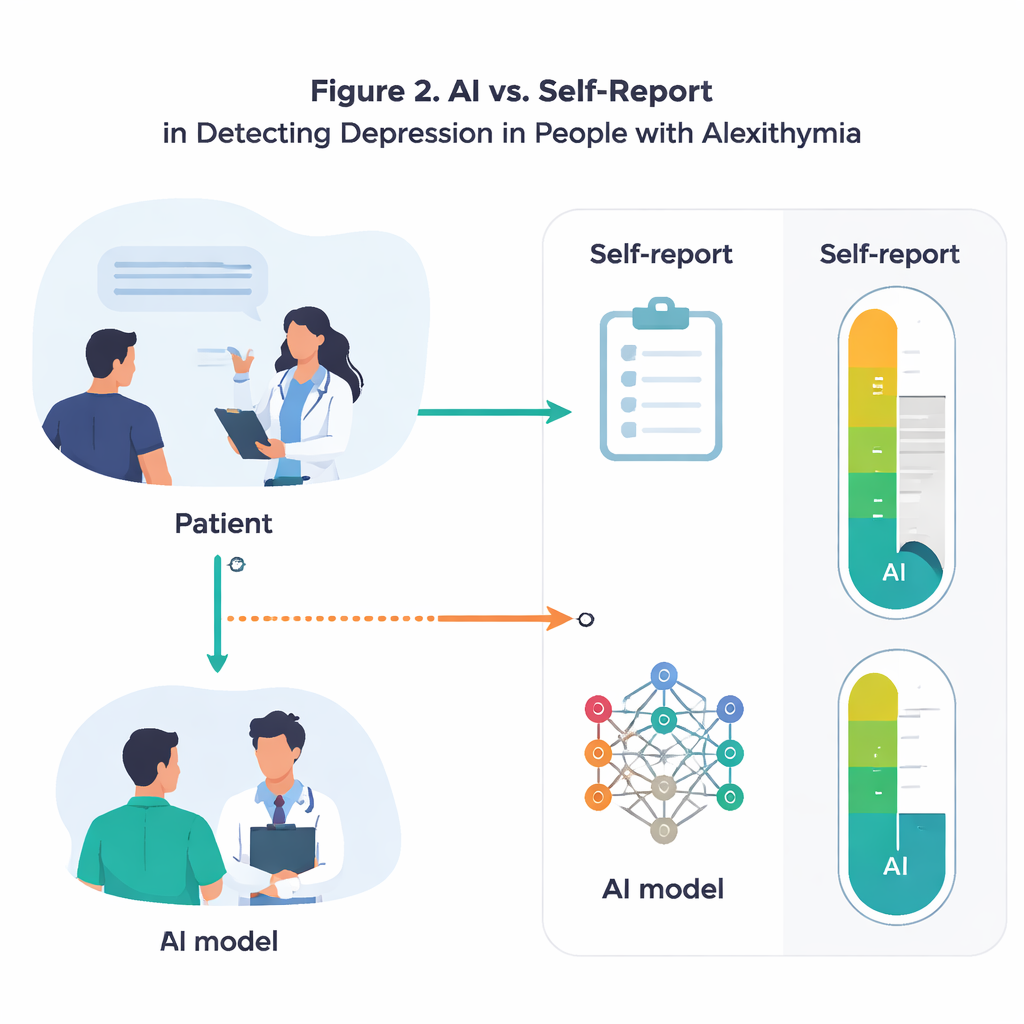
The study compared how well the AI models and a widely used self-report scale, the Hospital Anxiety and Depression Scale–Depression Subscale (HADS-D), could identify depression. Across all participants, four of the eight AI models clearly outperformed the self-report scale. When the team zoomed in on people with alexithymia, the contrast was striking: the self-report scale’s accuracy dropped to the level of a poor guess, while the AI models stayed strong, showing good to excellent performance. Importantly, the AI systems worked just as well whether people had no alexithymia, possible alexithymia, or clear alexithymia, suggesting that difficulties in describing feelings did not throw these models off.
Why AI stays steady when words fail
Why might computers succeed where checklists stumble? The authors argue that spoken language in an interview contains many subtle clues—choice of words, level of detail, patterns of hesitations—that reflect a person’s inner state, even when they cannot name their own emotions. Large language models are designed to pick up such patterns across long stretches of text. In contrast, self-report scales offer a fixed set of brief questions that focus mainly on thoughts and feelings; they leave little room for people who are unsure how to rate themselves. The findings suggest that AI tools, when built and tested carefully, could serve as powerful assistants to clinicians, especially in settings where specialist time is limited and waiting lists are long.
What this means for future care
For a layperson, the key message is simple: some people are less able to describe how they feel, and for them, standard depression questionnaires can miss important problems. This study shows that AI systems that analyze what patients say in an interview can often detect depression more reliably than self-report forms, and they keep their accuracy even when alexithymia is present. While AI will not replace human clinicians, it could help flag at-risk individuals earlier and guide more personalized care. The authors suggest that similar approaches might one day improve detection of other mental health conditions, bringing us closer to mental health assessments that truly fit each person, rather than asking everyone to fit the same form.
Citation: Lam, C., Xian, L., Huang, R. et al. Deep learning for detecting depression in individuals with and without alexithymia. Commun Med 6, 123 (2026). https://doi.org/10.1038/s43856-026-01393-0
Keywords: depression detection, alexithymia, artificial intelligence, clinical interviews, mental health screening