Clear Sky Science · en
A multivariate decomposition analysis of drivers of overweight and obesity among Ghanaian women
Why this matters for everyday life
Across the world, more people are living with extra body weight, and Ghana is no exception. For Ghanaian women in their childbearing years, overweight and obesity are no longer rare—they are becoming the norm. This matters because excess weight raises the risk of heart disease, diabetes, and other long-term illnesses that affect families, communities, and the national economy. This study looks beneath the surface numbers to ask a key question: what social and economic changes are really driving this trend among Ghanaian women?
A growing weight problem over two decades
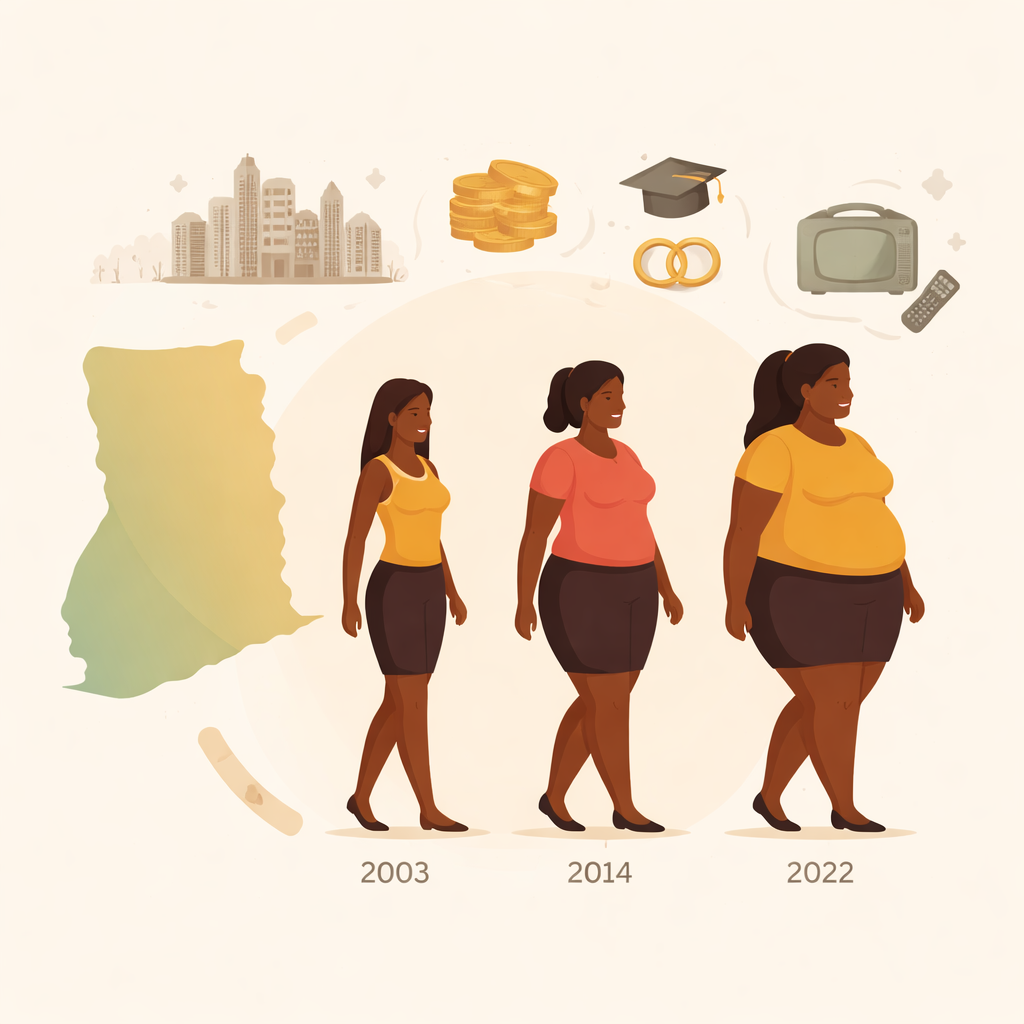
The researchers analysed data from four nationally representative Ghana Demographic and Health Surveys, carried out in 2003, 2008, 2014, and 2022. These surveys measured women’s height and weight and collected detailed information about their age, schooling, wealth, where they live, family situation, and daily habits. Over nearly twenty years, the share of women aged 15 to 49 who had overweight or obesity rose from about one in four to more than two in five—reaching 43% in 2022. The increase did not affect all women equally: those living in cities, in wealthier households, and with more years of schooling were more likely to have higher body weight.
Who is most affected and why
To understand which women face the greatest risk, the team used statistical models that compare women with a healthy weight to those with overweight or obesity. Age was a strong factor: as women grew older within the 15–49 age range, their odds of having excess weight went up. Marital status also mattered. Women who were never married had lower odds of being overweight than married or cohabiting women, although this protective effect has weakened over time. Education and wealth were important, too. Women with secondary or higher education and those in the richest households were much more likely to be overweight or obese than women with no schooling or in the poorest homes. Living in urban areas—especially the Greater Accra region—was linked with higher odds of obesity, reflecting easier access to processed foods, more sedentary jobs, and fewer chances for physical activity.
Looking beyond individual choices
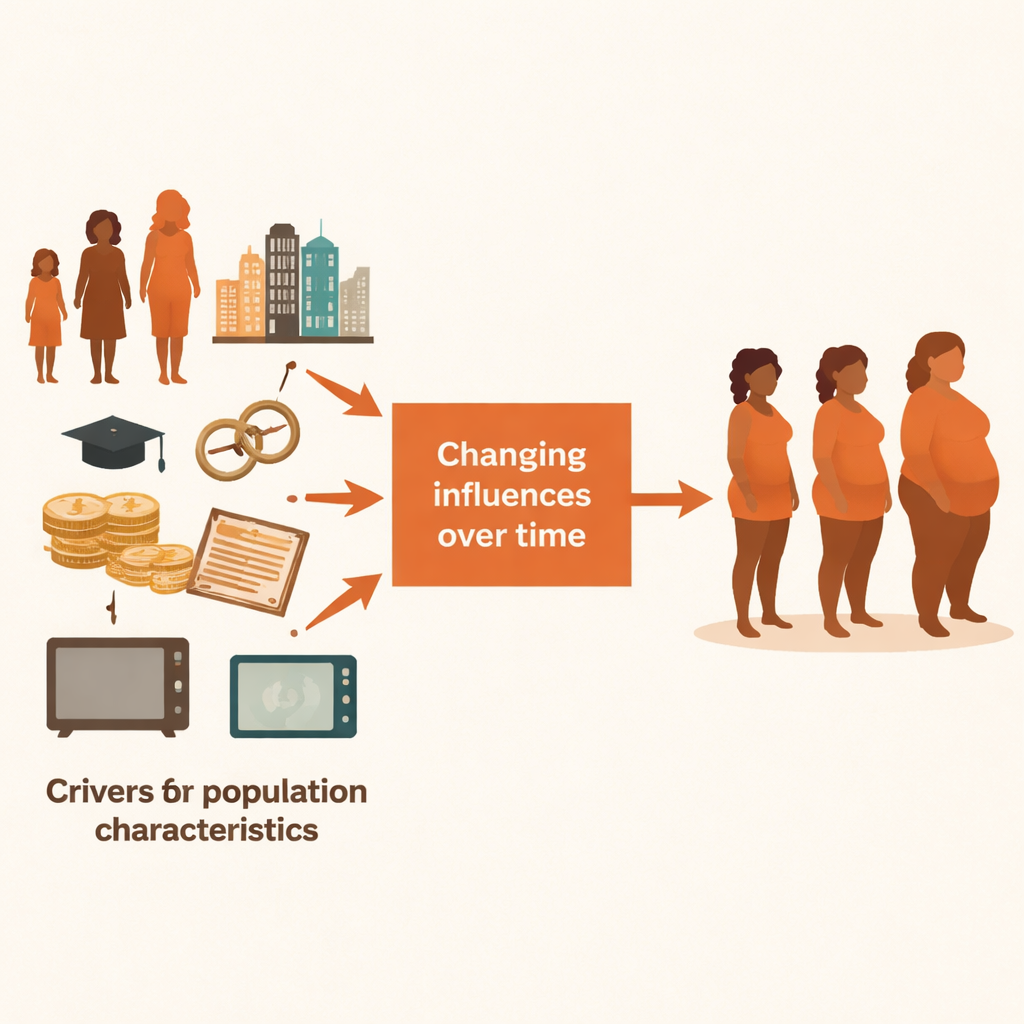
Rather than stopping at simple associations, the researchers used a method called decomposition analysis to tease apart two issues: how much of the rise in overweight and obesity comes from changes in who makes up the population (for example, more women living in cities or finishing secondary school), and how much comes from changes in how strongly these factors influence weight over time. They found that only about a fifth of the increase could be explained by shifts in population characteristics alone. The bulk of the rise was driven by changing “effects” of these characteristics: being urban, educated, or wealthier now leads to a higher risk of excess weight than it did in the early 2000s. Factors like increased use of modern contraceptives and more television watching also contributed to higher odds of overweight, pointing to modern lifestyles that encourage less movement and more calorie-dense foods.
City life, culture, and modern habits
The study highlights how Ghana’s rapid urban growth and social change are reshaping women’s bodies. In many Ghanaian communities, a fuller figure has long been seen as a sign of prosperity, health, and respectability, especially for women. As more women gain education and income and move into city-based, desk-focused work, they are simultaneously surrounded by cheap processed foods and powerful cultural messages—both local and global—about what a desirable body looks like. Rural women, by contrast, often perform more physically demanding work and may have diets based more on traditional staples, which can offer some protection. Yet rural areas face their own nutrition problems, such as undernutrition and food insecurity, underscoring that “thin” does not always mean healthy.
What this means for health and policy
For a layperson, the core message is that rising overweight and obesity among Ghanaian women are not simply about personal willpower or individual food choices. They are the product of wider social and economic shifts—ageing, urbanisation, rising education and wealth, changing family structures, and new technologies that promote sitting rather than moving. The authors argue that solutions must therefore go beyond telling women to “eat less and exercise more.” Instead, Ghana needs flexible, context-specific strategies that promote healthier food environments, support active living in cities, integrate nutrition advice into family planning and women’s health services, and address cultural expectations around body size. Only by tackling these broader forces can the country hope to slow, and eventually reverse, the growing burden of overweight and obesity.
Citation: Mensah, J.P., Akparibo, R., Atuobi-Yeboah, A. et al. A multivariate decomposition analysis of drivers of overweight and obesity among Ghanaian women. Commun Med 6, 122 (2026). https://doi.org/10.1038/s43856-026-01391-2
Keywords: obesity, Ghanaian women, urbanisation, socioeconomic factors, public health