Clear Sky Science · en
Stability and distribution of dense hydrous magnesium silicates in the mantle transition zone under low water activity conditions
Water Hidden Deep Inside Earth
Far beneath our feet, water doesn’t just flow as liquid – it hides inside crystals and helps control how our planet works. This study asks a deceptively simple question: as ocean plates dive deep into Earth, how much of their water can really make it past a key boundary hundreds of kilometers down? The answer matters for understanding everything from how volcanoes form to how much water the planet may store in its rocky interior.
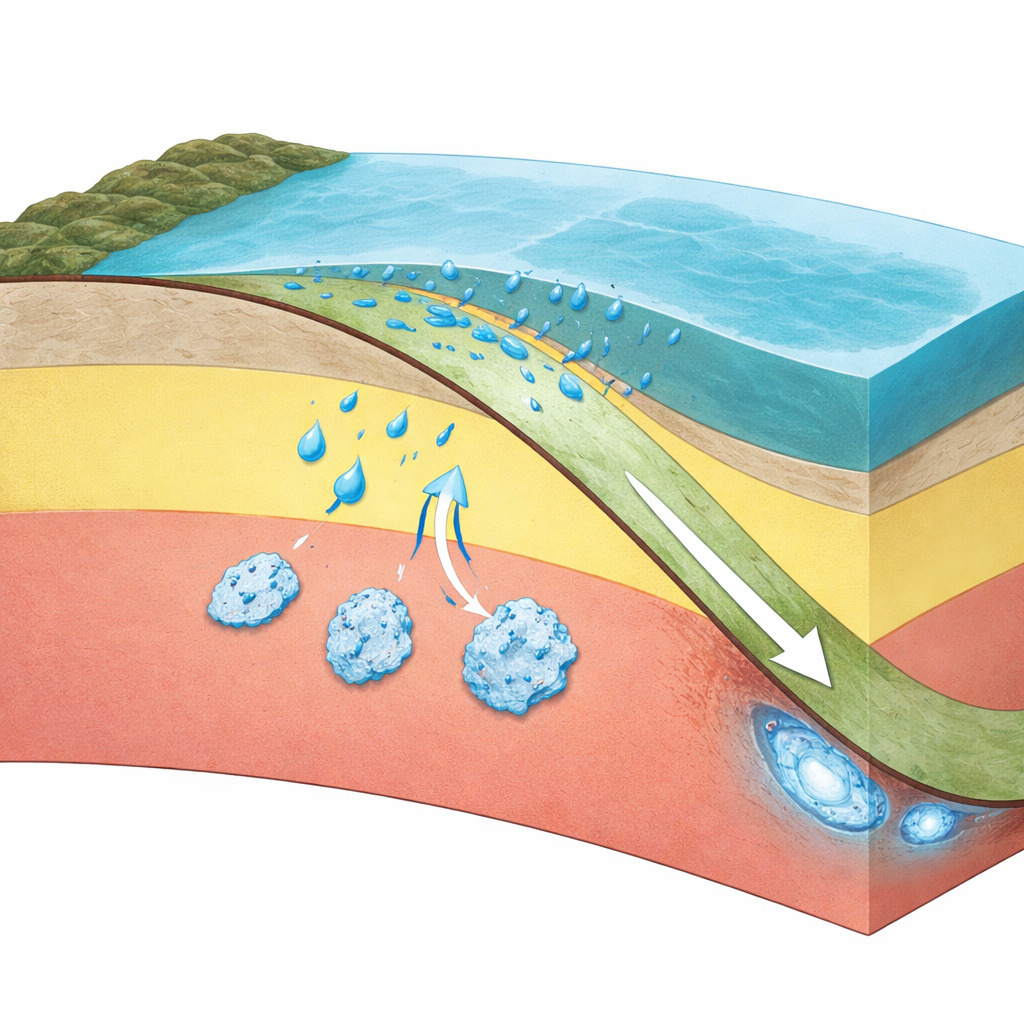
Where the Sinking Plate Takes Its Water
When an oceanic plate plunges into the mantle, it carries water locked in minerals such as serpentine and related hydrous rocks. As the plate sinks and heats up, most of these minerals break down and release their water, which tends to rise and feed magmas and volcanoes. Only a fraction of the original water survives to reach the mantle transition zone, a middle layer between about 410 and 660 kilometers depth. Geologists have long debated whether special hydrous minerals called dense hydrous magnesium silicates could take over as the main deep water couriers once the plate reaches this zone.
Recreating Deep Earth in the Laboratory
To test this idea, the authors compressed and heated simple mixtures of magnesium, silicon, and water to pressures and temperatures matching those in the mantle transition zone. By carefully varying the bulk water content from very dry to moderately wet, they watched which minerals formed at 16 and 21.5 gigapascals and 1400 Kelvin. Microscopic imaging and precise measurements of water in individual crystals allowed them to track where the hydrogen actually ended up inside the rock.
Crystals That Soak Up Water
The experiments show that two common mantle minerals, wadsleyite and ringwoodite, behave like powerful sponges. As long as the overall water content stays below roughly 1.2 weight percent, almost all water is drawn into these minerals as tiny defects in their crystal structures, rather than forming separate hydrous phases. Only when this threshold is exceeded do dense hydrous magnesium silicates begin to appear, and even then they grow at the expense of wadsleyite and ringwoodite. Calculations that balance all of the mass in the system confirm that these results are consistent over a wide range of compositions.
Why the Deep Mantle Stays Relatively Dry
Natural subducting plates, even in unusually cold and wet regions like the Mariana trench, rarely carry more than about 1 weight percent water once their shallow hydrous minerals have broken down. That means they typically fall below the threshold needed to stabilize the special water‑rich silicates. Instead, water remains mostly stored in the nominally dry minerals as crystal defects, making it easier for water to leak out or be redistributed before reaching greater depths. Additional complications, such as the presence of carbon dioxide, further lower the effective water activity and make these dense hydrous phases even harder to form in real rocks.
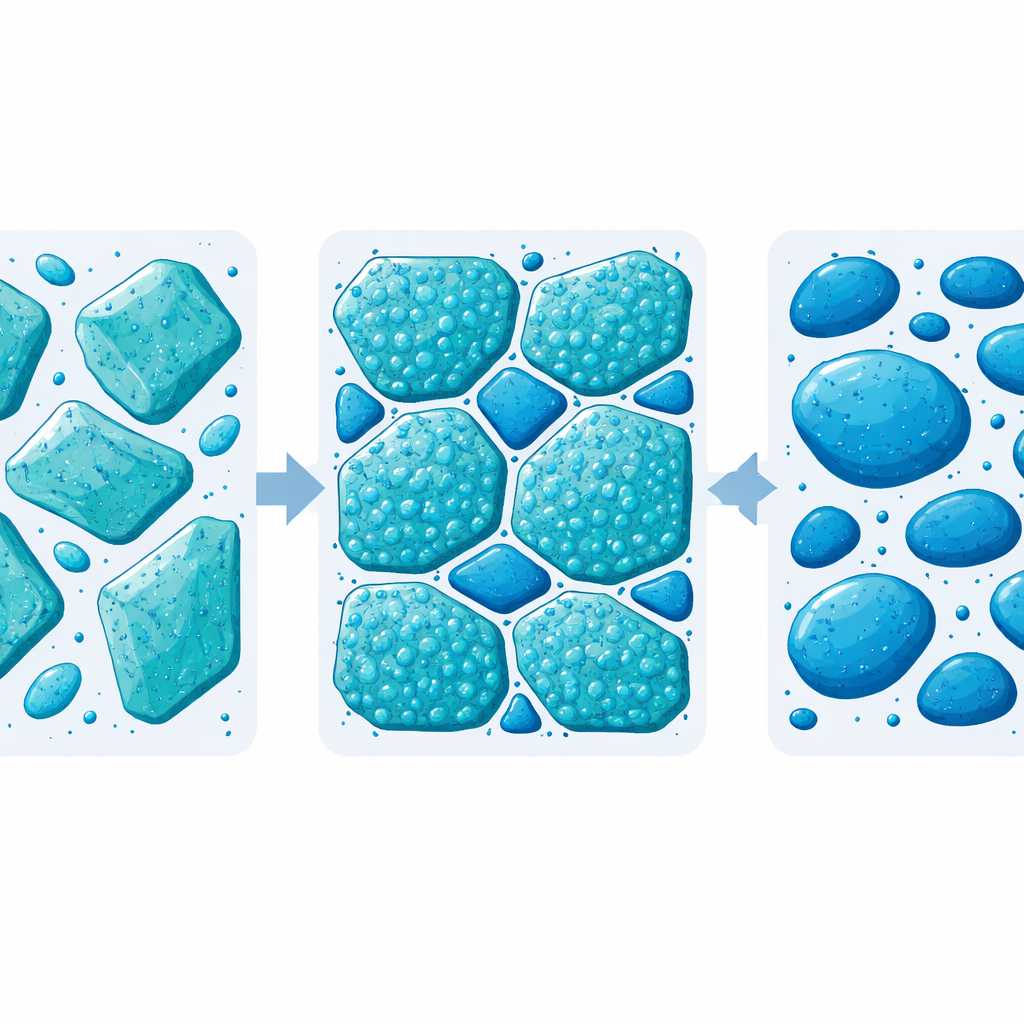
What Happens at the 660-Kilometer Boundary
As the slab descends past about 660 kilometers, ringwoodite breaks down into lower‑mantle minerals that can hold very little water. The excess water then forms small pockets of melt that tend to pool or move upward, rather than being dragged farther down. Only a few highly stable, aluminum‑rich hydrous phases may carry a limited amount of water deeper still. Overall, the study concludes that the mantle transition zone acts more as a roadblock than a highway for deep water transport: wadsleyite and ringwoodite trap most of the water there, and large‑scale recycling of ocean water into the lower mantle is likely modest.
Citation: Song, Y., Guo, X., Zhai, K. et al. Stability and distribution of dense hydrous magnesium silicates in the mantle transition zone under low water activity conditions. Commun Earth Environ 7, 265 (2026). https://doi.org/10.1038/s43247-026-03379-1
Keywords: mantle transition zone, subduction water cycle, wadsleyite and ringwoodite, deep Earth hydration, hydrous mantle minerals