Clear Sky Science · en
Microbial oxidation and carbonate cementation led to three-dimensional preservation of ichthyosaur bones
Ancient Sea Creatures Frozen in 3D
Some of the most spectacular marine fossils on Earth come from a dark Jurassic mudstone in southwest Germany called the Posidonia Shale. Among them are sleek dolphin‑like reptiles known as ichthyosaurs, whose skeletons are often preserved in remarkable three dimensions instead of being crushed flat. This study asks a simple but fascinating question: what hidden chemical and microbial processes allowed one ichthyosaur to be preserved so perfectly inside a stony egg‑shaped nodule of limestone?
A Quiet, Poisonous Sea
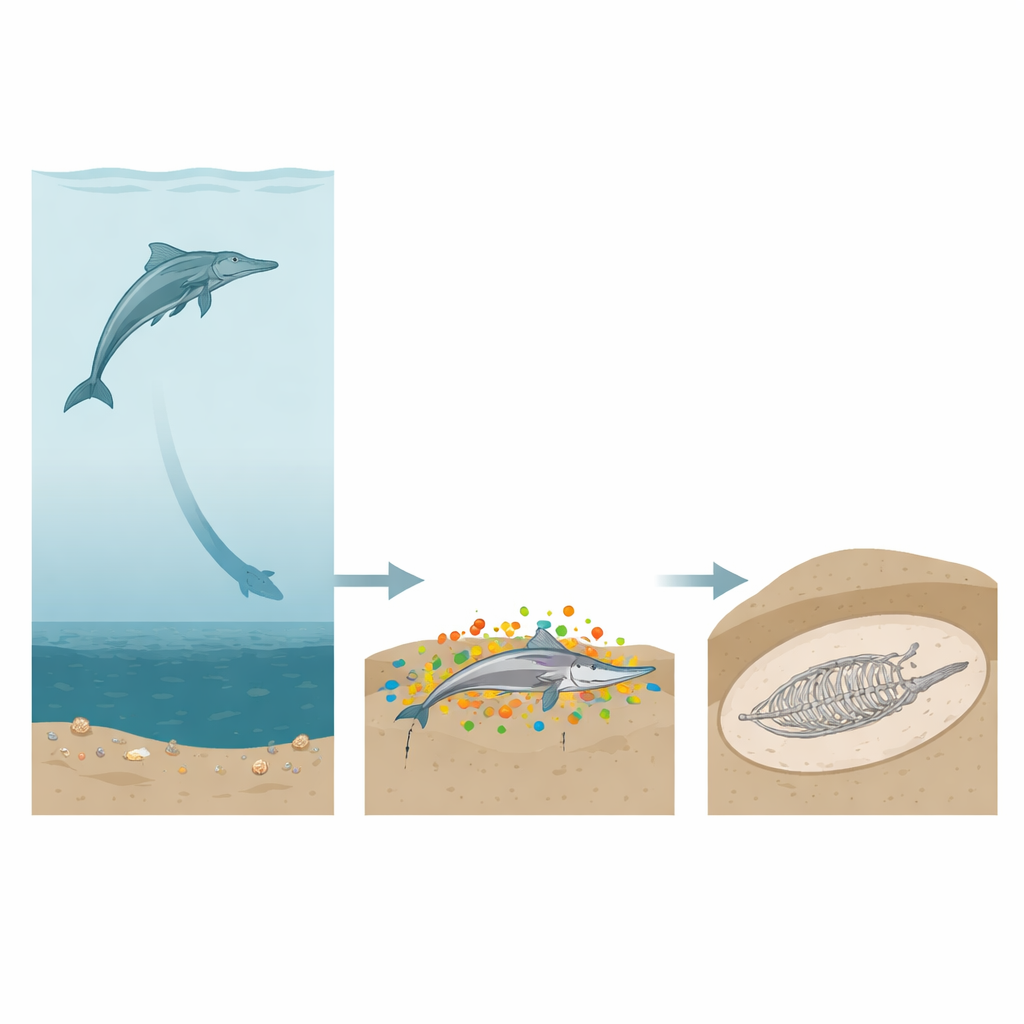
About 183 million years ago, the area that is now southwest Germany lay beneath a shallow sea. The bottom waters were starved of oxygen and rich in hydrogen sulfide gas, creating a toxic setting where most larger seafloor animals could not survive. Fine mud and dead plankton slowly settled, forming a black, organic‑rich seafloor. The ichthyosaur in this study died and sank into this soft, smelly mud. Earlier work assumed that the simple lack of oxygen was enough to explain its exceptional preservation. The new research shows that the story is more intricate: small‑scale chemical hotspots around and inside the carcass played an equally important role.
A Fossil in Three Chemical Worlds
The researchers examined a cross‑section through a single carbonate concretion—an oval lump of limestone—that contains part of an ichthyosaur’s backbone and ribs. By combining X‑ray CT scans, thin sections, and detailed measurements of carbon, oxygen, nitrogen, and sulfur isotopes, they identified three distinct “chemical worlds” in just a few centimeters: the surrounding black shale, the limestone of the concretion itself, and the fossil bones. The shale records a stagnant, sulfide‑rich sea floor where bacteria used sulfate from seawater to break down organic matter. This activity produced bicarbonate that later hardened into limestone, helping the concretion grow around the carcass and seal it off from later crushing and decay.
Microbial Work Inside the Bones
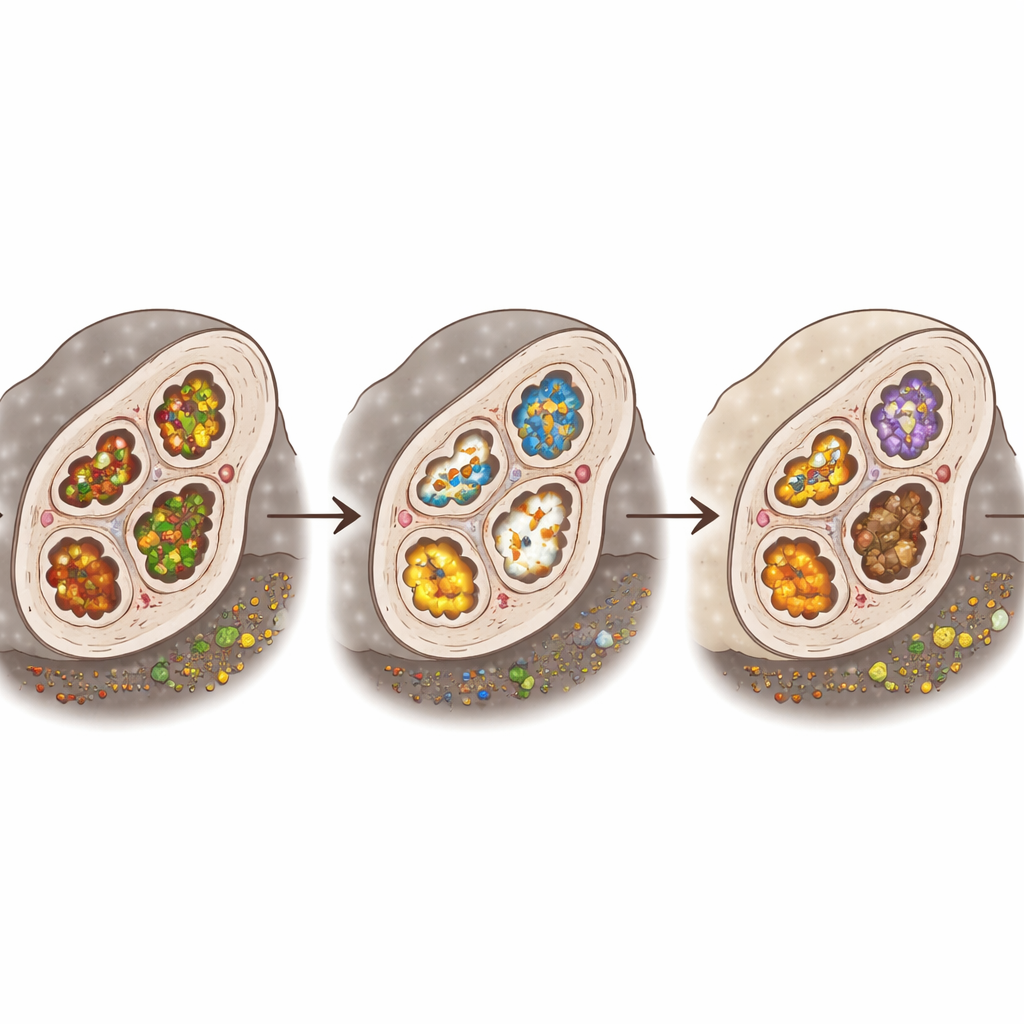
Inside the ribs and vertebrae, the picture is very different. The bones once held fatty marrow and soft tissues that became food for microbes. As these tissues broke down, they released acids and other breakdown products that locally changed the chemistry. The team found that much of the original bone collagen had been transformed into a phosphate mineral, indicating that brief bursts of acidity helped replace soft tissue with more durable material. At the same time, tiny cavities inside the bones were filled with two key minerals: calcite (a form of calcium carbonate) and barite (a barium sulfate). The pattern of sulfur isotopes and the restricted occurrence of barite only inside bones point to specialized bacteria that, even without oxygen, were able to oxidize sulfide into sulfate right within these microscopic spaces.
Miniature Chemical Factories in a Dead Reptile
The study proposes a step‑by‑step sequence. First, the carcass settled into the sulfidic mud and was shallowly buried. Next, waves of microbial activity inside the body and bones consumed soft tissues, briefly making the pore waters more acidic and encouraging phosphate minerals to form on collagen fibers. Certain bacteria living in and around the bones converted sulfide into sulfate, while also concentrating barium so that barite crystals grew within the marrow spaces. Finally, as burial continued, other bacteria in the surrounding mud generated bicarbonate from decaying organic matter. This bicarbonate reacted with dissolved calcium to rapidly grow a limestone shell—the concretion—around the skeleton. That shell stiffened the sediment, protected the bones from compaction, and locked in the barite‑filled, phosphate‑stabilized structure.
Why This Matters for Fossil Treasures
To a non‑specialist, the key message is that extraordinary fossils are not preserved simply because they lie in oxygen‑poor mud. In this ichthyosaur, tiny microbial communities turned bone cavities into miniature chemical factories that reshaped the minerals and locked the skeleton in place. The surrounding limestone concretion, also driven by microbial activity, then acted like a protective casing. Together, these processes allowed a Jurassic marine reptile to survive the crush of millions of years, giving scientists today a three‑dimensional window into ancient oceans and the microscopic helpers that guard their secrets.
Citation: Jian, A.J.Y., Schwark, L., Poropat, S.F. et al. Microbial oxidation and carbonate cementation led to three-dimensional preservation of ichthyosaur bones. Commun Earth Environ 7, 268 (2026). https://doi.org/10.1038/s43247-026-03366-6
Keywords: ichthyosaur fossils, microbial fossilization, carbonate concretions, anoxic seafloor, Jurassic Posidonia Shale