Clear Sky Science · en
Strengthened resource limitation driven by accelerated microbial growth dampens response to elevated CO2 in a mature forest
Why extra carbon in the air doesn’t guarantee more forest growth
As carbon dioxide in the atmosphere rises, many people hope that forests will simply grow faster and soak up more of this excess carbon, slowing climate change. But forests do not live on carbon alone. They also need nutrients from the soil, and they share those nutrients with vast communities of microbes. This study explores what happens in a mature Australian eucalyptus forest when the air is enriched with CO2 for a decade, revealing that hungry soil microbes can throttle back the forest’s ability to lock away carbon.
A forest experiment in the real world
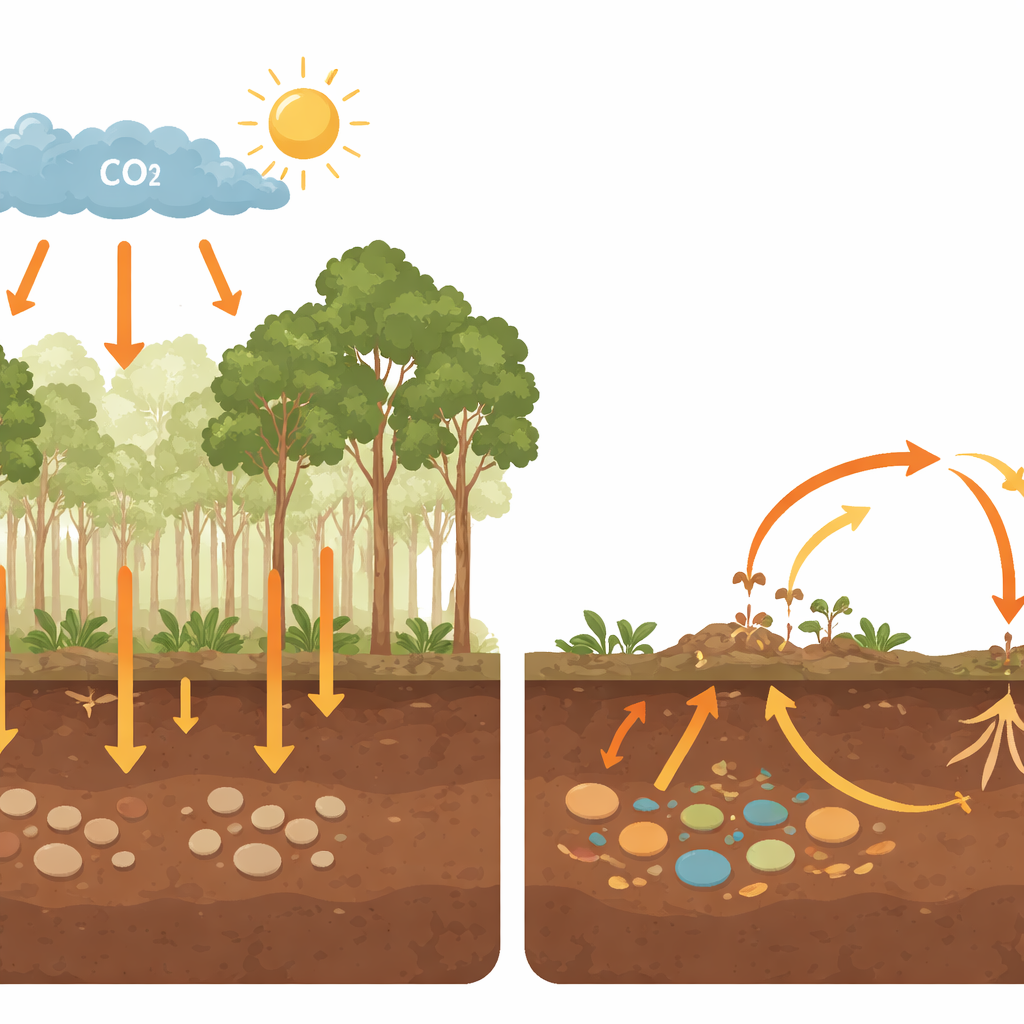
To move beyond small potted plants and short-term trials, researchers used a large outdoor experiment called EucFACE in a native eucalyptus woodland in Australia. There, giant metal rings surround patches of forest and gently release extra CO2 into the air, raising concentrations to levels expected later this century, while nearby rings stay at today’s levels. The soil at this site is poor in phosphorus, a key nutrient for plant growth. Earlier work showed that extra CO2 initially boosted photosynthesis in the trees, but their biomass did not increase much, and the added carbon was largely breathed back to the air from the soil. Scientists suspected that soil microbes might be hoarding phosphorus and limiting tree growth, but they needed direct tests of how these microbes respond to carbon and nutrient shortages.
Testing what soil microbes are missing
The team collected soils from both normal-CO2 and high-CO2 rings after ten years of treatment. In the lab, they carried out two types of experiments. First, they added different combinations of carbon, nitrogen, and phosphorus to the soils over short periods and measured how quickly microbes grew and respired. A surge in growth after a particular addition reveals which resource is in shortest supply. Second, they ran a longer six-week trial in which they added large amounts of leaf litter, with or without extra nitrogen and phosphorus, to see how soil microbes responded over time in terms of growth, enzyme activity, and nutrient storage.
Microbes crave carbon first, phosphorus second
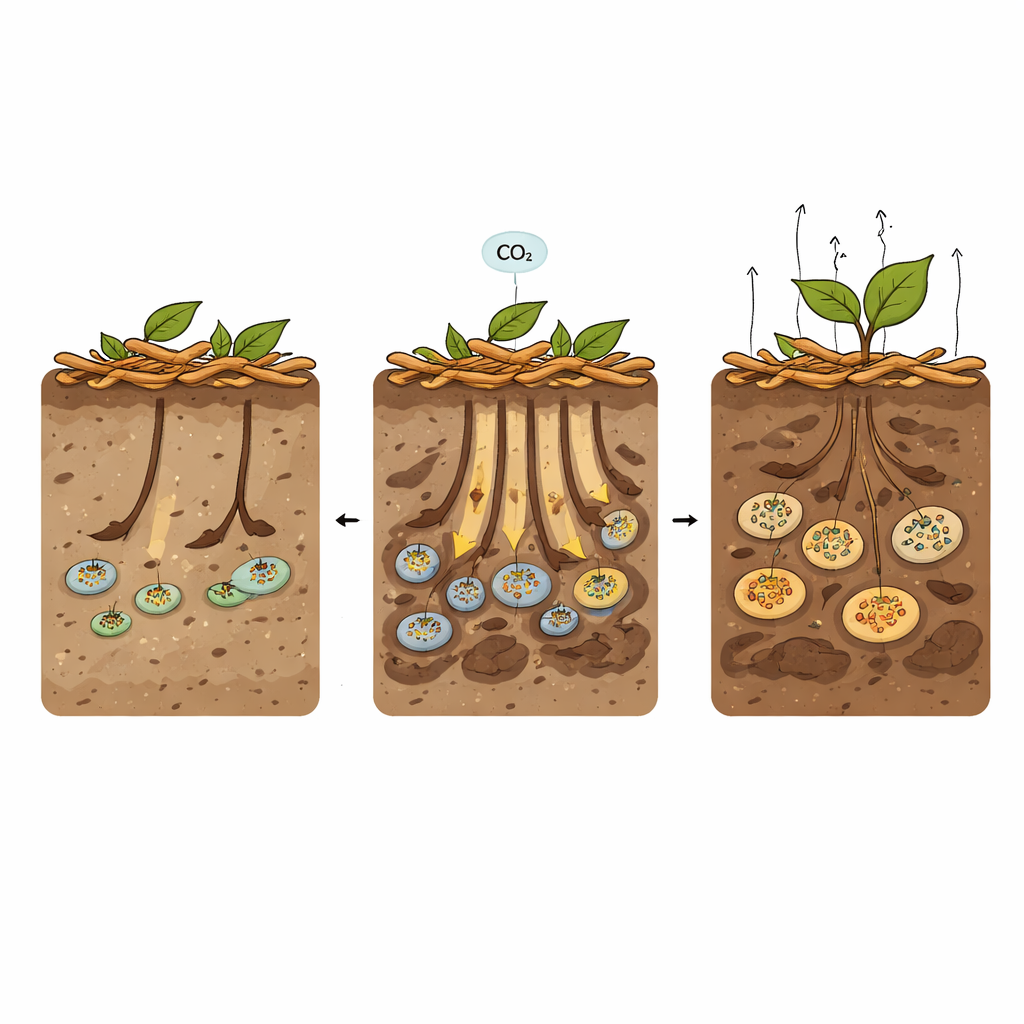
Contrary to expectations for this phosphorus-poor forest, microbial growth was found to be limited mainly by carbon and only secondarily by phosphorus. In other words, the decomposers living in the soil were most constrained by a lack of easily usable carbon food, even though plants themselves were held back by low phosphorus. Adding carbon and leaf litter strongly stimulated microbial growth, and combining these inputs with phosphorus amplified the effect, confirming that both resources mattered. Surprisingly, long-term exposure to elevated CO2 made these limitations even stronger: microbes in high-CO2 soils showed bigger growth responses when carbon and phosphorus were supplied, indicating that they had become more starved for both.
Faster-growing microbes, same community faces
Why would microbes become more limited by carbon when more plant carbon is flowing into the soil under elevated CO2? The authors propose that the extra root exudates and litter favor “copiotrophic” microbes—organisms that grow quickly when resources are plentiful but demand a lot of fuel to maintain that pace. Measurements supported this idea: overall microbial growth rates were higher under elevated CO2, driven mostly by bacteria, while respiration, total biomass, and broad community composition changed little. Enzymes that specialize in extracting carbon and phosphorus from organic material became more prominent, suggesting that microbes invested more effort in acquiring these scarce resources. At the same time, microbes efficiently locked phosphorus into their own biomass when it was available, further tightening the local nutrient cycle.
What this means for forest carbon storage
The picture that emerges is of a mature forest where extra atmospheric CO2 feeds more carbon into the soil, but this primarily accelerates a fast-growing microbial community that is hungry for both carbon and phosphorus. These microbes rapidly consume fresh litter, mine older organic matter for nutrients, and immobilize phosphorus in their cells. As a result, less phosphorus is left for trees, and much of the incoming carbon is quickly returned to the atmosphere rather than being stored in wood or long-lived soil pools. For a layperson, the take-home message is that boosting CO2 does not guarantee that forests will lock away more carbon. Instead, the hidden tug-of-war over nutrients between roots and microbes can weaken the forest’s role as a long-term carbon sink, especially in older, phosphorus-poor ecosystems.
Citation: Yuan, M., Macdonald, C.A., Hicks, L.C. et al. Strengthened resource limitation driven by accelerated microbial growth dampens response to elevated CO2 in a mature forest. Commun Earth Environ 7, 261 (2026). https://doi.org/10.1038/s43247-026-03365-7
Keywords: elevated CO2, soil microbes, forest carbon, phosphorus limitation, EucFACE