Clear Sky Science · en
Ice-marginal proglacial lakes enhance outlet glacier velocities across Greenland
Why lakes at the ice edge matter
The Greenland Ice Sheet is one of the planet’s largest stores of freshwater, and how quickly its ice flows into the ocean helps determine future sea-level rise. In recent decades, more and more lakes have appeared along the edges of this ice sheet as the climate warms. This study asks a simple but important question: when outlet glaciers end in these lakes instead of on solid ground, does that change how fast the ice moves, and therefore how much ice Greenland can lose?
Growing lakes at Greenland’s icy rim
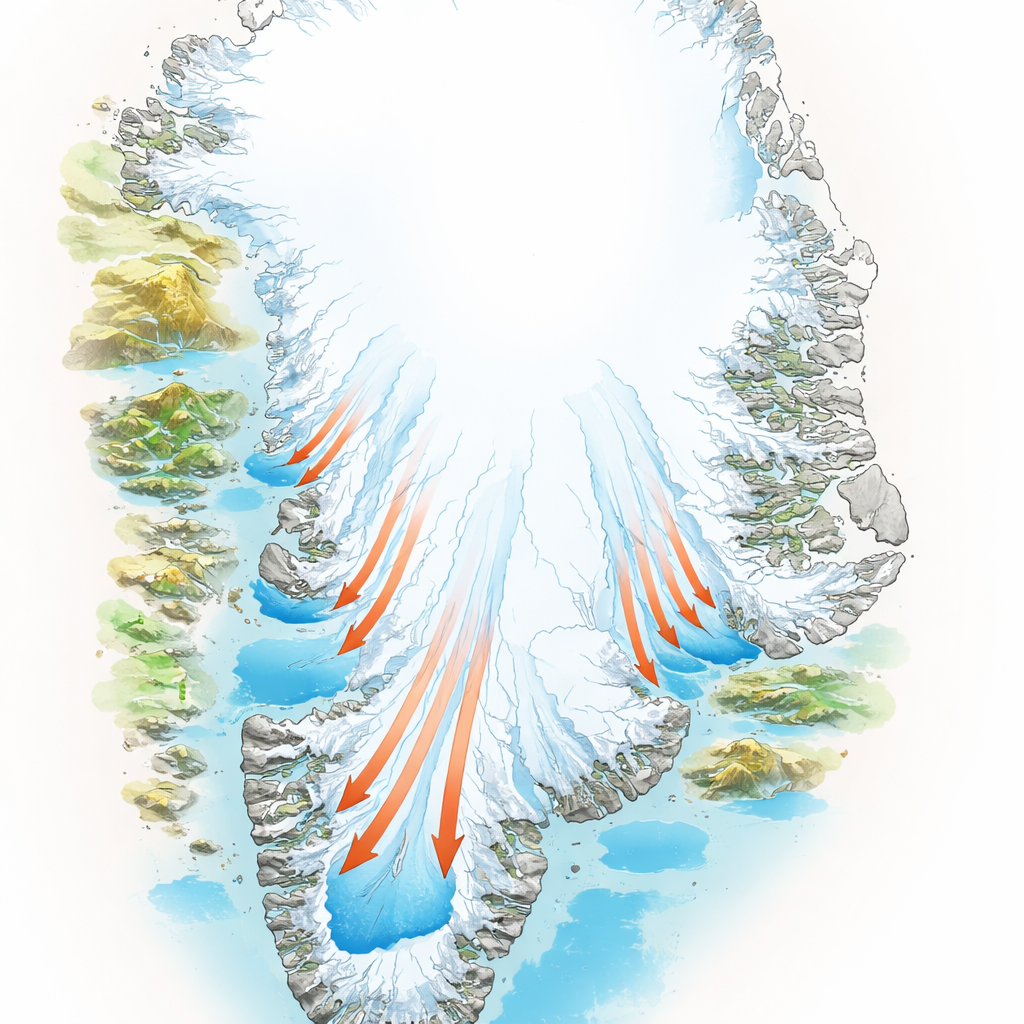
As Greenland’s ice margin retreats, meltwater collects in bowl-shaped hollows carved into the landscape, forming what scientists call ice-marginal lakes. About one tenth of the ice sheet’s edge is now bordered by freshwater, and that share is expected to grow. Earlier work hinted that these lakes can cause nearby ice to thin, break off, and retreat faster, but those observations were mostly limited to a few locations. What was missing was a Greenland-wide picture showing whether lakes systematically change how outlet glaciers behave compared with similar glaciers that simply run out over land.
Comparing lake-fed and land-fed glaciers
The researchers assembled a set of 102 outlet glaciers around Greenland that currently end in lakes larger than one square kilometre. For each of these, they identified a nearby glacier of similar size that ends on land instead, giving a paired comparison. Using satellite-based velocity maps from NASA’s ITS_LIVE project, they traced flowlines up to 10 kilometres inland and sampled ice speeds in a series of boxes from 500 metres to 9.5 kilometres behind each glacier front. They also checked the local surface slopes and elevations to make sure the lake- and land-terminating groups were otherwise comparable.
Faster flow where ice meets water
The contrasts they found are striking. On average, glaciers that end in lakes were more than twice as fast at their fronts as their land-ending partners, with a 231% increase in terminus speed during 2017. While this “speed boost” weakened inland, it remained clearly detectable up to about 3.5 kilometres from the margin. Land-terminating glaciers generally slowed down as they approached their fronts, with a typical 50% drop in speed over the lower two kilometres. By contrast, nearly half of the lake-terminating glaciers actually sped up toward their fronts, a sign of stretching flow that tends to thin the ice and deliver it more quickly to where it can break off.
When bigger lakes drive stronger change
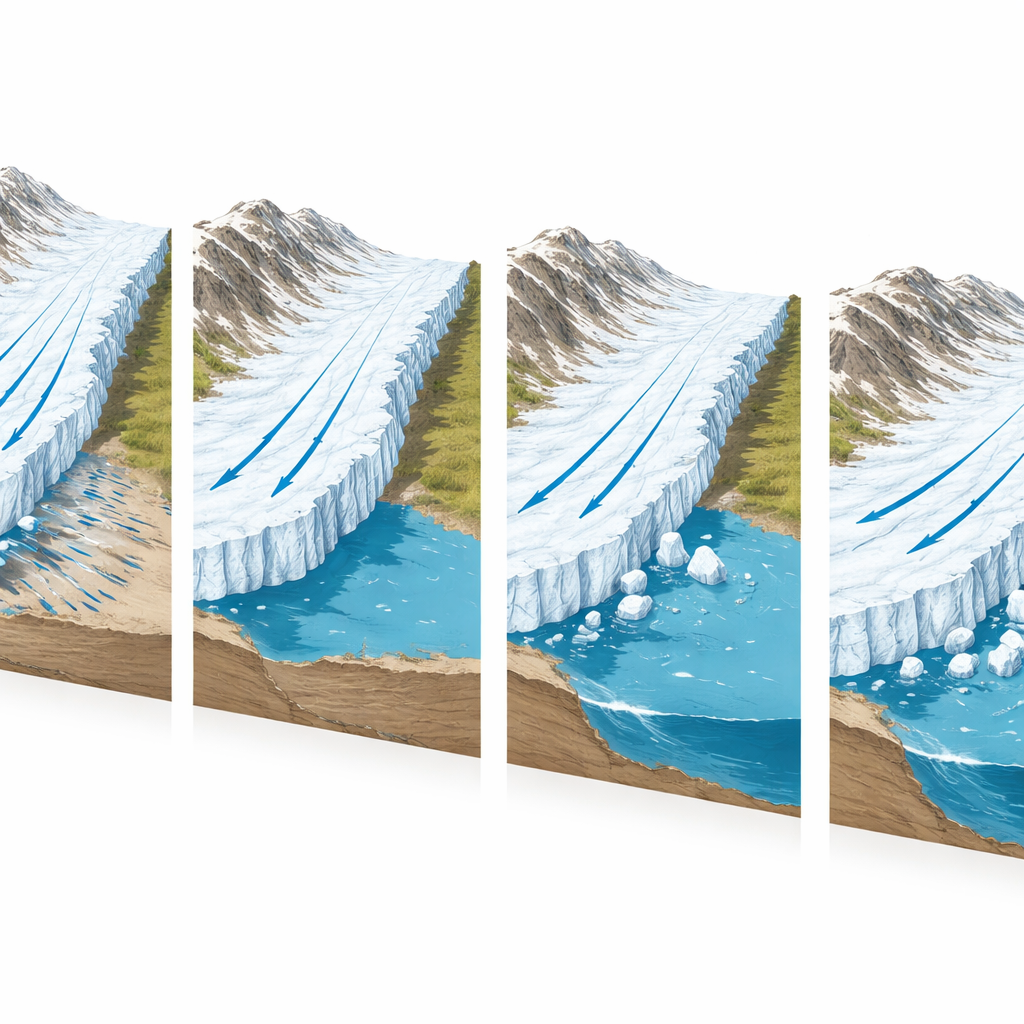
The team also investigated whether lake size matters. They ranked the outlet glaciers by the area of the lake they drain into, from just over one to almost ninety square kilometres. Glaciers flowing into the very largest lakes had median speeds around 40% higher, measured several kilometres inland, than those draining into the smallest lakes. These big-lake glaciers were also more likely to show strong down-glacier acceleration. Yet the relationship was not perfectly smooth: some of the most dramatic increases in velocity occurred for glaciers fronting medium-sized lakes, suggesting a complex dance between lake growth, ice thickness, lake depth, and the shape of the valley floor beneath the ice.
Why this changes our sea-level outlook
For a layperson, the key message is that lakes at the edge of the Greenland Ice Sheet act like slippery, undermining cushions that help pull ice seaward faster, not just right at the water’s edge but several kilometres upstream. As these lakes become more common and grow larger in a warming climate, more outlet glaciers are likely to join this faster-flowing group. Current computer models and some observational methods often focus on glaciers that reach the sea and may overlook these lake effects. This study shows that doing so could underestimate Greenland’s future ice loss and its contribution to rising seas, highlighting the need to treat these expanding lakes as active players rather than passive puddles at the ice sheet’s rim.
Citation: Harpur, C.M., Smith, M.W., Carrivick, J.L. et al. Ice-marginal proglacial lakes enhance outlet glacier velocities across Greenland. Commun Earth Environ 7, 287 (2026). https://doi.org/10.1038/s43247-026-03363-9
Keywords: Greenland ice sheet, proglacial lakes, outlet glaciers, sea level rise, glacier dynamics