Clear Sky Science · en
Melt re-injection into large magma reservoir after giant caldera eruption at Kikai Caldera Volcano
Why a hidden magma pool matters
Far beneath the waves south of Japan, the Kikai Caldera hides the scars of one of Earth’s most powerful eruptions in the last 10,000 years. Understanding what happened to the magma left behind—and whether it is being replenished—matters for long‑term volcanic hazard assessment. This study peers into the crust below Kikai using sound waves, revealing a large pocket of partially molten rock that appears to be recharging after the ancient blast.
A giant eruption in Earth’s recent past
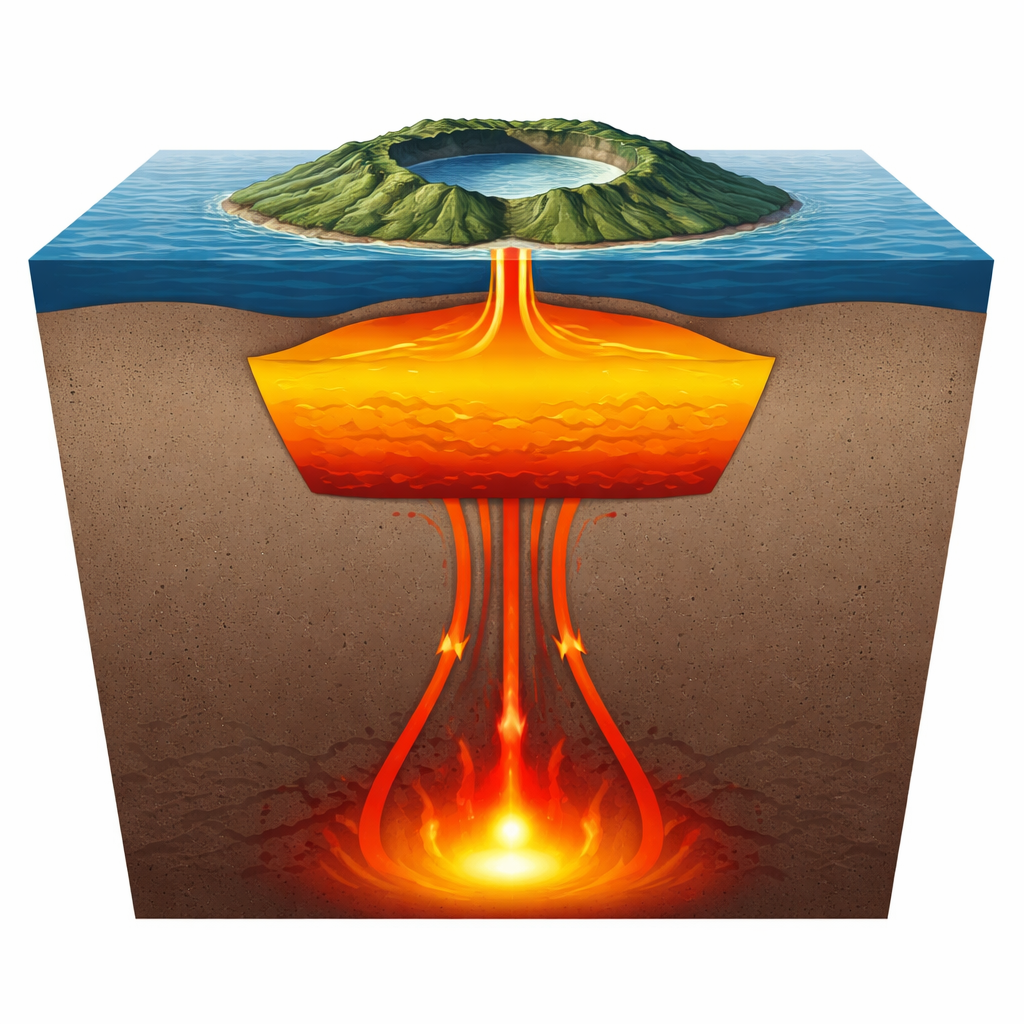
About 7,300 years ago, the Kikai‑Akahoya eruption blasted roughly 160 cubic kilometres of magma from a submarine volcano, collapsing the seafloor to form a wide caldera. Such “giant caldera” events are far larger than typical cone‑building eruptions and can alter regional climates and landscapes. Geological and petrological studies have shown that, after this catastrophe, new volcanic activity built a massive lava dome in the centre of the caldera a few thousand years later, hinting that fresh magma returned to the system. But the structure, size, and current state of the magma body feeding Kikai remained uncertain.
Listening to the ground with undersea seismometers
To image the crust beneath Kikai, the researchers deployed 39 ocean‑bottom seismometers along a 175‑kilometre line that crossed the caldera. They fired controlled acoustic pulses from a ship and recorded how the resulting seismic waves travelled through the crust. Because these waves move more slowly through hotter or more molten rock, the team could reconstruct a two‑dimensional map of wave speeds with depth. Comparing Kikai’s structure to neighbouring regions, they identified four distinct crustal zones; the one beneath the caldera stood out as unusually slow between about 2 and 12 kilometres below the seafloor.
Finding a warm, partly molten reservoir
By subtracting a background crustal model from their measurements, the team isolated a pronounced “low‑velocity anomaly” directly under the caldera. The region where wave speeds were reduced by more than 15 percent forms a broad, trapezoid‑shaped body between about 2.5 and 6 kilometres deep. Using laboratory relationships between rock temperature, melt content, and seismic speed, the authors converted this slowdown into estimates of heat and melt fraction. They infer that this body is a large magma reservoir with a melt content of roughly 3–6 percent, and very likely not more than about 10 percent, corresponding to a total volume of about 220 cubic kilometres—at least as wide as the inner caldera itself.
Evidence for magma returning after collapse
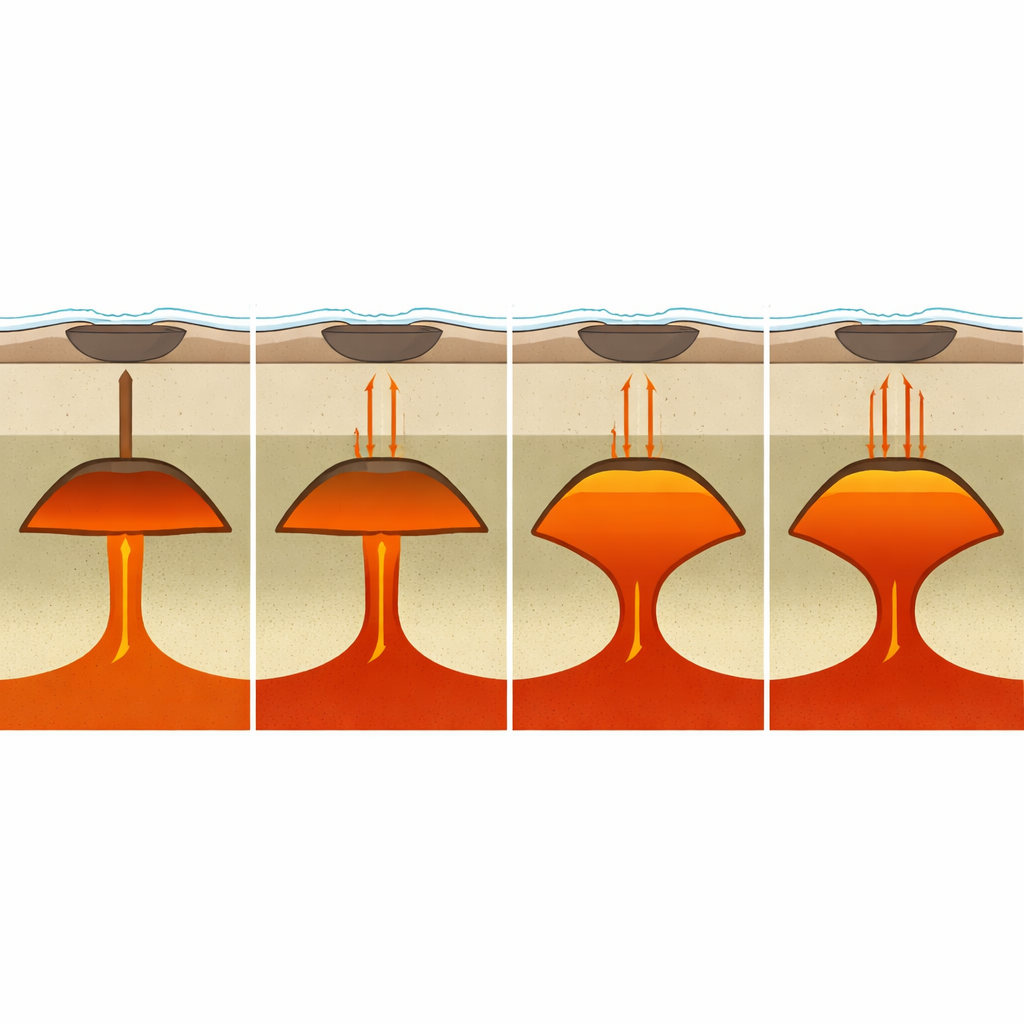
How does this newly imaged reservoir relate to the ancient eruption? Petrological studies of crystals from both the giant eruption deposits and the younger central lava dome indicate that magma was stored at similar shallow depths—between roughly 2 and 7 kilometres—both before the eruption and during later activity. The new seismic image locates today’s reservoir at those same depths, just beneath the caldera. Rock chemistry further suggests that the lava dome was supplied by magma distinct from that of the original giant eruption. Putting these clues together, the authors propose a “melt re‑injection” model: after the caldera‑forming blast emptied much of the original reservoir and triggered collapse, new magma from deeper levels gradually refilled the same space, at an average rate of at least about 8 cubic kilometres per thousand years, eventually building the central lava dome.
A pattern shared by other supervolcanoes
The idea that giant caldera systems refill their shallow reservoirs over thousands of years is not unique to Kikai. Similar shallow magma bodies have been imaged beneath Yellowstone in the United States, Toba in Indonesia, and Santorini in Greece, at depths comparable to those inferred for their past eruptions. This convergence suggests that re‑injection of melt into long‑lived, shallow reservoirs may be a common stage in the life cycle of large caldera volcanoes. Tracking how seismic wave speeds evolve in such regions can therefore provide valuable hints about how much melt is present, how it is distributed, and how these systems might be preparing—over geologic timescales—for future large eruptions.
What this means for living with volcanoes
For non‑specialists, the key message is that a giant eruption does not permanently shut down a volcano. At Kikai, the crust beneath the caldera now holds a large but only partly molten reservoir that has been slowly replenished since the last great blast. While the presence of this melt does not mean an imminent catastrophe, it shows that the volcanic system remains active and evolving. Continued seismic monitoring and improved imaging of such reservoirs can help scientists better understand how Earth’s most powerful eruptions are prepared in the deep crust and how their risks may change over thousands of years.
Citation: Nagaya, A., Seama, N., Fujie, G. et al. Melt re-injection into large magma reservoir after giant caldera eruption at Kikai Caldera Volcano. Commun Earth Environ 7, 237 (2026). https://doi.org/10.1038/s43247-026-03347-9
Keywords: caldera volcano, magma reservoir, seismic imaging, supereruption, volcanic hazards