Clear Sky Science · en
Cascading wood use into bioenergy with carbon capture and storage ensures continuous and enduring temperature reduction
Why this matters for our future climate
Keeping global warming in check will almost certainly require not just cutting emissions, but also pulling carbon dioxide out of the air and locking it away for good. This paper explores one promising way to do that using something many of us rarely think about: the leftover bits of wood from sawmills. By following where this "waste" wood goes over decades, the authors show how smart use of it can provide energy, support forest management, and still cool the planet in a lasting way.
Turning wood leftovers into a climate tool
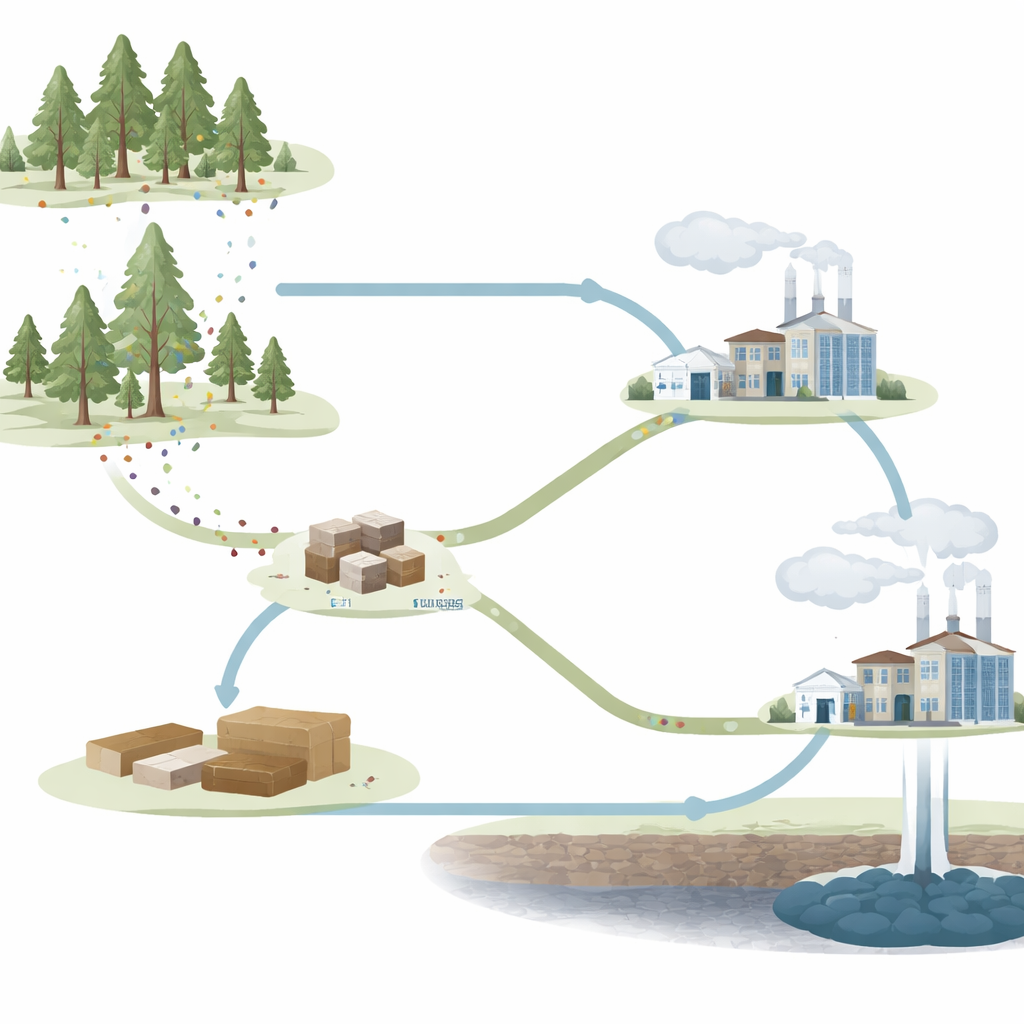
When logs are cut into planks, a large share ends up as residues such as chips and sawdust. Today these are commonly burned for energy or used in products like particleboard. The study looks at what happens to the climate when these residues are burned in power plants equipped with carbon capture and storage (often called BECCS), compared with using them directly for energy, or first turning them into wood products and only later burning them. The key question is how much and how long carbon is kept out of the atmosphere in each case, once the whole chain from forest to final storage is considered.
Following carbon through time, not just on paper
Most environmental assessments add up greenhouse gas emissions over a standard 100-year window, without paying much attention to when those emissions actually occur. Here, the authors instead use a "dynamic" life-cycle approach that tracks carbon year by year. They model sawmill residues coming from sustainably managed spruce forests, where tree growth balances harvest so that overall forest carbon remains stable. They then simulate many possible futures: different speeds of cleaning up the wider energy system, different levels and timing of carbon capture on bioenergy plants, and different ways of using the residue wood before it is finally burned.
Why using wood more than once helps
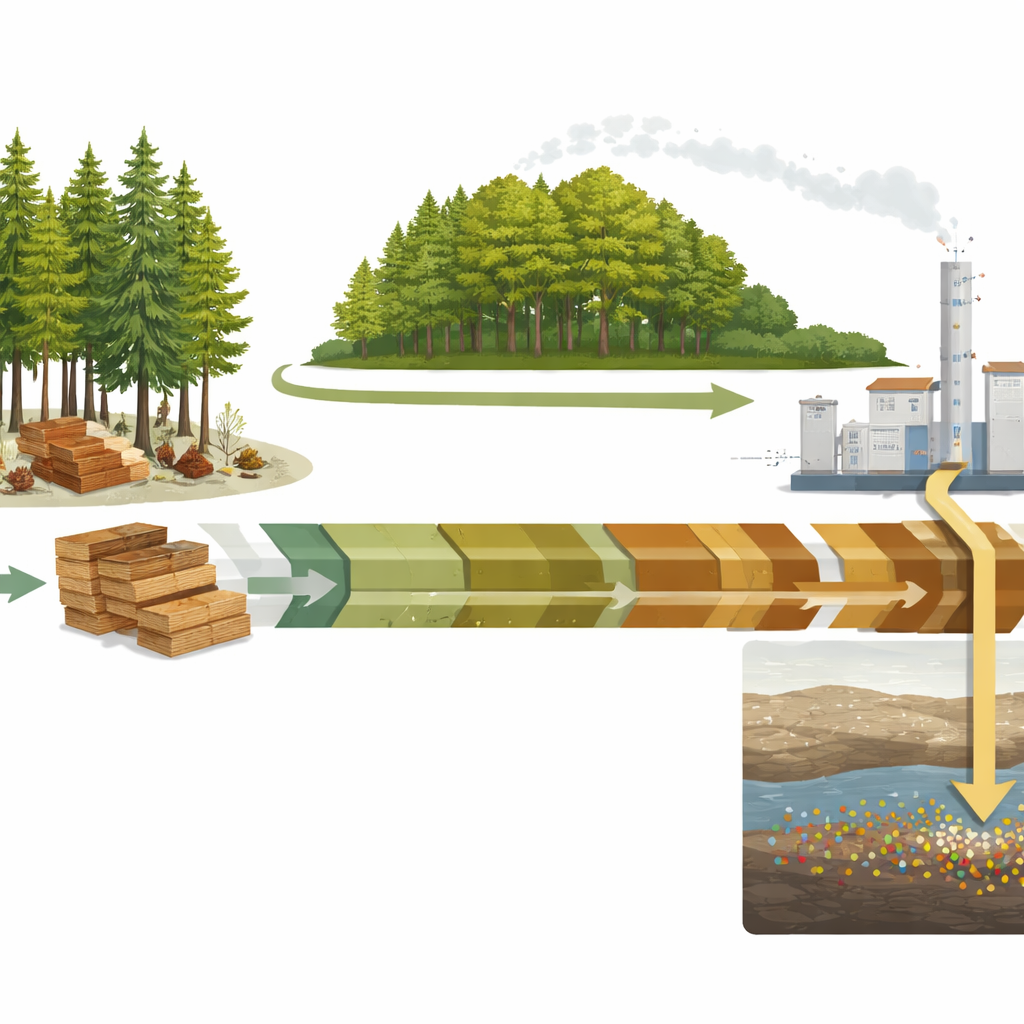
One major comparison is between burning residues right away for power versus first embedding them in particleboard, which stores the carbon in buildings or furniture for about 30 years, and then sending that board to a BECCS plant at the end of its life. In a fossil-fuel heavy world, this cascading use gives a strong double benefit: the wood products temporarily store carbon and replace more polluting materials like steel or cement, and later the captured carbon from burning is pumped deep underground. Even as the wider economy decarbonises and those material replacement benefits shrink, the strategy of using wood in products before BECCS still brings earlier and often stronger cooling than burning the residues at once.
Forests left alone versus forests supplying BECCS
The study also asks what would happen if a portion of forest is simply left unharvested, letting trees keep absorbing carbon, and no residues are produced at all. In the near term, this hands-off approach can cool the climate more than sending residues to energy, because the forest acts as a strong carbon sink. But this extra uptake slows as the forest matures, and the stored carbon remains vulnerable to fire, storms, pests, or disease. By contrast, when residues from sustainably managed forests are used in cascading products and then BECCS, a growing share of that biogenic carbon ends up in geological formations where it is effectively permanent. Over several decades to a century, the modeled scenarios show that these wood-and-BECCS chains can surpass even unharvested forests in total cooling effect, especially when capture technology is rolled out quickly.
What the results mean in plain terms
Put simply, the authors find that burning sawmill residues in plants that capture and store the carbon can be a reliable way to deliver long-lasting temperature reductions, as long as the source forests are managed so that overall forest carbon stocks do not decline. Letting wood do useful work first—such as in particleboard—and only later feeding it into BECCS tends to boost early-century benefits and gives societies time to build the necessary capture and storage infrastructure. Over the long run, shifting biogenic carbon from living forests into deep geological reservoirs through multiple stages of use appears more durable and resilient than relying solely on trees to hold that carbon in an increasingly risky climate.
Citation: Bishop, G., Duffy, C., Berndes, G. et al. Cascading wood use into bioenergy with carbon capture and storage ensures continuous and enduring temperature reduction. Commun Earth Environ 7, 233 (2026). https://doi.org/10.1038/s43247-026-03333-1
Keywords: bioenergy with carbon capture, cascading wood use, forest carbon, negative emissions, climate mitigation pathways