Clear Sky Science · en
Reforestation scenarios shape global and regional temperature outcomes
Why Planting Trees Is Not Always Simple
Planting trees is often promoted as a straightforward solution to climate change: more forests, less warming. But where those trees are planted matters just as much as how many are planted. This study uses a sophisticated Earth system model to test how different global reforestation plans affect temperatures around the world. The results show that reforestation can cool the planet overall, but it can also warm some regions—and that smart placement can achieve similar global benefits with far less land.

Three Different Ways to Reforest the Planet
The researchers compared three prominent maps of where new forests could be grown worldwide. All three highlight familiar hotspots for regreening—parts of the eastern United States, the Amazon, central Africa, and eastern China. Yet they differ strongly in total area and latitude. Two maps assume very large potentials close to a billion hectares, with one putting more new forest in the tropics and another extending far into northern, snowy regions. A third map is more conservative, using about half as much land and focusing less on high latitudes. The team fed each of these patterns into a fully coupled Earth system model that simulates interactions among land, air, and ocean from 2015 to 2100.
How Forests Cool and Warm the Planet
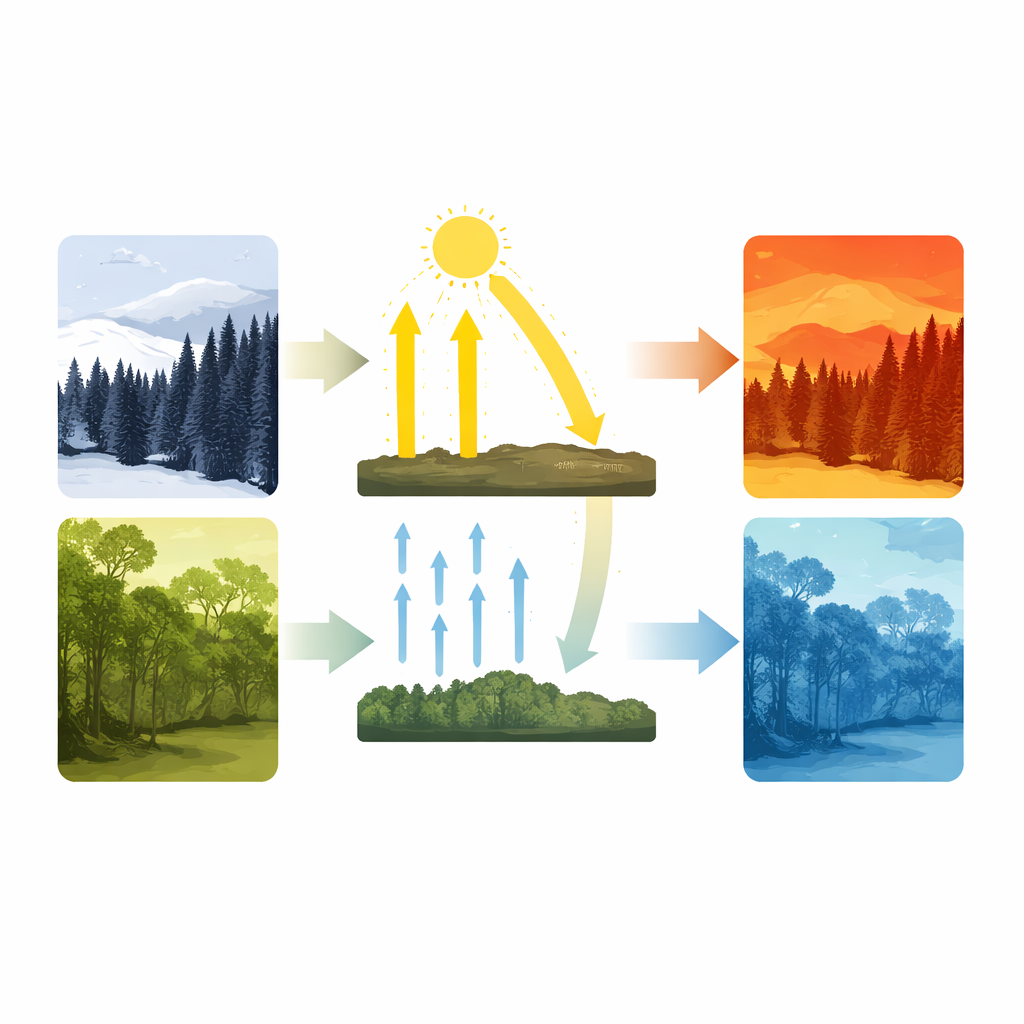
Forests influence climate in two main ways. First, by absorbing carbon dioxide, they slow the buildup of greenhouse gases; this long-term “carbon effect” tends to cool the planet. Second, forests change local physical conditions such as how much sunlight the surface reflects, how much water they evaporate, and how rough the land is to the wind; these “surface effects” can either cool or warm nearby regions. Dark tree canopies over snow reflect less sunlight and can warm high-latitude areas, while lush tropical forests evaporate more water and tend to cool the air. The model allowed the authors to separate these two influences and to see how they interact under a realistic future emissions pathway.
Global Cooling, But Regional Surprises
Across all three reforestation plans, extra carbon uptake by new forests produced a clear global cooling by the end of the century, between about 0.13 and 0.25 degrees Celsius. This cooling kept strengthening even after tree planting stopped in 2070, as forests continued to store carbon in wood and debris. Surface effects told a more mixed story. In the scenario with extensive high-latitude planting, the darkening of snowy landscapes caused noticeable warming over northern lands, partly erasing the cooling from carbon storage. In contrast, the more targeted, smaller-area scenario produced little such surface warming. Despite using roughly 450 million hectares less land, it achieved almost the same net global cooling as the most expansive scenario, simply by avoiding areas where new forests would strongly reduce reflectivity.
Local Cooling, Distant Side Effects
Zooming in, the model showed that reforestation reliably cooled many tropical and subtropical regions, especially parts of South America and Africa, where more evaporation and cloud changes helped lower temperatures. At higher latitudes, however, local warming from darker surfaces often combined with large-scale shifts in winds and ocean currents. These distant ripple effects could either reinforce or counteract local changes, sometimes making regions warmer even when nearby forests themselves had a mild cooling influence. For example, some North American areas experienced amplified warming, while parts of Europe saw slight cooling driven mainly by changes in nearby ocean circulation rather than by local land changes.
Guiding Tree Planting for Real Climate Gains
For non-specialists and policymakers, the core message is that trees are a useful but limited tool in the climate toolbox—and that “where” matters as much as “how much.” The study finds that even very ambitious reforestation could cool the globe by at most about a quarter of a degree Celsius by 2100, far from enough to replace rapid cuts in fossil fuel use. Still, by prioritizing tropical and subtropical regions and being cautious about large-scale planting in snowy or high-latitude areas, societies can get more climate benefit from fewer trees. Climate-smart reforestation—focused on the right places and combined with deep emission reductions—offers a more realistic and effective path than simply trying to cover as much land with trees as possible.
Citation: Fahrenbach, N.L.S., De Hertog, S.J., Jäger, F. et al. Reforestation scenarios shape global and regional temperature outcomes. Commun Earth Environ 7, 204 (2026). https://doi.org/10.1038/s43247-026-03331-3
Keywords: reforestation, climate mitigation, forest cooling, Earth system modeling, land use change