Clear Sky Science · en
Perceived deservingness shapes attitudes toward environmental migrants in rural Bangladesh
Why this story matters
As climate change reshapes our planet, millions of people are being pushed from their homes by floods, storms, and slowly crumbling riverbanks. Most of these moves happen within their own countries, often from one rural village to another. This study looks at how people living in rural Bangladesh feel about neighbors who arrive after losing their homes to the river, and what drives acceptance or rejection. Understanding these everyday judgments matters because they can either ease social tensions or deepen divides as more people are forced to move.
Life on a shifting river
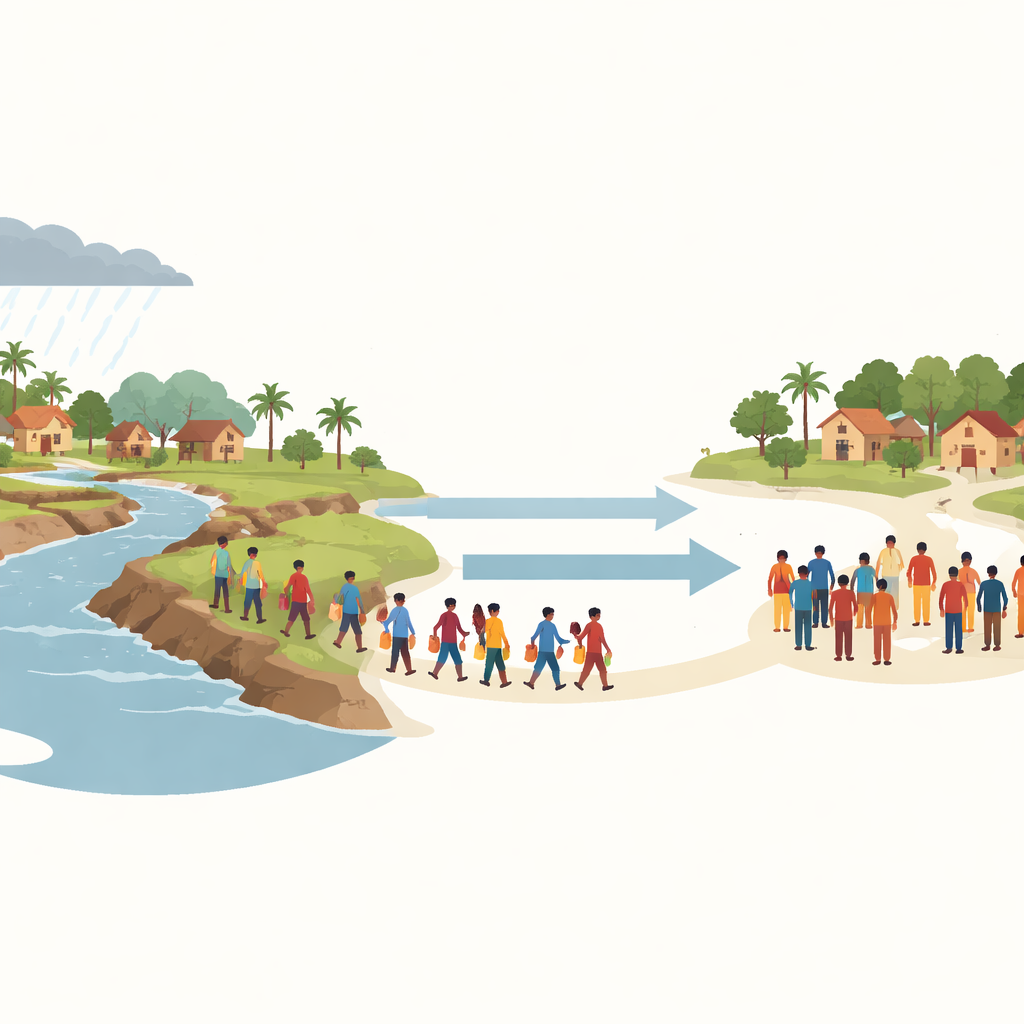
Along Bangladesh’s Jamuna River, the ground itself is unstable. Powerful currents and rising waters eat away at the riverbanks, destroying fields, homes, and roads. Around 200,000 people a year are displaced in this way, and many try to resettle in nearby villages rather than moving to distant cities. They rely on familiar farming skills, local customs, and kinship ties to rebuild their lives. The researchers surveyed 265 residents in such receiving villages to see how they felt about incoming households, focusing on those pushed out by erosion compared with people who moved mainly for work or better income.
Who seems most "deserving" of a welcome
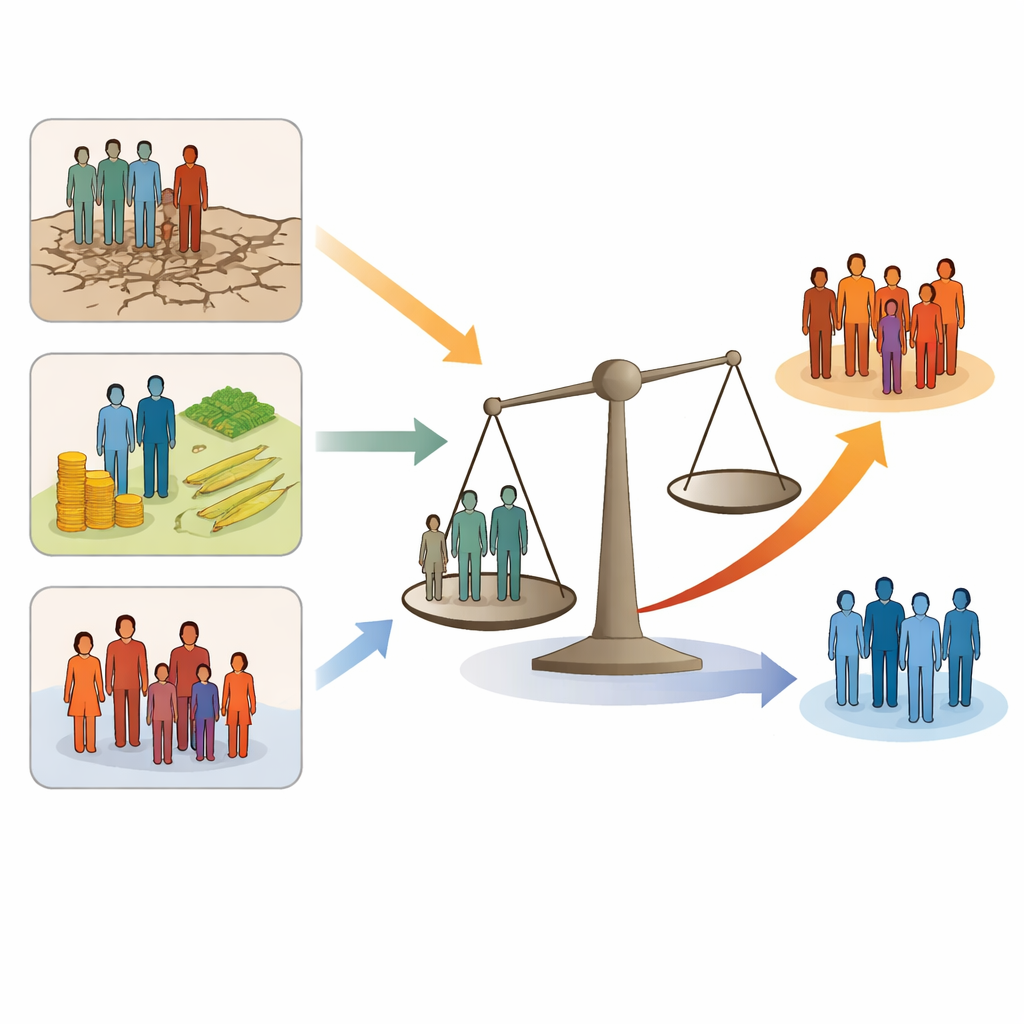
A key idea in the study is “deservingness” – the everyday moral judgment about who truly needs help. To measure this, the team used a visual choice experiment. Villagers were repeatedly shown pairs of simple stories about possible newcomers that differed in four ways: why they moved (erosion, family reunification, or economic reasons), their job (e.g., teacher, farmer, cobbler), religion, and how far away they came from. For each pair, respondents chose whom they would rather have as a neighbor. Across hundreds of such choices, a clear pattern emerged: people who moved because riverbank erosion destroyed their home were 21 percentage points more likely to be chosen than those who moved for economic reasons. Family reunification also scored higher than economic motives, but erosion-triggered moves came out on top, suggesting people strongly distinguish between forced and voluntary movement.
How work, faith, and distance still matter
Even as erosion-displaced migrants were generally preferred, other traits still shaped attitudes. Migrants with higher-status or more respected jobs, such as teachers and farmers, were chosen more often than those with low-status occupations. Religion made an even bigger difference: migrants who shared the majority faith in the area were strongly favored over religious minorities. Distance also played a role, though more modestly: newcomers from faraway places were slightly less likely to be selected than those from nearby communities. These patterns echo broader research showing that people tend to feel warmer toward those they see as economically self-reliant, culturally similar, and geographically close.
When hardship softens other barriers
The most striking finding is how being pushed out by erosion can soften these other biases. For economic migrants, being from a distant place or having a lower-status job clearly reduced acceptance. For environmental migrants, these penalties shrank or disappeared: distance no longer mattered, and differences between occupations became less important. In other words, when villagers saw newcomers as victims of forces beyond their control, they were more willing to overlook traits that might otherwise trigger hesitation. People who had themselves lost a house to erosion showed especially strong support for erosion-displaced migrants, hinting that shared hardship may deepen empathy, although the sample was too small to confirm this effect with high statistical certainty. By contrast, rough measures of how much migration a village had recently seen, or whether someone had migrants as friends, did not show clear links to more welcoming attitudes.
What this means for a warming world
Overall, the study paints a picture of rural communities that are surprisingly open to newcomers, even in places where land and jobs are scarce. Villagers strongly prefer people whose move is clearly forced by environmental loss over those seen as moving for economic gain, and that moral judgment can blunt fears about distance, status, or difference. At the same time, religious minorities still face disadvantages, showing that some social boundaries remain stubborn. For a world facing rising levels of climate-related displacement, these results suggest that policies which keep relocation close to home, support family ties, and clearly communicate the involuntary nature of moves may help sustain acceptance. In many climate-vulnerable regions, it is not just resources but also everyday ideas of fairness and shared fate that will determine how well migrants and hosts can live together.
Citation: Rudolph, L., Hormuth, L., Freihardt, J. et al. Perceived deservingness shapes attitudes toward environmental migrants in rural Bangladesh. Commun Earth Environ 7, 247 (2026). https://doi.org/10.1038/s43247-026-03320-6
Keywords: climate migration, Bangladesh, riverbank erosion, host community attitudes, environmental displacement