Clear Sky Science · en
Pathogen dispersal can lead to high exposure risk at European flat oyster restoration sites
Why Oyster Health Matters to Everyone
Along Europe’s coasts, the once-abundant flat oyster has nearly vanished, taking with it natural reefs that sheltered marine life, filtered coastal waters, and buffered shorelines. Scientists and conservation groups are now working hard to rebuild these reefs, but a tiny parasite threatens to undo that progress. This study asks a deceptively simple question with big consequences: even if we move only healthy oysters, can invisible disease still hitch a ride on ocean currents and reach new restoration sites?
Tiny Parasites on the Move
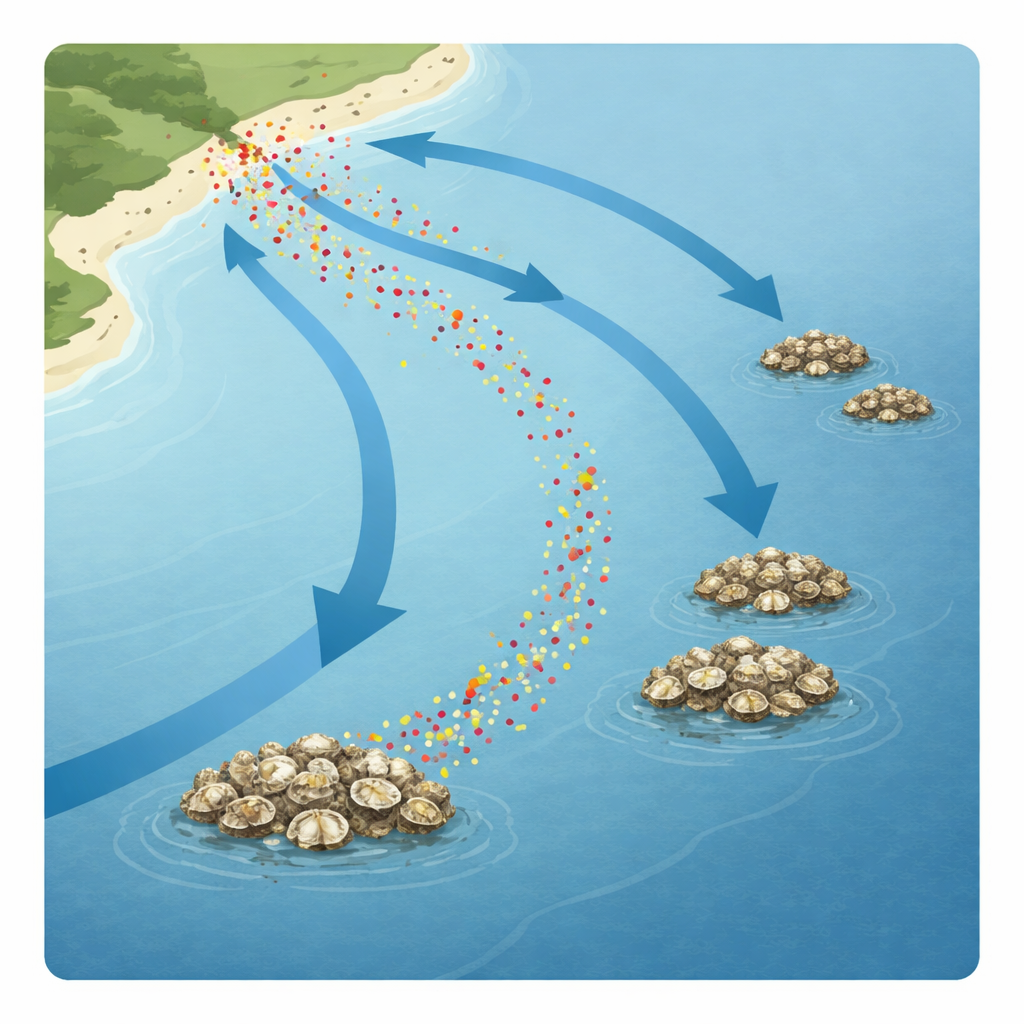
The culprit, Bonamia ostreae, is a microscopic parasite that infects the European flat oyster. Over the past decades it has devastated wild and farmed oyster populations, slashing production in places like France and contributing to the near-disappearance of natural reefs. Today, more than 40 restoration projects are trying to bring this native oyster back. They follow strict rules to avoid moving infected animals, but Bonamia cells and infected larvae can drift freely in seawater. Because these particles are too small and short-lived to track easily in the field, the authors turned to computer simulations to ask how far they might travel and where they are most likely to collide with vulnerable oyster beds.
Following Invisible Trails in the Sea
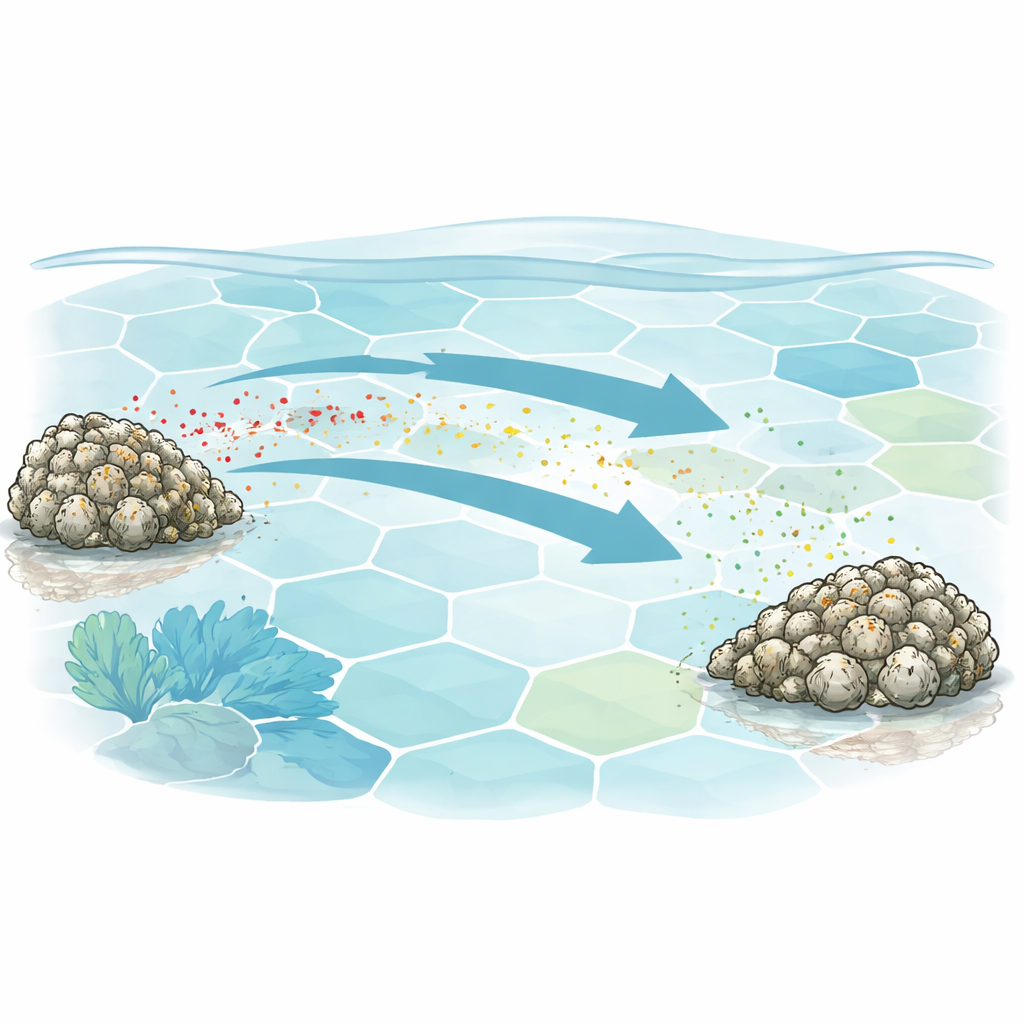
To trace these hidden journeys, the team combined a detailed ocean circulation model for the North-West European shelf with a “virtual particle” approach. They released millions of simulated particles into the model ocean, representing either free-living Bonamia cells that survive up to about a week or oyster larvae that can remain in the water column for several weeks. The model tracked how currents pushed these particles from known infected and aquaculture areas toward shallow regions where oysters can live. Instead of rerunning the simulations for every new question, the researchers built a reusable framework that stores how each part of the sea connects to every other, allowing rapid testing of different disease and habitat scenarios.
Risky Places and Safer Havens
The simulations show that typical travel distances are on the order of tens of kilometers—around 30 km for short-lived free parasite cells and 50–60 km for infected larvae—with some rare journeys spanning hundreds of kilometers. Crucially, these ranges are not uniform: local current patterns create strong differences in how far and where particles drift. Some infected regions, especially around southern Brittany and parts of the Wadden Sea, are highly connected and can send parasites toward many suitable oyster habitats. When the researchers focused on actual restoration sites, about 30% of them repeatedly lay in pathways where particles from infected areas accumulated, particularly along western and southern Brittany, southern England, Wales, and western Ireland. Others were only occasionally exposed, and nearly half showed no simulated connection to known disease sources during the study period.
Using Currents to Guide Smart Restoration
The study goes beyond mapping exposure to suggest how these patterns can inform real-world decisions. By turning the relative model outputs into a simple scaling factor, managers can combine local measurements of parasite load with the simulated dilution patterns to estimate absolute exposure levels at any site. This can help regulators define more realistic disease “zones” based on how water actually moves, not just on political boundaries. For restoration teams, the same tools can highlight areas that are both historically suitable for oysters and relatively isolated from infection sources, or reveal trade-offs where a site is well connected for larval supply but also more exposed to disease. Although the model intentionally takes a conservative, worst-case view and does not predict exactly how many oysters will die, it offers a practical way to prioritize monitoring and refine site selection.
What This Means for Oyster Comebacks
In plain terms, the study shows that even without moving sick oysters, ocean currents alone can carry disease from existing hotspots to new restoration reefs, sometimes across national borders and over surprisingly long distances. Yet it also reveals that not all sites are equally vulnerable: some locations appear consistently risky, while others are naturally shielded by the way water flows. By understanding these invisible connections, conservationists and regulators can move from reacting to outbreaks after the fact to planning reefs, farms, and monitoring in places where the odds of staying healthy are higher. That shift could make the difference between fragile, short-lived oyster outposts and the long-term recovery of thriving, resilient reef ecosystems along Europe’s coasts.
Citation: Schmittmann, L., Rath, W., Bean, T.P. et al. Pathogen dispersal can lead to high exposure risk at European flat oyster restoration sites. Commun Earth Environ 7, 246 (2026). https://doi.org/10.1038/s43247-026-03319-z
Keywords: oyster restoration, marine disease, ocean currents, pathogen dispersal, coastal ecosystems