Clear Sky Science · en
Net primary productivity orchestrates uncertainty sources driving global soil organic carbon under land use change
Why the ground beneath us matters
Soils quietly hold more carbon than all the world’s plants and the atmosphere combined, making them a powerful lever in the fight against climate change. When we clear forests, expand farms, or plant new trees, we change how much carbon enters and leaves the soil. Yet scientists still disagree on whether these land changes are turning soils into a net carbon source or sink for the planet. This study digs into that puzzle, showing that how much plants grow each year is the biggest source of disagreement in global models of soil carbon change.
Changing the face of the land
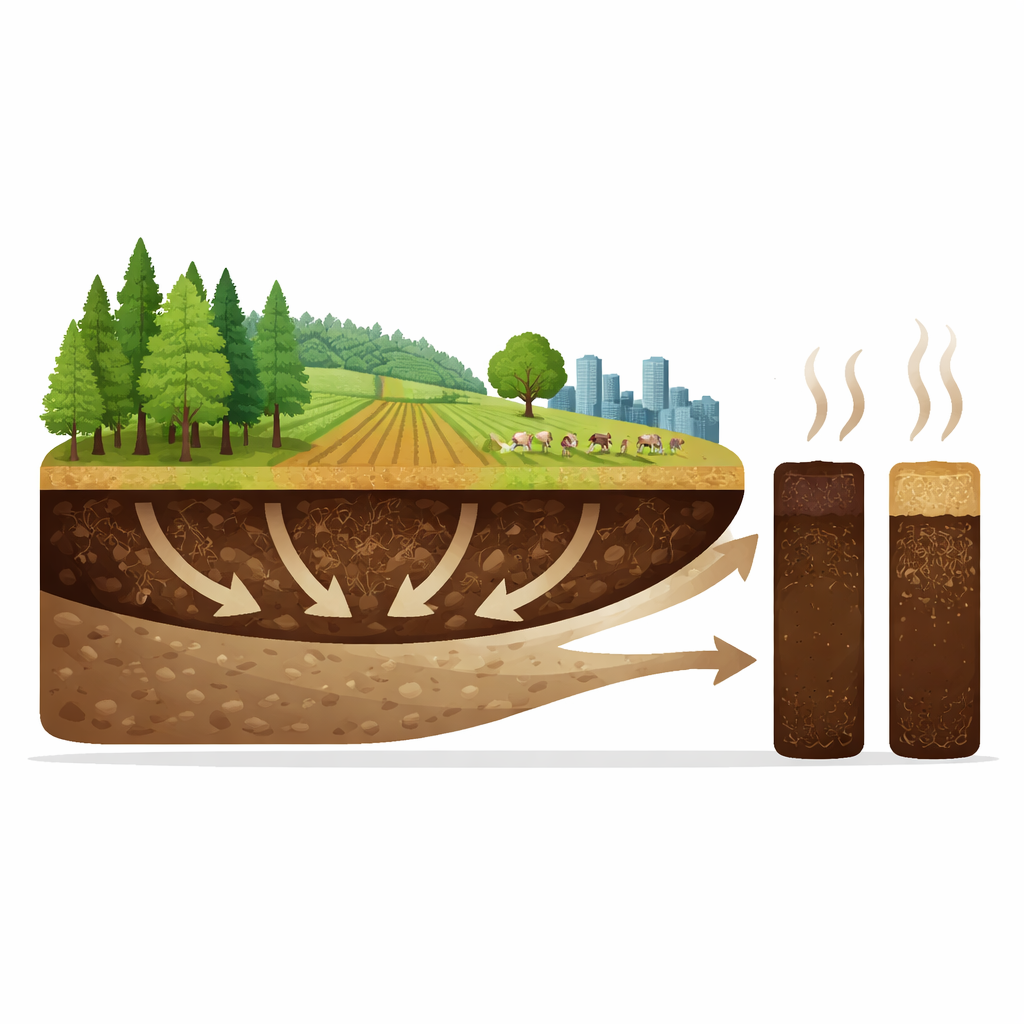
Over the past century, people have transformed about a third of Earth’s land surface through deforestation, farming, grazing, urbanization, and tree planting. These shifts, known as land use and land cover change, alter the balance between carbon entering soils from plant growth and carbon leaving soils through decay. When forests are converted to croplands, for example, shorter growing seasons, harvests that remove biomass, and plowing that disturbs the soil often reduce soil carbon. In contrast, widespread tree planting in regions such as China has increased plant growth and, in many cases, soil carbon. Because these effects are complex and spread unevenly across the globe, researchers rely on large computer models to estimate the net outcome.
How scientists try to track buried carbon
The authors analyzed results from 35 state-of-the-art computer models that simulate how land, vegetation, and climate interact over time. These models are organized into three international comparison groups, each using different climate data, land-use histories, and representations of vegetation and soils. For each model, the team compared paired simulations: one with historical land-use change and one with land use held constant. The difference between the two reveals how much soil organic carbon changed specifically because of human land decisions since 1901.
A split verdict on global soil gains and losses
The models did not agree on whether land-use change has increased or decreased global soil carbon. One group of models suggested that, overall, soils gained carbon, mainly in northern regions. The other two groups indicated net soil carbon losses, especially in the tropics and many temperate areas such as the central United States, Europe, China, and parts of South America and Africa. Regionally, the tropics stood out as hotspots of soil carbon loss in most models, reflecting intense deforestation, warm and moist conditions that speed up decay, and soils that offer less mineral protection for organic matter. Despite the conflicting global totals, there was broad agreement that many heavily farmed or deforested regions have lost soil carbon over the last century.
Plant growth as the biggest wild card
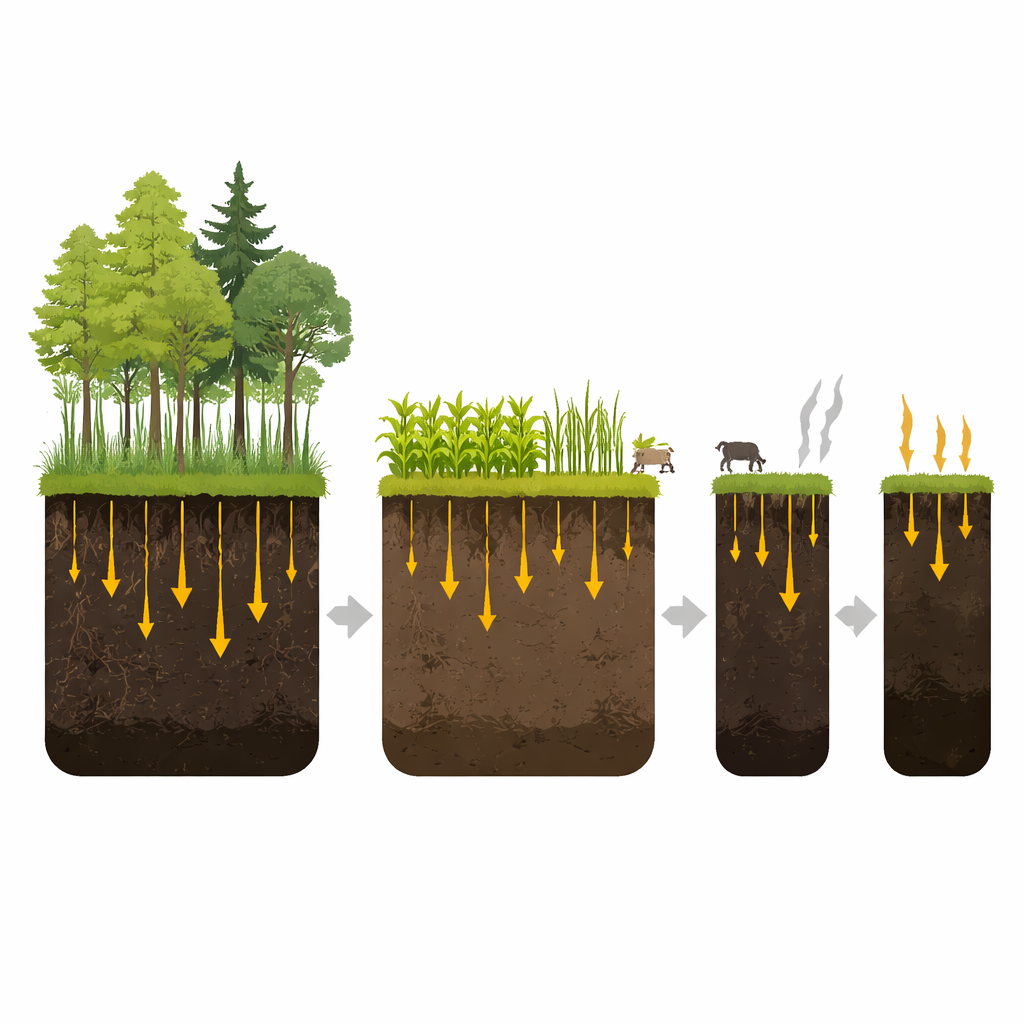
To understand why models disagreed, the researchers used a diagnostic framework that separates soil carbon change into four pieces: changes in plant growth (the carbon entering soils), changes in how long carbon stays in soils, the interaction between these two, and how far soils are from a steady balance between input and loss. Across all model groups, shorter soil carbon residence times consistently pushed soils toward losing carbon after land-use change. In other words, when land conversions or management sped up decomposition, soils tended to become a source of carbon. The real uncertainty came from plant growth. In some model groups, land-use change reduced plant production and drove large soil carbon losses; in another group, plant growth actually increased enough in many regions to more than compensate for faster soil turnover, leading to net gains. This shows that how models represent vegetation growth and its response to land use and climate is the dominant source of disagreement.
What this means for climate solutions
From a layperson’s perspective, the study’s message is that the climate impact of changing land use depends critically on two levers: how much plants grow and how quickly soil carbon breaks down. All models agree that speeding up soil decay through practices like intensive tillage, repeated harvests, or poorly managed deforestation erodes soil carbon. But they diverge on how strongly reforestation, improved management, or rising carbon dioxide might boost plant growth enough to rebuild those stocks. The authors argue that better long-term measurements of plant productivity and soil carbon turnover, combined with new data and machine-learning tools, are essential to narrow these uncertainties. Getting those numbers right will improve global carbon budget estimates and help design land-use and farming strategies that truly lock more carbon safely in the ground rather than releasing it to the air.
Citation: Gang, C., Wei, N., Feng, C. et al. Net primary productivity orchestrates uncertainty sources driving global soil organic carbon under land use change. Commun Earth Environ 7, 285 (2026). https://doi.org/10.1038/s43247-026-03312-6
Keywords: soil carbon, land use change, plant productivity, carbon cycle, climate mitigation