Clear Sky Science · en
COVID-19 containment and control reduced lake turbidity around the world
When a Global Pause Cleared the Waters
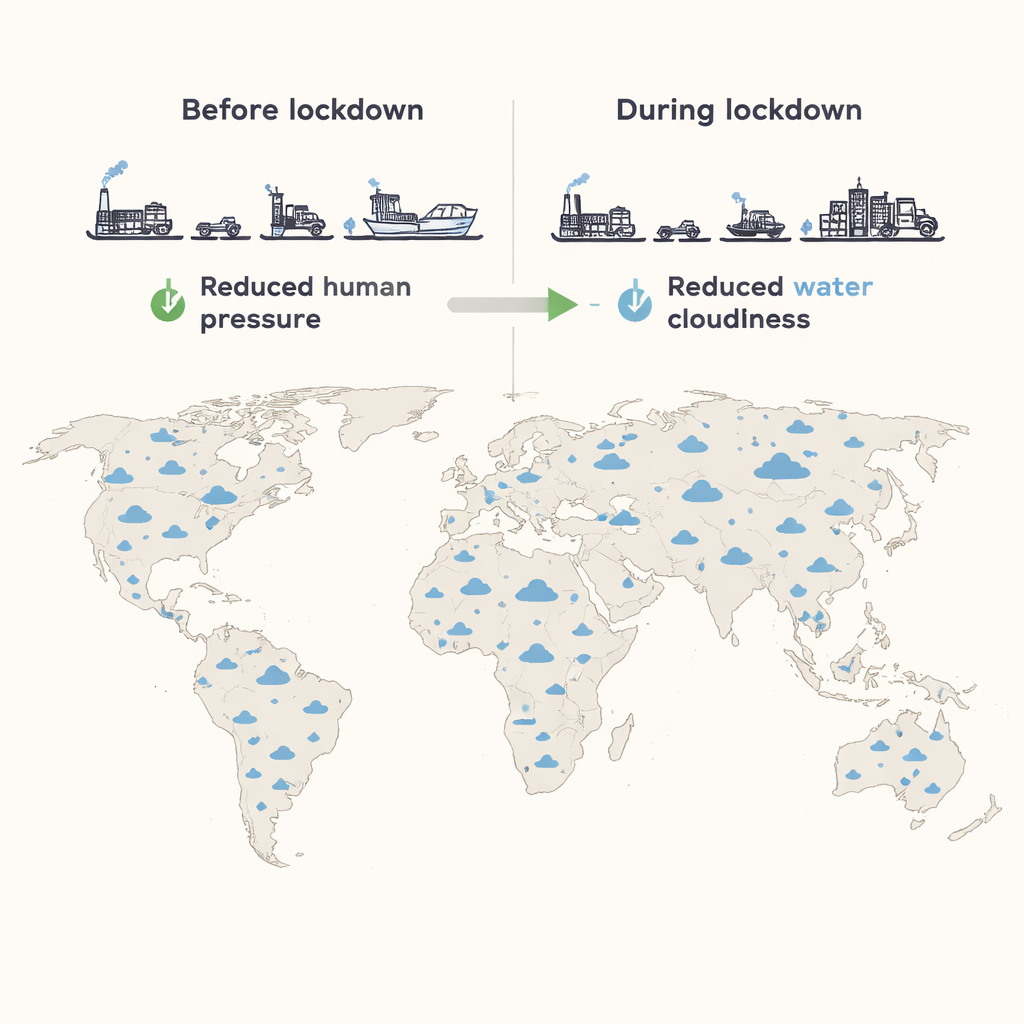
The COVID-19 lockdowns changed daily life in obvious ways—empty streets, grounded planes, and closed factories. Less visible was what happened underwater. This study used satellites to look at more than 700 lakes around the world and found that when human activity suddenly slowed, many lakes, especially along their shores, became noticeably clearer. That natural experiment offers a rare glimpse of how strongly our actions can cloud, or clean, the waters we depend on.
A Planet-Sized Natural Experiment
Healthy lakes provide drinking water, food, recreation, and habitat for wildlife, but they are easily muddied by farming, industry, and construction. Extra soil and pollution make the water turbid—cloudy with suspended particles—which blocks light, lowers oxygen, and can tip ecosystems toward algae-filled, low-oxygen states. Normally it is hard to separate the influence of weather from human activity. The abrupt slowdown during COVID-19 offered a once-in-a-generation chance to see what happens to lake water when human pressure suddenly eases while climate keeps marching on.
Reading Lake Clarity from Space
The researchers relied on a European satellite product that measures turbidity every ten days for lakes worldwide. They examined 774 lakes on all continents from 2017 through 2022, looking separately at the cloudiest parts of each lake (usually near shores and river inlets) and the clearer open-water centers. They compared conditions before the pandemic (2017–2019) with those during it (2020–2022), and used statistical and machine-learning tools to tease apart the roles of climate, lake characteristics, and changes in human activity linked to COVID-19 containment rules in each country.
Shorelines Cleared, Centers Stayed Steady
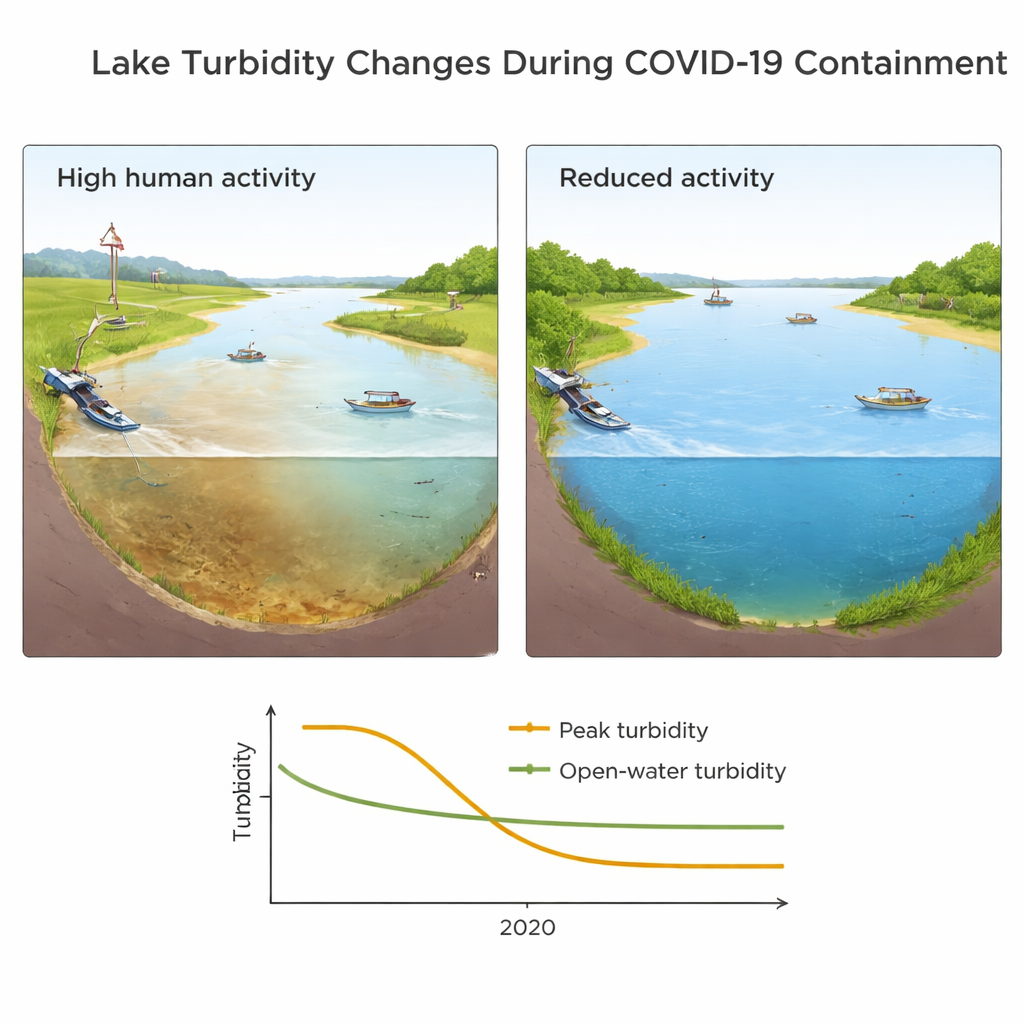
The sharpest signal appeared in the cloudiest lake zones, where turbidity typically runs highest. Globally, these “peak turbidity” areas became about 7 percent clearer in 2020 than in 2019. Careful modeling suggests that most of that drop—roughly 6 percent—was directly tied to COVID-19 containment, not to weather swings. On average, peak turbidity during 2020–2022 would have been about 5 percent higher without lockdowns. Three out of four lakes saw their peak turbidity fall, and in more than 40 percent of lakes the drop topped 10 percent. Lakes in countries with stricter pandemic measures and heavier human footprints around their shores—dense populations, intensive farming, strong nighttime lighting—showed the biggest improvements and the quickest rebound as restrictions eased in 2022. By contrast, the clearer central parts of lakes changed little, underlining that nearshore zones are far more sensitive to short-term human disturbance.
Tracing the Fingerprints of People and Climate
To understand what drove these shifts, the team linked lake changes to satellite data on night-time lights (a proxy for economic activity), runoff from surrounding land, snowmelt, wind, and more. In heavily used landscapes, drops in night-time lights and changes in runoff best explained the improvement in water clarity. Where lights dimmed most—signaling slower industry, transport, and tourism—nearshore waters cleared the most. In quieter, less developed regions, climate factors such as increased snowmelt and altered runoff played a bigger role, sometimes making lakes clearer and sometimes murkier. Overall, lakes where human activity declined stood out: in 168 lakes, containment-driven improvements in peak turbidity averaged nearly 19 percent, a larger gain than typical climate-driven improvements.
What a Sudden Cleanup Teaches for the Long Term
The study shows that lake muddiness is not fixed: in many places, simply reducing day-to-day disturbance and pollution inputs can quickly improve nearshore water quality, even though deeper, central waters respond more slowly. It also highlights turbidity—how cloudy water is—as a practical, early-warning indicator that can be monitored efficiently from space. While the pandemic was a crisis, its unintended “quiet period” around many lakes revealed how much difference good wastewater treatment, careful farming, and reduced shoreline disturbance could make. For policymakers and communities, the message is straightforward: targeted efforts to curb pollution and physical disturbance around lake edges can deliver rapid, visible benefits, while deeper, long-lasting cleanup requires sustained control of pollutants across entire watersheds.
Citation: Wu, D., Liu, W., Makowski, D. et al. COVID-19 containment and control reduced lake turbidity around the world. Commun Earth Environ 7, 201 (2026). https://doi.org/10.1038/s43247-026-03311-7
Keywords: lake turbidity, COVID-19 lockdown, water quality, satellite monitoring, freshwater ecosystems