Clear Sky Science · en
Abrupt Gulf Stream path changes are a precursor to a collapse of the Atlantic Meridional Overturning Circulation
Why a Shifting Ocean Current Matters to Everyday Life
The Gulf Stream is a powerful ocean current that helps keep Europe relatively mild, shapes storms along the U.S. East Coast, and influences sea level and fisheries on both sides of the Atlantic. This study explores a worrying question: could sudden changes in the Gulf Stream’s path be an early sign that a much larger ocean circulation system, the Atlantic Meridional Overturning Circulation (AMOC), is heading toward collapse under human-driven climate change?
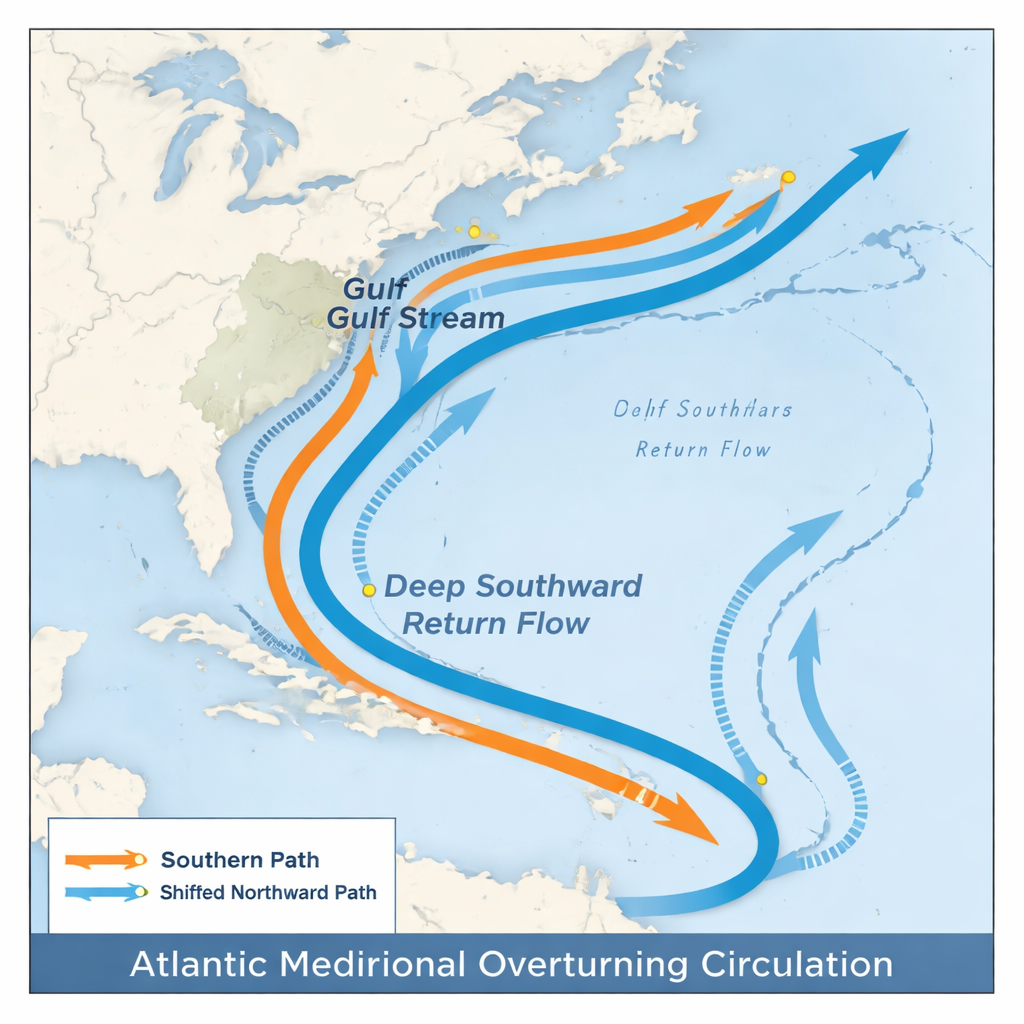
A Giant Conveyor Belt Beneath the Waves
The AMOC is often described as a giant conveyor belt in the Atlantic Ocean. Warm, salty water flows northward near the surface, releases heat to the atmosphere, cools and sinks in the subpolar North Atlantic, and returns southward at depth. The Gulf Stream is the fast, surface branch of this system along the U.S. East Coast before it veers into the open ocean. Because the AMOC is thought to be a climate “tipping element” that could weaken abruptly, scientists want practical warning signs that such a tipping event is approaching. The Gulf Stream, which we can monitor from space and from ships, is a natural candidate.
A Virtual Ocean Put to the Test
To probe this connection, the authors used a very high‑resolution ocean model that can realistically capture narrow currents and swirling eddies. In this simulation, they slowly added freshwater to the North Atlantic over several centuries. This freshening makes the surface less dense, eventually disrupting the sinking branch of the AMOC, which then collapses from about its present strength down to a much weaker state. Because the atmosphere in the model is held in a repeating seasonal cycle, any large changes in the Gulf Stream come from changes in the ocean circulation itself, not from shifting winds or weather patterns.
An Abrupt Jump in the Gulf Stream’s Track
As the simulated AMOC weakens, the Gulf Stream near Cape Hatteras at about 71.5°W latitude first drifts slowly northward for nearly four centuries. Then, within just two model years, its path jumps more than 200 kilometers farther north—a shift far larger than its normal year‑to‑year wobble. Deeper currents that normally hug the continental slope, known collectively as the Deep Western Boundary Current, fade dramatically before this jump. Without that deep flow interacting with the seafloor, the delicate balance of forces that helps pin the Gulf Stream in place changes, allowing the current to detach and shift northward. This sudden move happens roughly 25 years before the AMOC fully collapses in the simulation, acting as a clear early warning in the model world.
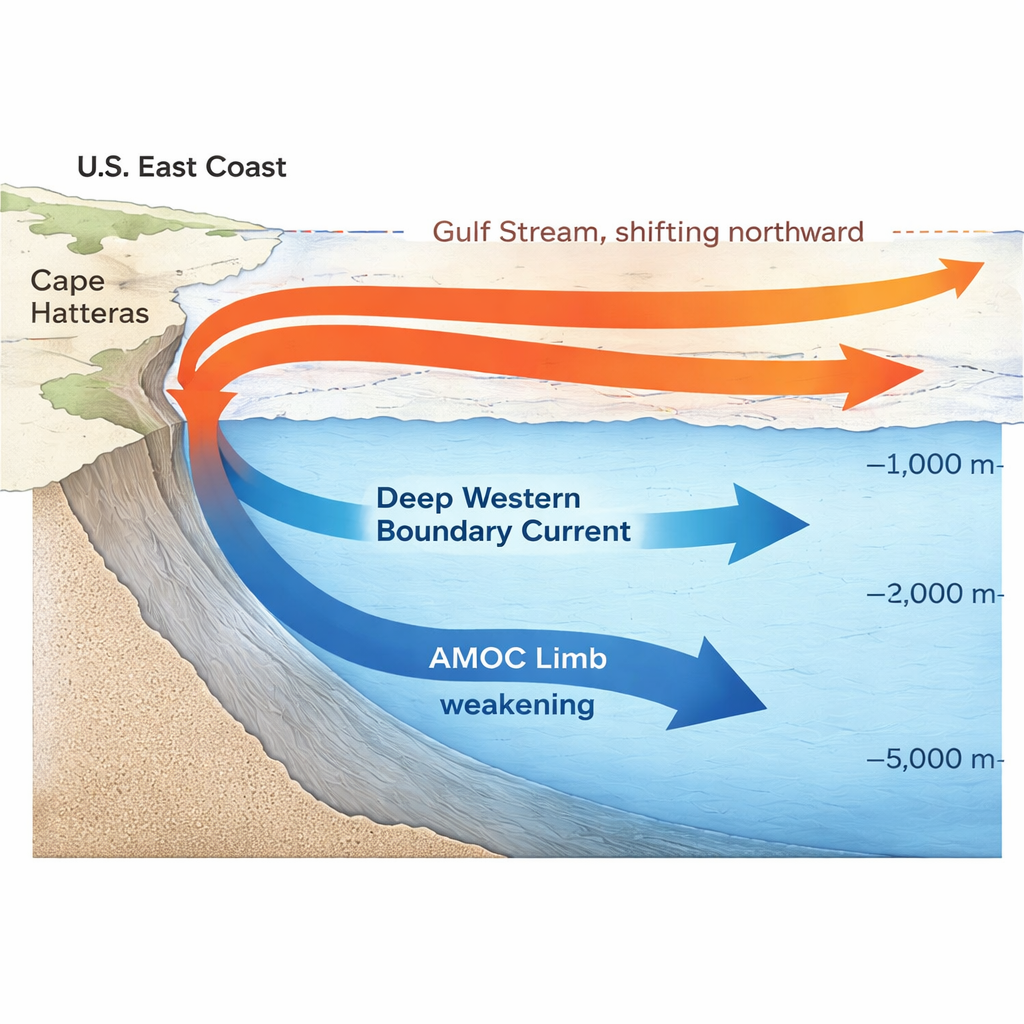
Warming Waters and a Weakening Deep Return Flow
The model shows that these circulation changes also reshape ocean temperatures. When the Gulf Stream shifts north, regions just north of its old position experience rapid warming at the surface and through the upper few hundred meters—by several degrees Celsius in only a couple of years. Farther east along the continental slope, warming is driven less by the Gulf Stream’s shift and more by the shutdown of the cold Labrador Current and an increase in energetic eddies mixing heat toward the coast. Together, these patterns create a distinctive “fingerprint” of a weakening AMOC: a warm band along the North American continental slope and changes in how the Gulf Stream meanders.
Real‑World Clues from Satellites and Ocean Measurements
To see whether anything similar is already happening, the authors turned to satellite altimetry, which measures sea surface height and can be used to track the Gulf Stream’s path, and to long‑term temperature profiles in the upper ocean. Since the early 1990s, satellites show that near Cape Hatteras the Gulf Stream has been drifting northward at about 0.16 degrees of latitude per decade, a trend that is statistically significant. Deeper, subsurface temperature data since the mid‑1960s also reveal a northward shift of the Gulf Stream’s thermal boundary. Meanwhile, independent studies suggest that the AMOC itself has weakened by roughly 15% since the mid‑20th century. The observed pattern of Gulf Stream movement—northward upstream, with more complex changes downstream—broadly matches what the high‑resolution model produces when the AMOC is on its way to collapse.
What This Means for Our Climate Future
For non‑specialists, the key message is that the Gulf Stream’s path is more than a curiosity on a weather map. In this study, an abrupt northward jump of the Gulf Stream in a realistic ocean model reliably appears a couple of decades before the AMOC collapses. Observations already show the Gulf Stream edging northward near Cape Hatteras and deep return flows weakening, consistent with a slowly faltering AMOC. While the real ocean is influenced by many factors beyond those in the model, these results suggest that closely watching where the Gulf Stream runs—and how quickly it shifts—could give society valuable advance warning if the Atlantic’s great conveyor belt is approaching a dangerous tipping point.
Citation: van Westen, R.M., Dijkstra, H.A. Abrupt Gulf Stream path changes are a precursor to a collapse of the Atlantic Meridional Overturning Circulation. Commun Earth Environ 7, 197 (2026). https://doi.org/10.1038/s43247-026-03309-1
Keywords: Gulf Stream, Atlantic circulation, AMOC tipping point, ocean currents, climate change