Clear Sky Science · en
Elevated ilmenite in lunar nearside cumulates revealed by extremely high-Ti glass beads augmented large-scale volcanism
Why the Moon’s “Face” Is So Different
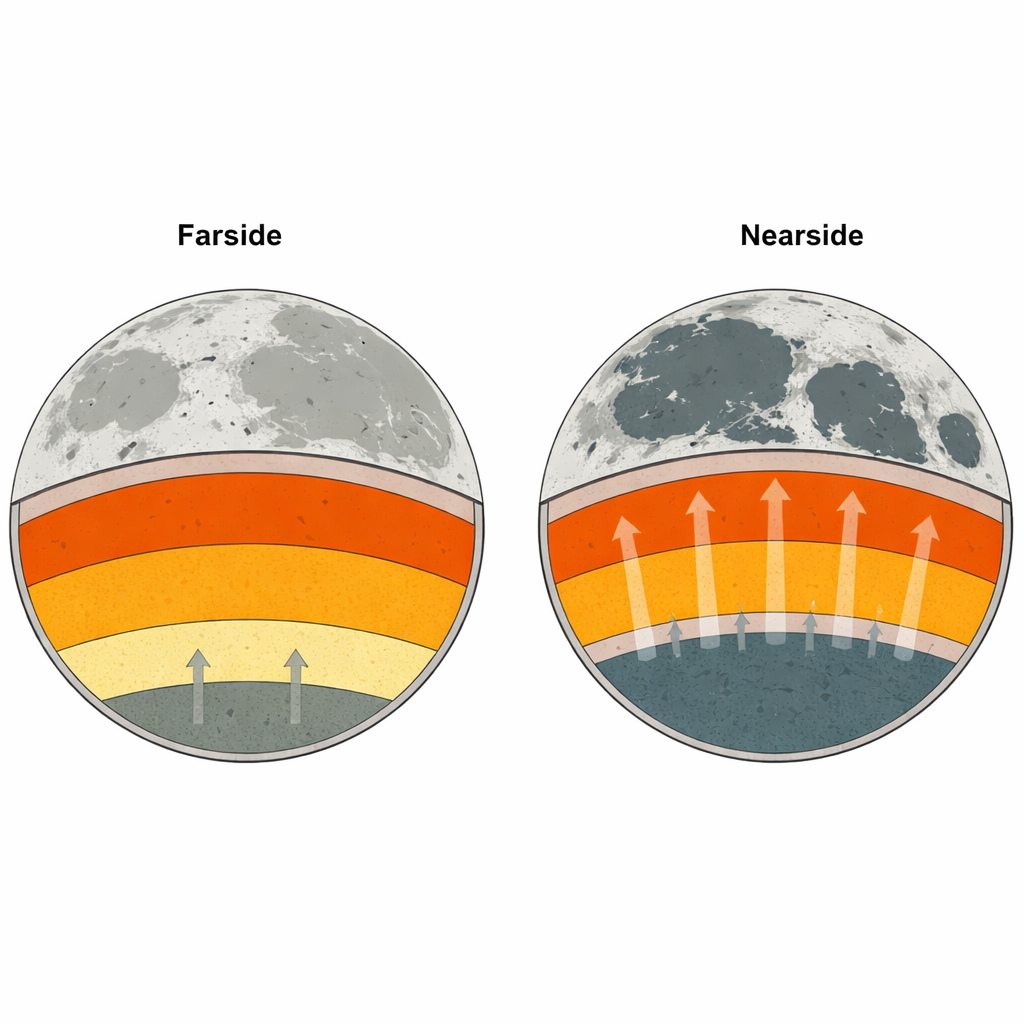
The side of the Moon that always faces Earth is covered by wide dark plains of frozen lava, while the hidden farside is much more rugged and pale. For decades, scientists have wondered why most of the Moon’s volcanic activity was concentrated on the nearside. This study uses microscopic glass beads returned by China’s Chang’e‑5 mission to probe deep beneath the lunar surface and uncover a new clue: an unusual abundance of a heavy, titanium‑rich mineral deep under the nearside that seems to have fueled extra melting and eruptions there.
Tiny Glass Clues from a Robotic Scoop
Chang’e‑5 landed in the Procellarum KREEP Terrane, a region on the nearside famous for its rich volcanic history. Mixed into the collected soil are local rock fragments and a small fraction of “exotic” material thrown in from distant impacts. Among these grains, the team hand‑picked four nearly spherical glass beads only 50–150 micrometers across, and combined their results with three similar beads reported previously. These glasses turned out to be extraordinarily rich in titanium and iron compared with typical lunar materials, immediately marking them as oddities that might record processes far below the surface.
Impact Fireballs, Not Ordinary Lava Sprays
Under the microscope, the beads show textures that point to violent impact origins rather than gentle volcanic fountains. Some contain swarms of tiny metallic iron particles; others trap broken minerals and bubbles frozen in glass. Their chemical makeup also fails to match known volcanic glasses, lacking the high magnesium contents expected from classic lunar lava droplets. Instead, they resemble impact‑melt glasses produced when meteorites strike lunar basalt and soil at high speed, briefly liquefying and then quenching the material into glass. Because impact melting does not strongly change the abundance of stubborn elements like titanium, the extreme titanium levels in these beads must already have been present in the original source rock before impact.
A Hidden Layer Rich in Heavy Mineral
To track down that source, the researchers compared the beads’ chemistry with models of how lunar magmas cool and crystallize. No reasonable path of normal lava evolution could generate rocks with such low silica yet such high titanium and iron. Using computer phase‑diagram calculations, they reconstructed the solid mineral mixture that would crystallize into the observed glass composition. The model points to a rock made mostly of clinopyroxene (a common mantle mineral) and ilmenite, a dense, titanium‑rich oxide, with smaller amounts of plagioclase and olivine. Crucially, ilmenite makes up about 15–20 percent of this assemblage—much more than predicted for the Moon’s average mantle. Remote sensing maps show no surface lavas with titanium contents high enough to match, implying this unusual material must come from a deep, buried layer rather than from ordinary surface basalts.
Rewriting the Moon’s Early Ocean of Magma
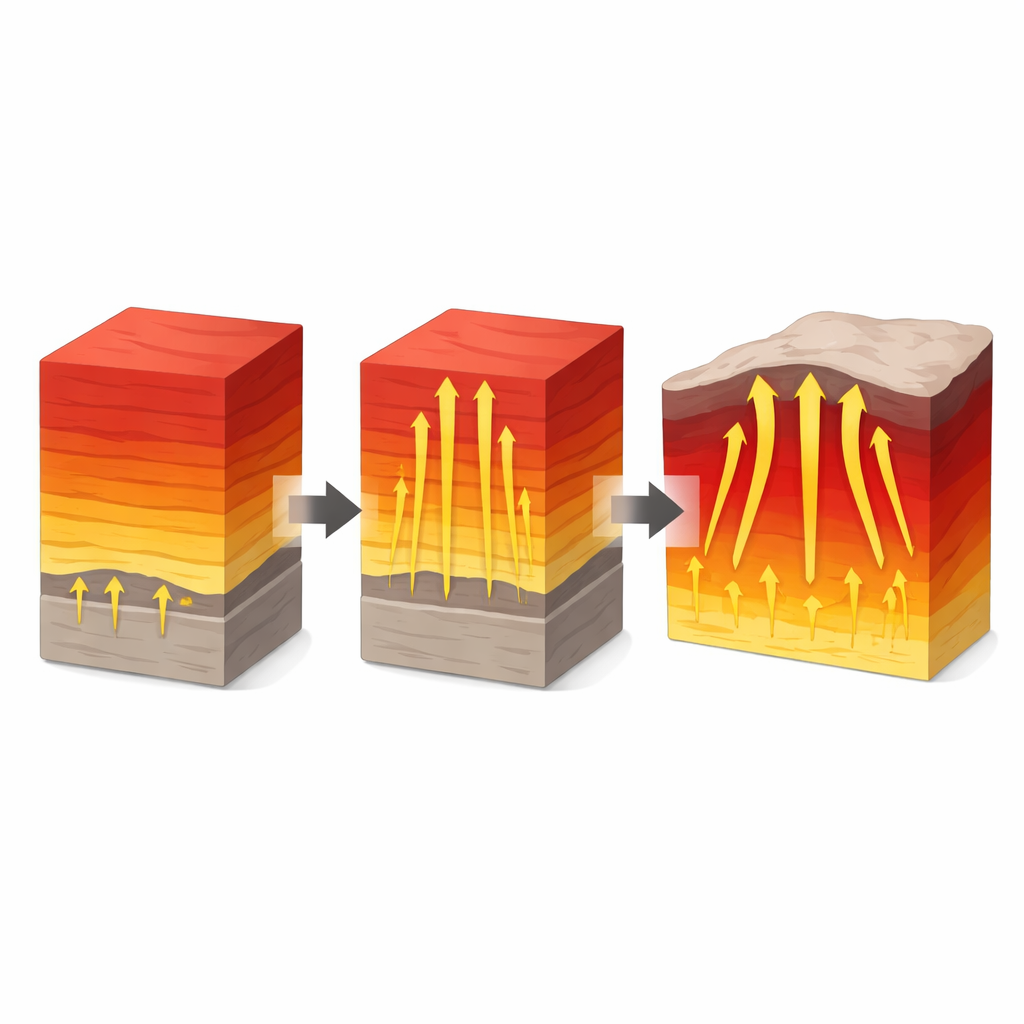
The Moon is thought to have formed with a global ocean of molten rock that cooled and separated into layers, leaving behind a late‑forming “ilmenite‑bearing cumulate” (IBC) layer deep in the mantle. Petrological experiments and the new modeling suggest that the Chang’e‑5 beads are direct samples of such an IBC layer beneath the nearside Procellarum region, but with far more ilmenite than global models typically assume. When the authors reconstruct what the original magma ocean must have looked like before lighter minerals floated off to form the crust, they find that matching the bead compositions requires an ilmenite fraction significantly above the global average, specifically under the nearside. Phase‑equilibrium calculations then show that this ilmenite‑rich IBC begins to melt at lower temperatures, and produces much larger volumes of melt, than more typical, ilmenite‑poor mantle layers.
Why the Nearside Is So Much More Volcanic
The work suggests a new, deep explanation for why the nearside is blanketed in dark lava plains while equally thin‑crusted parts of the farside, such as the South Pole–Aitken basin, remain relatively lava‑poor. Beneath the Procellarum region, an ilmenite‑rich layer would have been denser and easier to stir during early mantle overturn, and far more prone to melting once heated. This would have generated abundant magma over a long time, feeding extensive nearside eruptions even in the Moon’s later history. In contrast, farside mantle with less ilmenite would have melted less and produced fewer, smaller basalt flows. In simple terms, the study argues that the Moon’s lopsided volcanic face is rooted not just in crust thickness or radioactive heating, but in a hidden difference in the deep, titanium‑rich mineral layers beneath its two hemispheres.
Citation: Li, Z., Zhang, B., Qian, Y. et al. Elevated ilmenite in lunar nearside cumulates revealed by extremely high-Ti glass beads augmented large-scale volcanism. Commun Earth Environ 7, 272 (2026). https://doi.org/10.1038/s43247-026-03300-w
Keywords: Moon volcanism, lunar mantle, ilmenite-rich cumulates, Chang’e-5 samples, mare basalt asymmetry