Clear Sky Science · en
A deformation-driven earthquake interaction model for seismicity at Campi Flegrei
Why this restless volcano matters
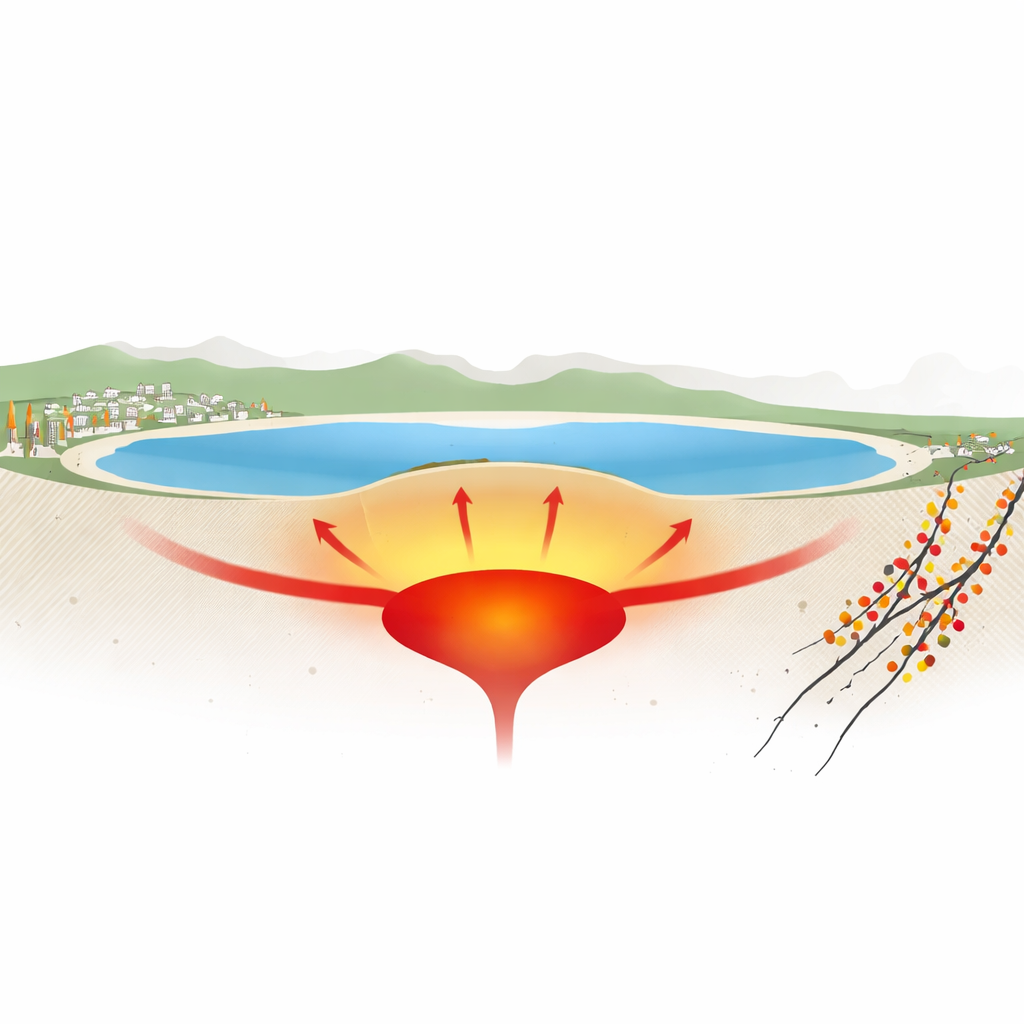
Campi Flegrei, a vast volcanic crater just west of Naples, sits beneath one of Europe’s most densely populated regions. For more than a century the ground there has slowly risen and fallen, sometimes by over a meter, and since 2005 both the uplift and the number of small earthquakes have been accelerating. People naturally ask: is this a warning sign of a coming eruption, or the noisy breathing of a long‑lived volcanic system? This study tackles that question by building a physics‑based model that links ground deformation and earthquake interactions, with the aim of better assessing short‑term seismic hazard for the area.
The restless ground of Campi Flegrei
Historical records and modern measurements show that the Campi Flegrei caldera has gone through repeated cycles of uplift and subsidence since at least 1905. Major uplift episodes occurred in the early 1950s, around 1970, in the early 1980s, and again from 2005 onward. Earthquakes tend to cluster during these uplift phases, but not in a simple, proportional way: the number of quakes rises faster than the uplift rate, and significant seismic activity often starts only once the ground level exceeds its previous high. This behavior resembles a phenomenon known from rock mechanics as the Kaiser effect, in which a stressed material remains quiet until a past maximum stress is surpassed. However, the observations at Campi Flegrei are more gradual than a strict “on–off” threshold, suggesting that more nuanced physics are at work.
How slipping faults remember past stress
To capture the long‑term pattern, the authors use a framework called rate‑and‑state friction, which describes how faults slip depending on both the current stress and their history of loading. In their simplified model, the stress acting on shallow faults is taken to be proportional to the measured vertical uplift at a GPS station inside the caldera. This approach naturally builds in memory: the model keeps track of all uplift since 1905, so earlier inflation episodes influence how easily faults start slipping today. With appropriate parameters, the rate‑and‑state model reproduces the overall century‑scale trend, including the delayed onset of seismicity until uplift exceeds earlier peaks. It mimics the timing implied by the Kaiser effect, but generates a smoother, accelerating rise in earthquake rates that matches observations more closely.
When earthquakes trigger more earthquakes
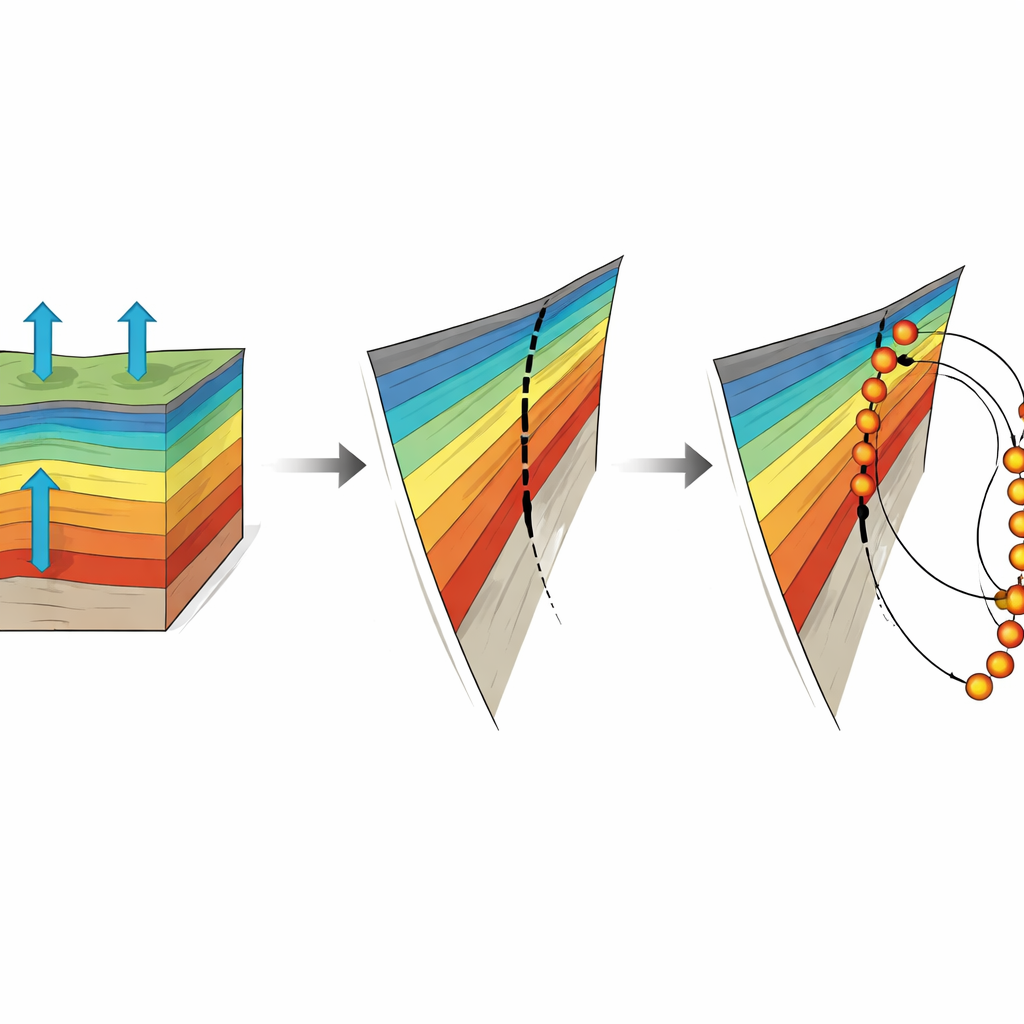
On shorter time scales of hours to days, the seismic record looks very different. Rather than isolated main shocks followed by neat aftershock sequences, Campi Flegrei often produces dense swarms of events. At first glance these swarms seem to lack clear main shocks, but the authors show that many contain hidden aftershock cascades. By stacking activity around the largest events, they find that earthquake rates jump immediately after these shocks and then decay with time in a way characteristic of aftershocks. The number of triggered events also grows rapidly with main‑shock size. This pattern reveals that earthquake‑earthquake interactions are a key ingredient of the swarm behavior, even if the clusters are modulated by fluids and other volcanic processes.
A hybrid view of stress and clustering
Because deformation alone cannot explain the intense short‑term clustering, the study combines two modeling approaches. The rate‑and‑state model provides a time‑varying “background” earthquake rate driven by uplift, while a statistical epidemic‑type aftershock model is layered on top to represent how each event can trigger further events. This hybrid model has seven parameters, calibrated using thousands of small earthquakes recorded since 2005. It succeeds where simpler alternatives fail: it matches both the long‑term rise in seismicity and the bursty, swarm‑like clusters, and it reproduces the timing and intensity of past uplift episodes when run back to the mid‑20th century. Notably, it also yields realistic estimates of how long faults “remember” previous stress.
What the model can tell us about risk
To test its practical value, the team used the hybrid model in a pseudo‑prospective way: starting from 2020, they repeatedly asked what the next week or month would look like in terms of the number and maximum size of earthquakes, using only information that would have been available at each step. Thousands of simulated scenarios for each forecast window produced probability ranges that largely encompassed the later observations, including a magnitude 4.6 event in mid‑2025. For residents and authorities around Campi Flegrei, this does not provide a precise prediction of any single earthquake or eruption. Instead, it offers a more reliable, physics‑informed way to estimate how busy and how strong the seismic activity is likely to be over the coming weeks to months, improving the basis for short‑term hazard assessments in this sensitive volcanic region.
Citation: Hainzl, S., Dahm, T. & Tramelli, A. A deformation-driven earthquake interaction model for seismicity at Campi Flegrei. Commun Earth Environ 7, 244 (2026). https://doi.org/10.1038/s43247-026-03296-3
Keywords: Campi Flegrei, volcanic earthquakes, ground uplift, seismic forecasting, earthquake swarms