Clear Sky Science · en
Tripole-like Antarctic sea ice pattern linked to remote forcing from the Indian Ocean and Maritime Continent
Why changes in Antarctic sea ice matter to you
Antarctic sea ice is more than a distant frozen edge on a map. It helps regulate Earth’s temperature, steers storms, and shapes ocean currents that ultimately influence weather and sea level around the world. This study shows that the pattern of Antarctic sea ice from year to year is more complex than scientists once thought and is strongly influenced by faraway ocean “hot spots” in the tropics, especially in the Indian Ocean and the cluster of islands and seas known as the Maritime Continent. Understanding these hidden links could improve how we anticipate shifts in Antarctic ice in a warming world.
A new three-part pattern around Antarctica
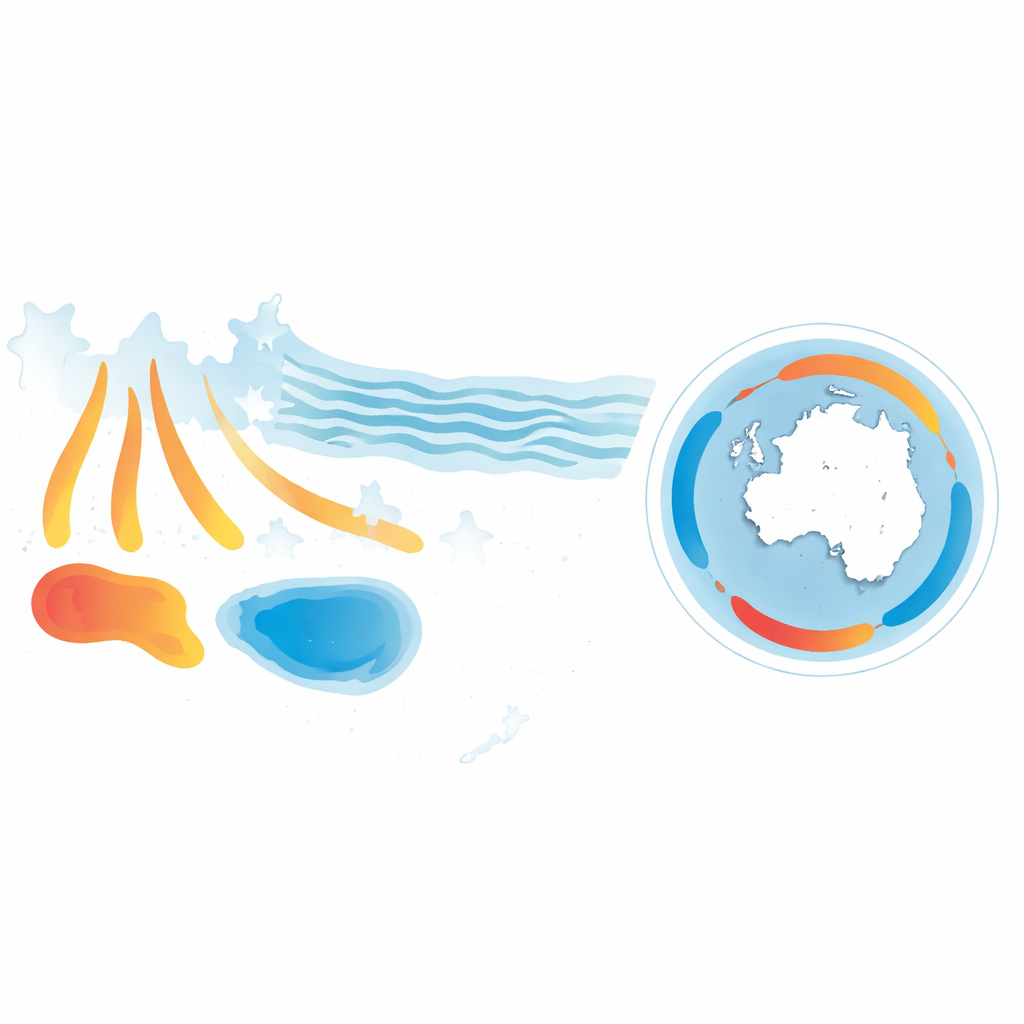
For decades, scientists have described Antarctic sea ice swings in terms of a “dipole” – a see-saw between two large regions around West Antarctica, where ice tends to grow in one area while shrinking in another. By carefully reanalyzing satellite observations from 1979 to 2023, the authors found that this picture is incomplete. In winter and spring, the dominant pattern actually has three main centers of change, not two. Alongside the familiar West Antarctic see-saw, a third region in East Antarctica lights up with strong year-to-year ice gains or losses, forming a tripole-like pattern that spans much of the Southern Ocean.
Seasonal shifts in the frozen frontier
The third center of action does not stay put all year. In winter, the extra sea ice anomaly appears near the King Hakon VII Sea, off East Antarctica. By spring, it shifts to another East Antarctic region, the Dumont d’Urville Sea. The study shows that these hot spots tend to sit along a narrow “transition belt” where the ocean quickly changes from open water to dense sea ice. Because ice here is very sensitive to changes in wind and temperature, even modest shifts in the overlying air can create large swings in ice cover. This helps explain why East Antarctic regions, long treated as secondary, can rival West Antarctica in how much their ice varies from year to year.
Winds, waves in the sky, and moving ice
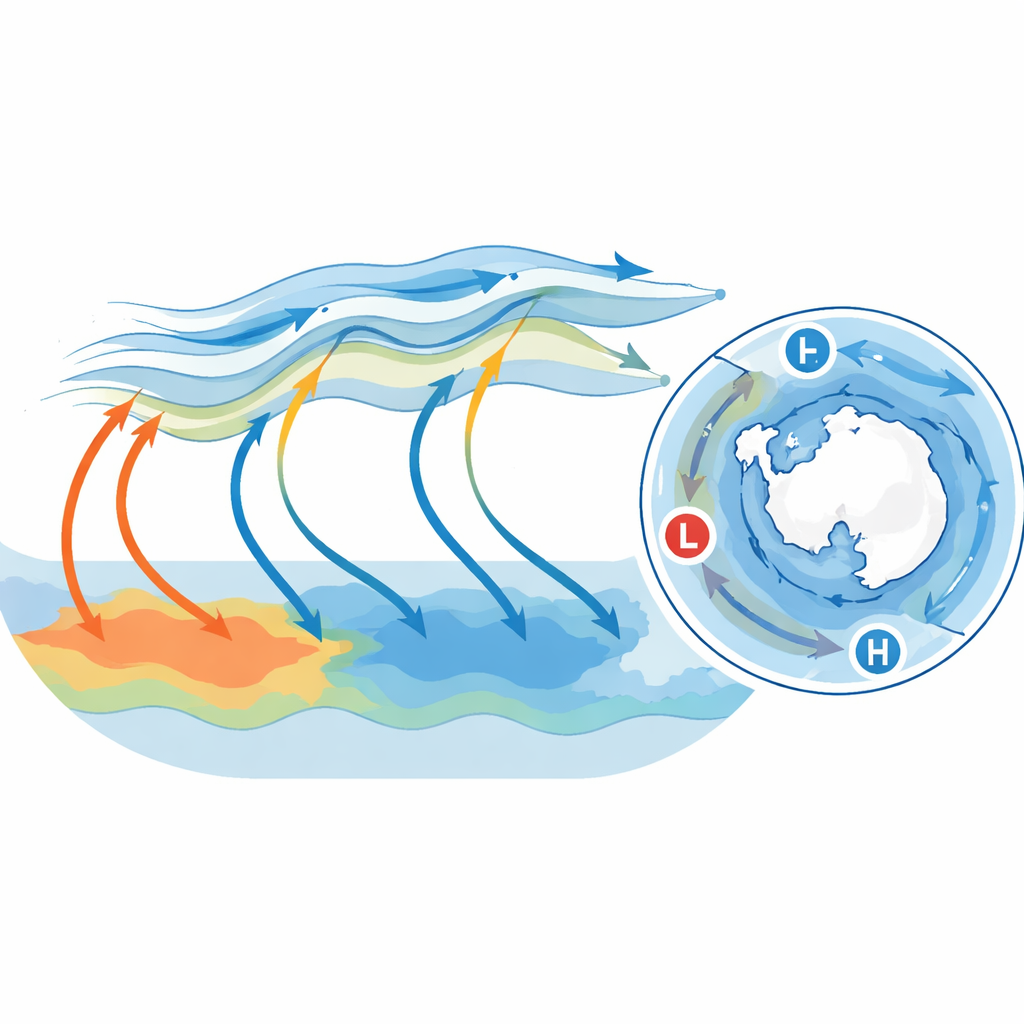
The researchers traced these sea-ice patterns back to broad swirls in the atmosphere. In both winter and spring, three major pressure centers set up around Antarctica, forming what the authors call “circulation pairs.” Where these pressure systems straddle the sea-ice edge, they drive strong north–south winds that either push cold air and ice outward or draw warmer air inward. In winter, winds tied to these patterns melt ice in the King Hakon VII Sea while piling it up elsewhere; in spring, a subtle shift in the placement of the pressure centers weakens that winter hot spot and instead strengthens cooling winds over the Dumont d’Urville Sea. The key is not just the presence of pressure systems, but whether their winds slice across the sensitive transition belt.
How distant tropical seas tug on polar ice
What sets up these atmospheric patterns in the first place? The study points to slow changes in sea surface temperatures across the tropical Indo-Pacific. Warm or cool patches in the central Pacific, Indian Ocean, and Maritime Continent disturb tropical weather and launch large-scale “wave trains” in the atmosphere that arch toward the Southern Ocean. Using climate model experiments in which they selectively warmed or cooled individual tropical basins, the authors showed that the central Pacific has the strongest influence on the tripole in winter. In spring, however, the Indian Ocean and Maritime Continent become more important, helping to create or strengthen the East Antarctic ice center. Seasonal changes in the high-altitude jet stream either block or guide these wave trains into the Antarctic, controlling which tropical basin has the upper hand.
What this means for future climate insight
This work broadens the traditional dipole view into a continent-wide picture of Antarctic sea ice variability. It shows that far-flung tropical oceans, especially the Indian Ocean and Maritime Continent, can decisively shape when and where Antarctic ice advances or retreats. For non-specialists, the takeaway is that what happens in warm tropical waters does not stay there: it can help determine how much bright, reflective ice covers the dark Southern Ocean, with ripple effects on global climate. As scientists refine projections of how tropical seas will warm in the coming decades, these newly clarified links offer a pathway to better anticipate Antarctic sea ice changes and their consequences for Earth’s climate system.
Citation: Ma, W., Yuan, X., Hou, Y. et al. Tripole-like Antarctic sea ice pattern linked to remote forcing from the Indian Ocean and Maritime Continent. Commun Earth Environ 7, 271 (2026). https://doi.org/10.1038/s43247-026-03292-7
Keywords: Antarctic sea ice, tropical teleconnections, Indian Ocean, Rossby waves, Southern Ocean climate