Clear Sky Science · en
Transient deglacial simulations unravel the causes of Mediterranean sapropel formation
When a Sunny Sea Turned Into a Deep-Water Dead Zone
Today the Mediterranean Sea is a popular holiday destination, but in the not-so-distant past its deep waters became nearly devoid of oxygen, forming thick, dark, organic-rich muds called sapropels. Understanding how this transformation happened is more than a curiosity about ancient seas: it reveals how slow changes in sea level, climate, and life in surface waters can quietly reshape entire marine ecosystems over thousands of years, and it offers clues about how modern oceans might respond to ongoing warming.
A Natural Lab for Past Climate Change
The Mediterranean is often described as a miniature ocean, tightly connected to both African monsoon systems and European weather. Because it is almost enclosed and exchanges water with the Atlantic only through the narrow Strait of Gibraltar, it reacts strongly to changes in rainfall, river flow, and global sea level. Sediment cores from its floor reveal repeated episodes over the last 450,000 years when deep waters lost oxygen and dark sapropel layers formed. The most recent of these, called S1, appeared between about 10,800 and 6,100 years ago, just as North Africa went through the lush, rainy phase known as the African Humid Period. Scientists have long suspected that stronger African monsoons and increased river discharge played a key role, but until now it has been hard to tease apart the combined effects of sea-level rise, temperature changes, and nutrient inputs.
Replaying the Last Ice Age’s Big Melt
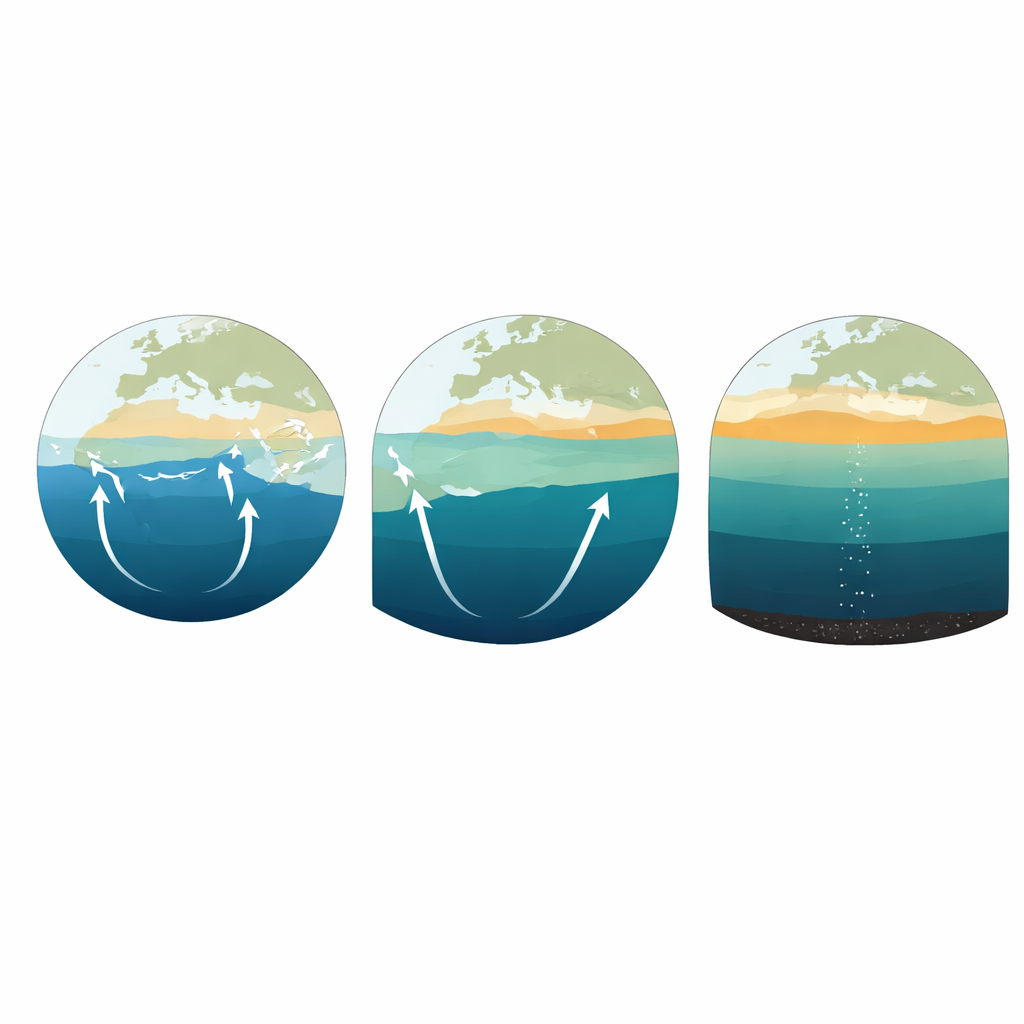
To untangle these drivers, the authors used a detailed computer model that simulates both water movements and chemistry in three dimensions across the entire Mediterranean from the Last Glacial Maximum 21,000 years ago up to 1949 CE. At the height of the last ice age, sea level was much lower and the connection to the Atlantic was shallower, yet the deep eastern Mediterranean remained well ventilated and oxygen-rich. Cold temperatures slowed the breakdown of sinking organic material, allowing nutrients to build up in the abyss, but oxygen levels were similar to today’s, so sapropels could not yet form. As the climate began to warm and ice sheets melted, sea level rose and the density of surface waters gradually decreased. This weakened the overturning circulation that normally renews the deep layers with fresh, oxygenated water, setting the stage—millennia in advance—for oxygen loss at depth.
How Rivers, Warmth, and Still Waters Worked Together
Between roughly 15,000 and 7,000 years ago, several processes aligned. Rising seas deepened the Strait of Gibraltar, increasing the exchange with the Atlantic but reducing the time that surface waters spent evaporating inside the basin, which in turn weakened their tendency to sink. At the same time, meltwater entering the North Atlantic and Mediterranean lowered salinity, further stabilizing the water column. When the African Humid Period began, stronger rivers—especially the Nile—delivered far more nutrients to the eastern basin. Surface life thrived and more organic particles rained down into the ocean interior. Because deep waters were still relatively cold, microbes broke this material down more slowly and at greater depths, consuming oxygen where renewal by mixing had already been suppressed. In the simulations, oxygen levels below about 1000 meters gradually fell, and between roughly 10,400 and 7,000 years ago the deep eastern Mediterranean became anoxic, while organic carbon flux to the seafloor rose by an order of magnitude, matching sediment records of sapropel S1.
Testing Other Suspects and the Clockwork of Change
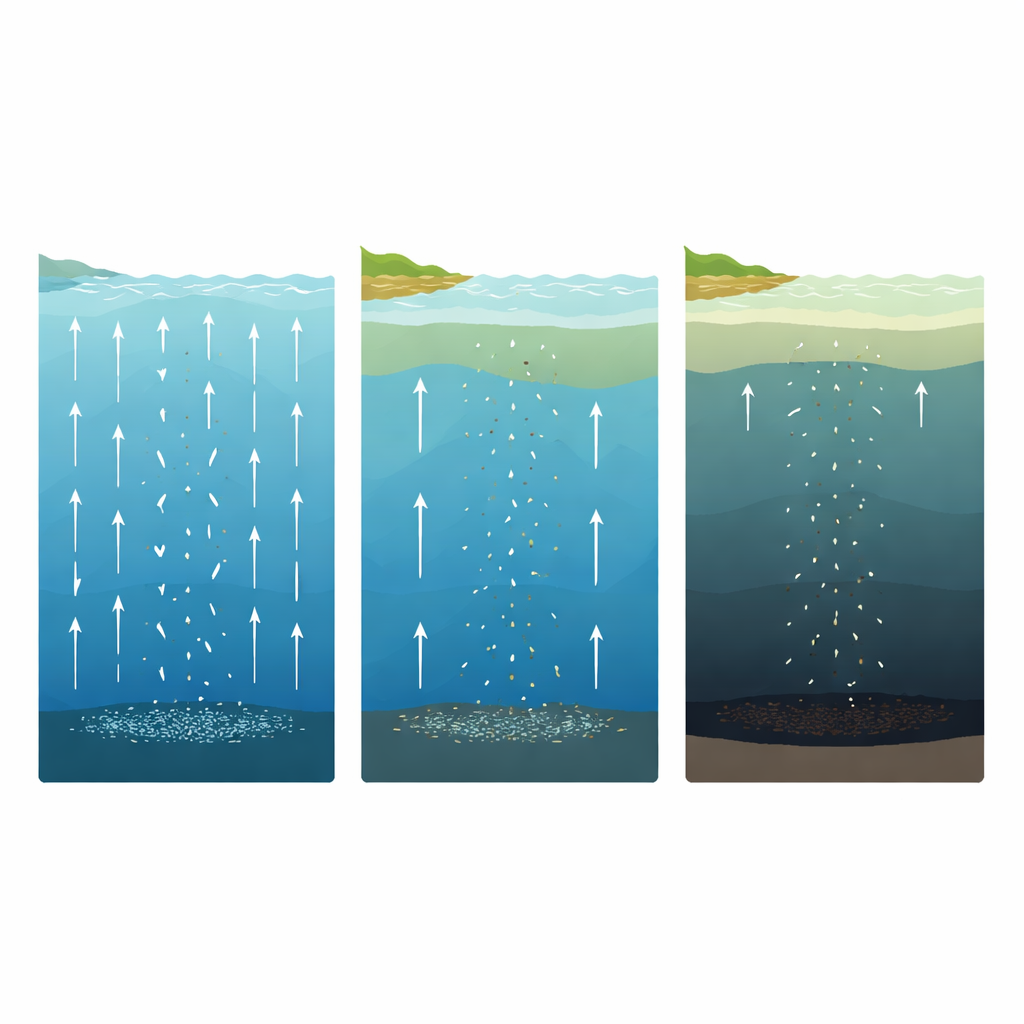
The researchers ran additional “what-if” experiments to separate physical from biological influences. When they turned off the extra nutrient enrichment from African rivers but kept the same changing climate and sea level, deep waters stayed oxygenated: physical changes alone accounted for almost half of the observed oxygen decline but did not push the system into full anoxia. Conversely, adding strong nutrient inputs to a modern-like Mediterranean with warmer, less dense deep water barely reduced oxygen, because vigorous mixing and faster microbial activity broke down organic matter higher in the water column. A separate test of a proposed freshwater overflow from the Black Sea showed only a minor, short-lived effect on deep oxygen. A simple linear model confirmed that sapropel formation requires both a long period of increasing stratification and a large cumulative supply of organic matter reaching deep layers, with cold temperatures helping that material sink farther before it is decomposed.
What This Ancient Event Tells Us About the Future
The study concludes that the primary trigger for sapropel S1 was the gradual buoyancy gain of surface waters—driven by deglacial sea-level rise and warming—which weakened deep ventilation long before sediments recorded any change. Enhanced river-borne nutrients during the African Humid Period, acting on a now-stagnant and cold deep sea, tipped the system into a prolonged anoxic state and built up the thick organic-rich layer we observe today. Additional freshwater from the Black Sea was not required. In a warming future, the authors argue, similar deep “dead zones” in the Mediterranean are unlikely to develop quickly: even with stronger stratification, the shift to anoxia would take thousands of years, and warmer waters tend to confine organic matter breakdown to well-ventilated surface layers. The saga of sapropel S1 thus highlights how slow, intertwined changes in sea level, circulation, and biology shape the deep ocean over geological timescales.
Citation: Six, K.D., Mikolajewicz, U. & Schmiedl, G. Transient deglacial simulations unravel the causes of Mediterranean sapropel formation. Commun Earth Environ 7, 258 (2026). https://doi.org/10.1038/s43247-026-03290-9
Keywords: Mediterranean Sea, sapropel, deglaciation, ocean oxygen, African Humid Period