Clear Sky Science · en
Light exposure patterns shape marine microbial biogeography and metabolic strategy
Why ocean microbes and sunlight matter to us
Far below the waves, countless microscopic organisms quietly run the chemistry that keeps our planet habitable. They help regulate carbon, nutrients, and even climate. Yet more than 99% of marine microbes have never been grown in a lab, leaving their abilities largely in the dark. This study shows that patterns of sunlight across the globe – from bright tropical seas to the dim deep ocean – strongly shape where these microbes live, how they make a living, and how we can finally bring many of them into culture.
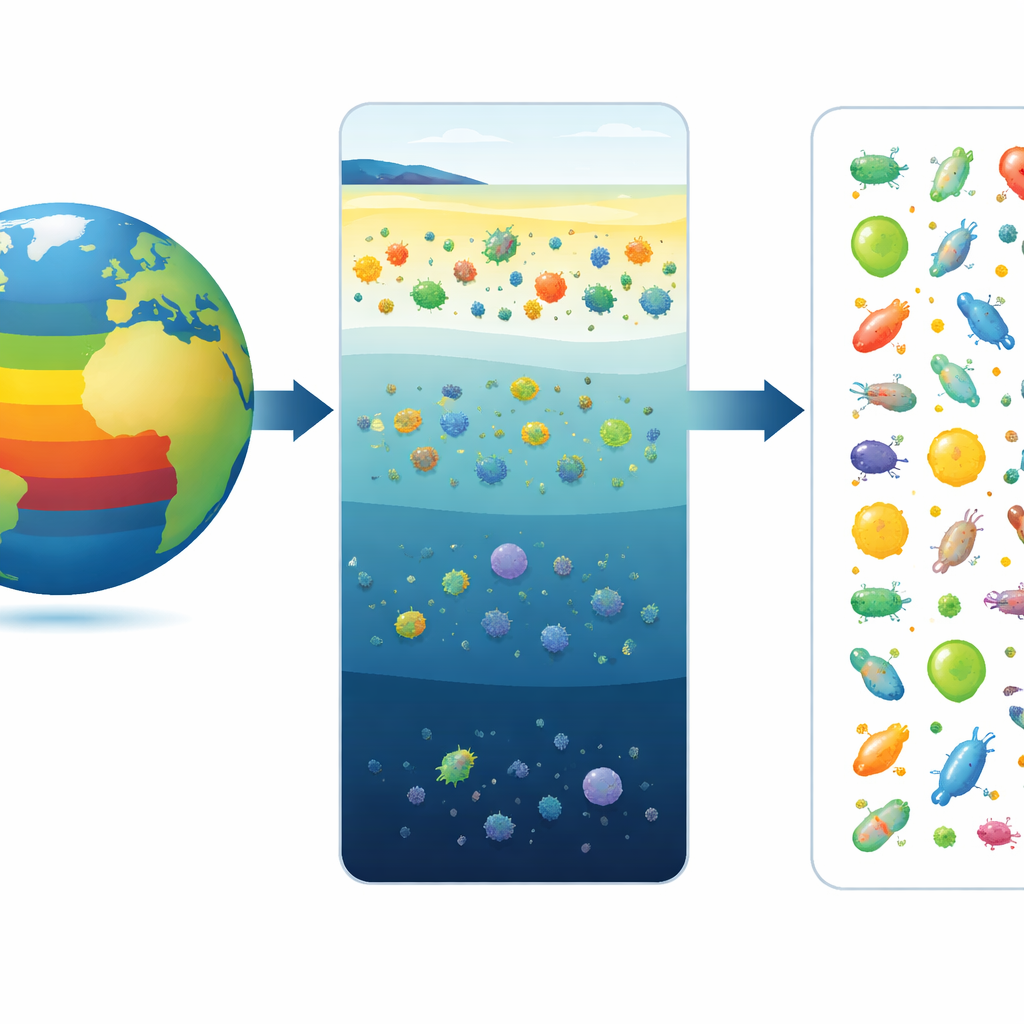
Life across a sunlit and shadowed ocean
The researchers assembled a decade-long global survey, combining DNA data from 1038 seawater samples with 16,931 microbial strains isolated from 1516 sites spanning all major oceans, latitudes, and depths down to 11,034 meters. They found that a few broad groups of bacteria and archaea dominate most regions, but their local mix changes in step with light conditions. Sunlit surface waters near the equator host especially high diversity, while deeper, darker layers favor different communities. These biogeographic patterns depended less on named ocean basins and more on latitude and depth – in other words, on how much light over the long term reaches each part of the sea.
Sunlight as a guide for where microbes choose to live
Looking closely at the cultured strains, the team showed that many microbe groups are tightly linked to particular combinations of light and climate zone. Some phyla were found only in dark, aphotic waters; others appeared almost exclusively in sunlit layers, and often only within certain temperature belts such as tropical or temperate zones. At the species level, 66% preferred a specific climatic zone, and this rose to nearly 72% for species from illuminated environments. In practical terms, if a species naturally thrives in, say, bright temperate surface waters, that history of light exposure is strongly tied to how and where it can be successfully cultured.
Different ways to make a living in the sea
To understand how environment shapes lifestyle, the authors grouped microbes by their "metabolic strategies" – recurring combinations of genes and pathways that describe how a cell gets energy and builds new material. They identified eight main strategies, each with distinct preferences for sunlight and latitude. Some strategies clustered in polar regions, others in the tropics, and some shifted from bright surface waters to darker depths. Many strategies were linked to particular ways of fixing carbon, using light-driven reactions, or investing energy in protein-making machinery versus nutrient-uptake systems. Using deep-learning methods, the team found that core cellular functions such as transport systems, secretion, ribosomes, and RNA processing are especially important in separating these strategies along light gradients.
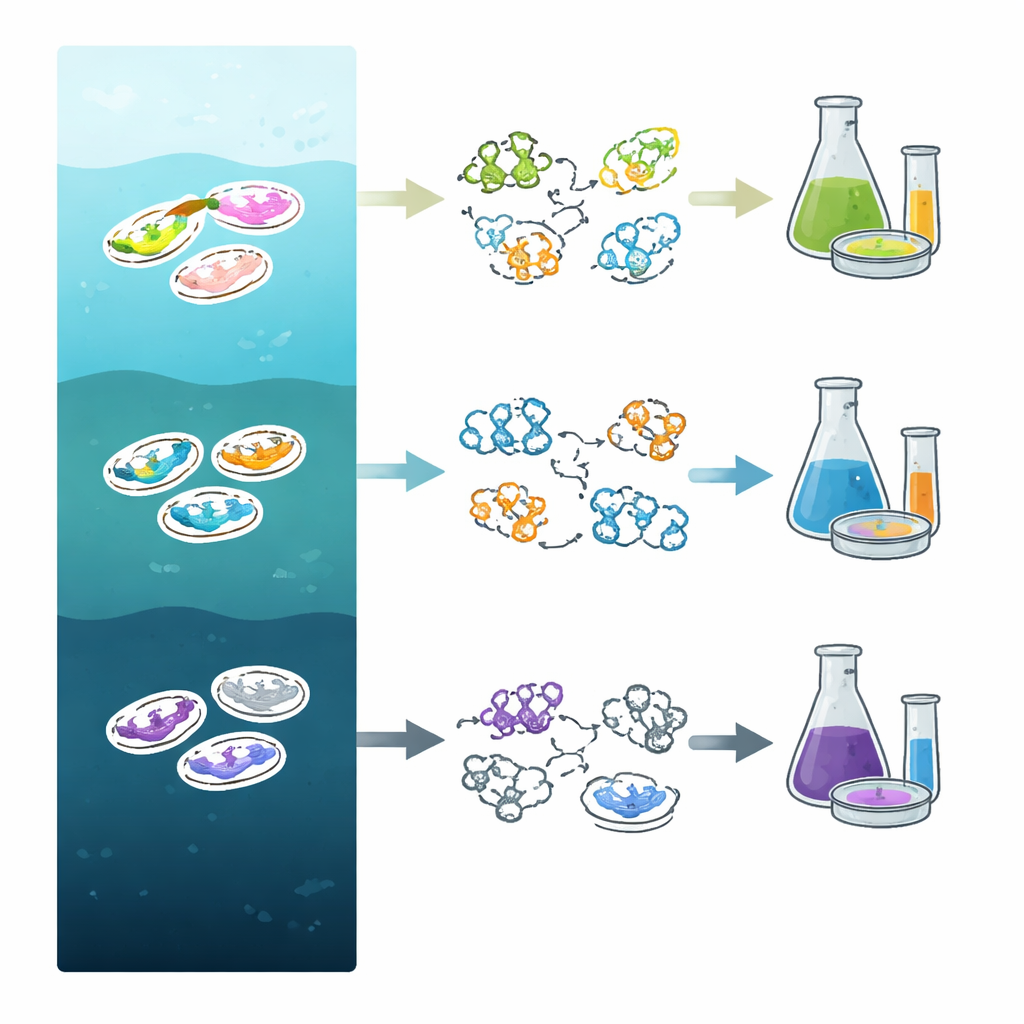
Turning ocean patterns into a culture recipe book
Because each metabolic strategy is associated with microbes found under specific light regimes, it also points to the growth conditions those microbes are likely to need in the lab. The researchers used this link to build a reference database that connects thousands of real strains and their successful media recipes to their underlying strategies. For any marine microbe with genomic data, the database can recommend temperature ranges and medium components tailored to its strategy and native environment. When tested on seawater samples, these predictions were strikingly accurate: 99.57% of strains (231 out of 232 attempts) grew under the suggested conditions, and even microbes from other water bodies showed nearly 80% success.
What this means for exploring the unseen majority
This work reframes marine microbial "dark matter" as a problem of matching biology to environment rather than one of random trial and error. Sunlight, filtered by latitude, depth, and climate zone, emerges as a major force that shapes not only where microbes live but also how we can cultivate them. By organizing ocean life into eight core metabolic strategies and linking these to concrete culture recipes, the study turns the hunt for new marine microbes into a more predictive science. For nonspecialists, the takeaway is that understanding something as familiar as day length and light levels can unlock new microbes, new biochemistries, and potentially new molecules for medicine and climate solutions.
Citation: Xiang, S., Li, G., Huang, Y. et al. Light exposure patterns shape marine microbial biogeography and metabolic strategy. Commun Earth Environ 7, 270 (2026). https://doi.org/10.1038/s43247-026-03289-2
Keywords: marine microbiology, sunlight and oceans, microbial cultivation, metabolic strategies, microbial dark matter