Clear Sky Science · en
Overlooked but widespread severe coastal erosion prior to typhoon landfall
Why the Shape of Our Coasts Matters Before a Storm Arrives
Coastal mudflats and wetlands often act as quiet, muddy shields between the open sea and the communities that live along low-lying shores. This study shows that some of the most damaging changes to these natural defenses can happen not when a typhoon makes landfall, but in the days before it arrives, when distant storm waves begin to attack the seafloor. Understanding this hidden phase of erosion helps explain how climate-driven changes in storms and river sediments may leave coasts more exposed to flooding and loss of habitat.
Hidden Life of a Muddy Shoreline
Intertidal mudflats are broad, gently sloping areas that are covered and uncovered by the tide. They provide feeding grounds for birds, nurseries for fish, and a natural buffer that absorbs wave energy before it reaches sea walls and towns. At first glance they look like featureless plains of soft mud. In reality, their upper few inches are often a loose, freshly deposited carpet resting on a much denser, better packed layer below. This vertical layering controls how easily waves can strip material away, yet it is rarely included in storm impact forecasts that focus mainly on water levels and peak wind speeds.
Watching a Typhoon Reshape the Seafloor
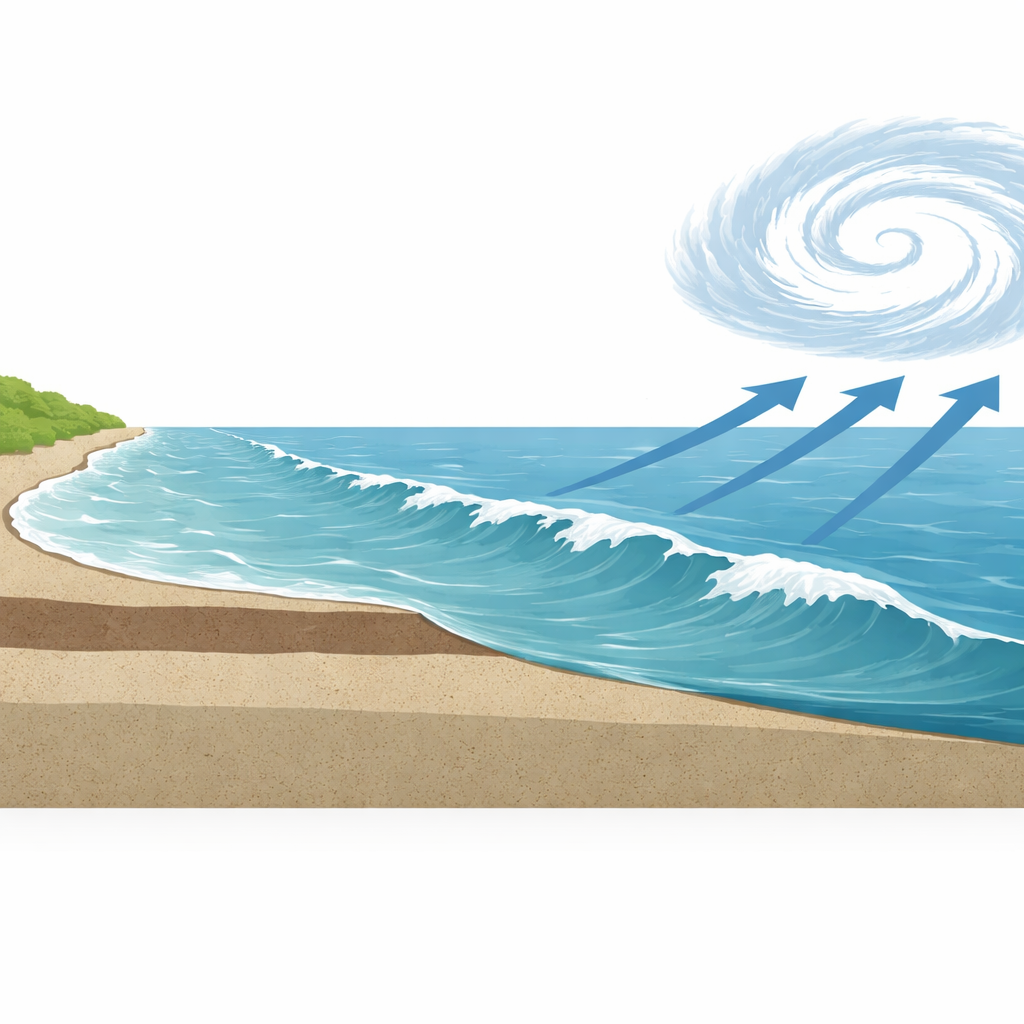
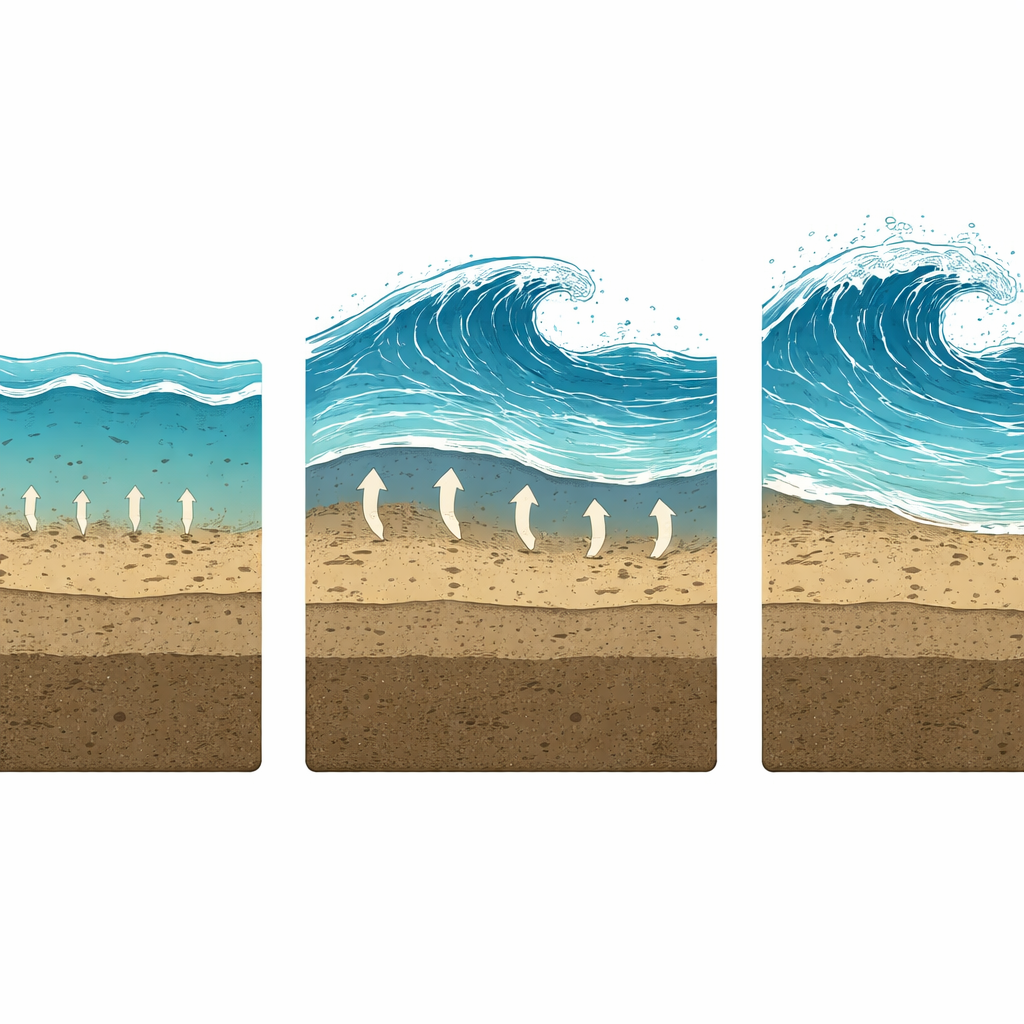
The researchers set up sensitive instruments on a mudflat in the Yangtze Estuary near Shanghai just as Typhoon Fung-wong passed the region in 2014. They recorded waves, currents, suspended mud in the water, and tiny up-and-down shifts of the seabed with millimeter precision before, during, and after the storm. As the typhoon approached, water levels rose, waves grew taller, and the combined push of waves and currents on the bed strengthened. In the days before landfall, the seabed dropped by about 11 centimeters as the loose surface layer was swept away and the water became heavily loaded with fine sediment.
The Surprising Calm at Landfall
When the storm finally reached its peak strength near landfall, the team expected the most intense erosion. Instead, they saw almost no further downward movement of the bed and lower mud levels in the water. The reason lay beneath the surface. By that time, earlier storm waves had already peeled off the soft upper layer, exposing a stiff, compacted layer that required far stronger forces to budge. The critical stress needed to erode the bed had risen more than seventy-fold compared with the original surface. Even though the storm’s waves were at their strongest, they were now acting on a hardened foundation that simply did not give way.
Storm Signals Seen Across Oceans
To find out whether this pattern was unique, the authors examined ten years of observations from another station in the estuary and compared them with records from other Chinese coasts and the Chesapeake Bay in the United States. They repeatedly found a “double-peak” pattern in the amount of mud suspended in the water: a strong spike before a typhoon’s closest approach, and often a weaker response later. The distance at which the first spike appeared depended on how powerful and long-lived the storm was and on the path it followed. Intense storms with long swell trains could stir up seabeds hundreds of kilometers away, showing that pre-landfall erosion is a widespread and easily overlooked part of coastal change.
What This Means for Coasts in a Warming World
This work reveals that the most severe reshaping of muddy shores can occur during the approach of a storm, when long, powerful swells attack a still-soft surface layer. Once that veneer is stripped away, the newly exposed, compacted sediments resist further scouring, even under the fiercest waves at landfall. As climate change boosts storm intensity and large dams reduce the supply of fresh river sediment, many deltas may struggle to rebuild these protective soft layers between storms. Coastal planners and modelers, the authors argue, need to account for both the timing of pre-landfall erosion and the layered nature of the seabed if they are to predict where shorelines will retreat and how best to protect communities and ecosystems.
Citation: Shi, B., Chen, X., Cooper, J.R. et al. Overlooked but widespread severe coastal erosion prior to typhoon landfall. Commun Earth Environ 7, 240 (2026). https://doi.org/10.1038/s43247-026-03287-4
Keywords: coastal erosion, typhoons, mudflats, sediment transport, Yangtze Estuary