Clear Sky Science · en
Beavers can convert stream corridors to persistent carbon sinks
Why Busy Beavers Matter for the Climate
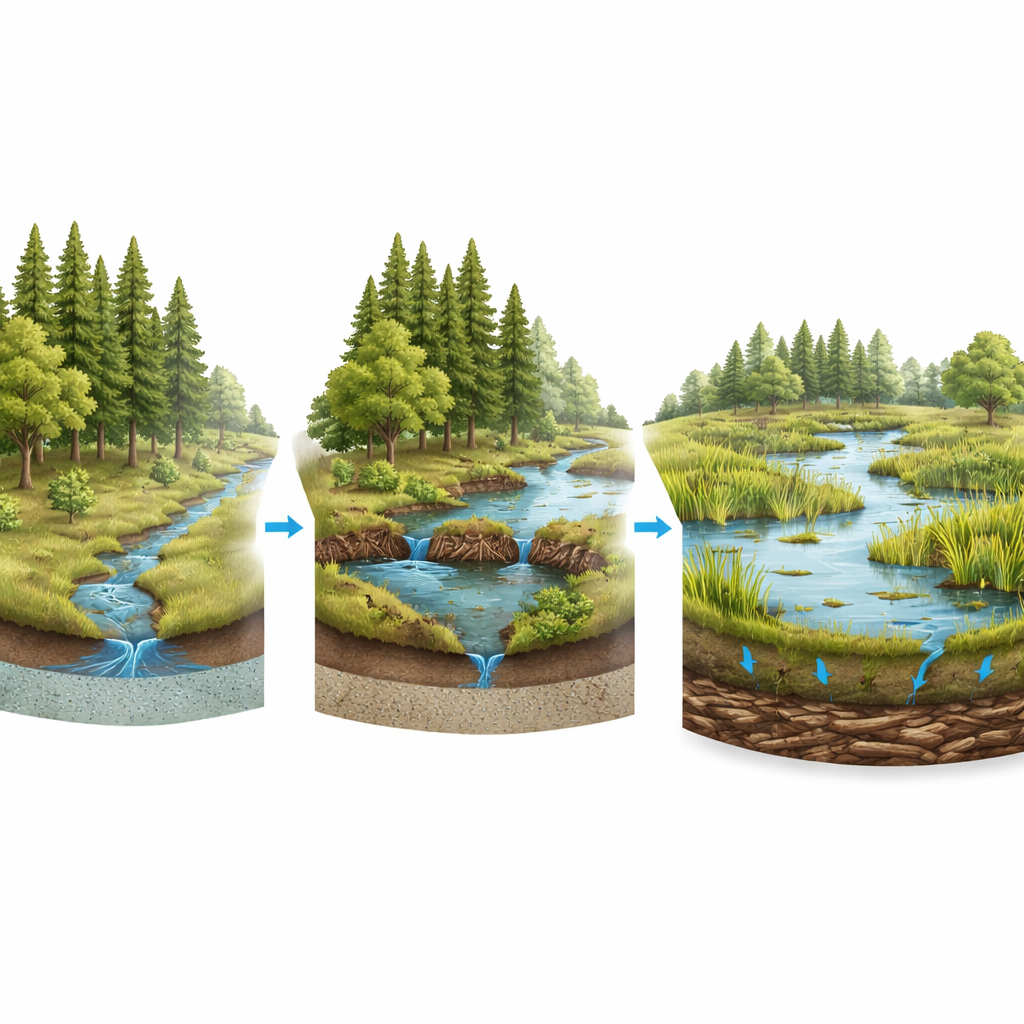
Beavers are best known for felling trees and flooding valleys, sometimes to the frustration of nearby landowners. But this study from a Swiss stream shows that their dam‑building can quietly lock away large amounts of carbon, the same element that drives climate change when released as carbon dioxide and methane. By turning a narrow stream into a chain of ponds and wetlands, beavers reshape how water and carbon move through the landscape, potentially turning small headwater valleys into powerful natural climate buffers.
From Trickle of Water to Sprawling Wetland
The research focused on an 800‑meter stretch of stream in northern Switzerland where beavers have been active since 2010. Their dams spread water out across the valley floor, creating a patchwork of shallow pools, flooded forest, and marshy ground. Over the course of a year, the scientists tracked how much water flowed in and out, and how much of different forms of carbon moved with it. They found that up to about 40% of the incoming stream water leaked sideways and downward through the gravel beneath the wetland, a loss far too large to be explained by evaporation alone. This hidden seepage turned out to be central to the beavers’ climate role.
Following the Carbon In, Out, and Underground
Carbon in streams shows up in several guises: dissolved in the water, bound to tiny particles, or escaping as greenhouse gases to the air. By combining chemical measurements, gas chambers, and detailed mapping of water levels, the team assembled a complete carbon budget for the beaver reach. Over a year, the wetland took in roughly 385 tons of carbon and released about 286 tons, ending as a net sink of about 98 tons—around a quarter of all incoming carbon. The biggest contributor was dissolved inorganic carbon, a form that behaves more like dissolved mineral than rotting leaves. As water slowed and spread through the wetland, much of this dissolved carbon slipped into the subsurface instead of continuing downstream or bubbling out as gas.
When a Carbon Sponge Also Breathes Out
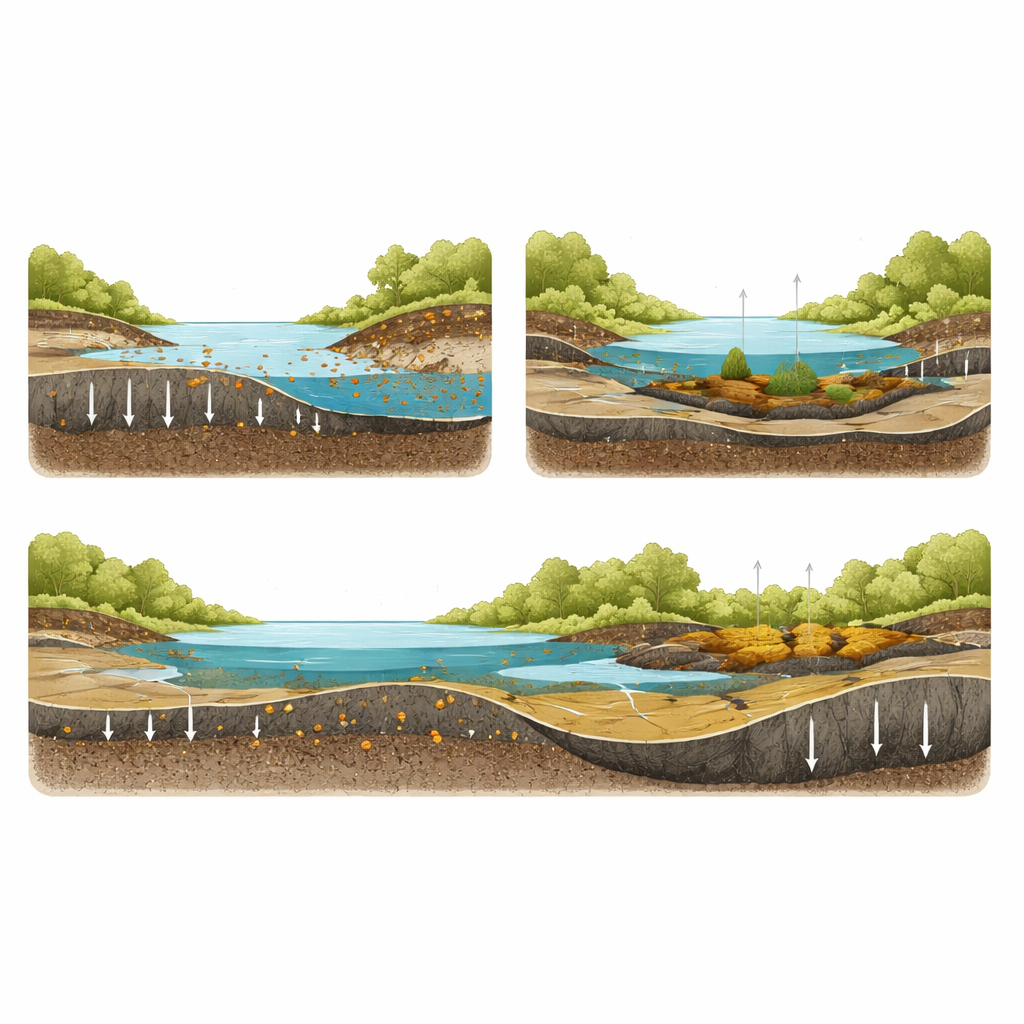
Beaver wetlands did not simply lock everything away. During dry summer periods, falling water levels exposed muddy surfaces, which then breathed out large amounts of carbon dioxide as microbes decomposed buried organic matter. These emissions were the largest single carbon loss in the system and were strong enough to temporarily turn the wetland into a carbon source in summer. However, over the full year they were still outweighed by carbon kept underground or buried in sediments. Methane, another powerful greenhouse gas often associated with wetlands, was surprisingly unimportant here: even when accounting for its climate impact, methane made up only a tiny fraction of the total warming effect.
Building Long‑Lasting Carbon Stores
To see what happens over decades, the researchers combined their measurements with sediment cores taken from the wetland and nearby unaffected soils. Wetland sediments held far more carbon—both organic and mineral‑like—than the surrounding forest floor or pre‑beaver floodplain. Permanently flooded areas were especially rich, suggesting that waterlogged, low‑oxygen conditions help preserve buried material. Dead trees killed by flooding added another big carbon stash, making up almost half of the accumulated store since the beavers arrived. Projecting forward to when the wetland gradually fills with sediment, the team estimate that this reach could lock away around 1,200 tons of carbon over about 33 years, much more than the same valley would have stored without beavers.
Small Valleys, Big Climate Potential
Finally, the authors asked what this might mean if beavers recolonize suitable valleys across Switzerland. Scaling up their long‑term burial rates suggests that beaver‑made wetlands could offset roughly 1–2% of the country’s annual carbon emissions, using only natural processes and no ongoing management. The results portray beavers as unplanned climate allies: by slowing water, spreading it across the land, and building up layers of mud and wood, they transform headwater streams from simple conduits into persistent carbon sinks. While these systems are patchy in space and time and can be disrupted if dams fail, they point to a powerful, nature‑based complement to engineered climate solutions.
Citation: Hallberg, L., Larsen, A., Ceperley, N. et al. Beavers can convert stream corridors to persistent carbon sinks. Commun Earth Environ 7, 227 (2026). https://doi.org/10.1038/s43247-026-03283-8
Keywords: beaver wetlands, carbon sink, stream ecosystems, nature-based climate solutions, sediment carbon storage